

In This Guide
- Territorial vs worldwide tax in one minute
- Personal tax starts with residence and source
- Companies follow a separate set of rules
- Territorial tax countries are not one category
- Six rules that change the headline
- Four cross-border examples
- A decision framework you can use
- Frequently Asked Questions
- Sources Used in This Guide
- Related Articles
Territorial vs worldwide tax describes which income a country brings into its tax base. A territorial system generally taxes income sourced within the country and excludes some foreign-source income. A worldwide system generally taxes residents on income from every country, then uses credits or exemptions to reduce double taxation. Non-residents are usually taxed only on income connected to the country.
That definition is useful, but it does not calculate anyone's bill. The individual and the company must be tested separately. Residence, income source, remittance rules, permanent establishments, controlled foreign company rules, treaties and relief provisions can all change the result. The rules in this guide were checked against official sources on July 22, 2026.
Short answer: territorial systems ask where income arose; worldwide systems ask where the taxpayer is resident. Real tax systems ask both questions, often more than once.
Territorial vs worldwide tax in one minute
| Question | Territorial approach | Worldwide approach |
|---|---|---|
| What enters the tax base? | Domestic-source income, plus any foreign income caught by receipt rules or exceptions | A resident's domestic and foreign income |
| What about non-residents? | Usually domestic-source income | Usually domestic-source income |
| How is double tax handled? | Foreign income may be outside scope or exempt; credits may still apply | Foreign tax credit, exemption or treaty relief |
| Main practical risk | Assuming "foreign" means exempt without checking source and conditions | Assuming tax paid abroad removes residence-country reporting or residual tax |
Residence-based taxation and worldwide taxation often travel together. Australia says its residents generally declare Australian and overseas income, while Canada treats factual and many deemed residents as taxable on worldwide income. Both countries separately tax non-residents on defined domestic-source income. Their residence tests are not the same, and neither is simply a day-count exercise. Australia's tax authority also stresses that tax residence differs from citizenship and immigration status.
Worldwide inclusion does not necessarily mean paying the full rate twice. A foreign tax credit commonly limits residence-country tax by reference to foreign tax paid and the domestic tax attributable to that income. The OECD describes exemption and credit methods as distinct forms of double-tax relief, each with ordering and limitation rules. Relief is a calculation, not an automatic refund of every foreign tax.
Territorial systems have a common source trap. Income does not become foreign-source because a foreign client pays it, the contract names an offshore company, or the cash lands in another country. Tax authorities usually look at the activity, asset or relationship that produced the income. A consultant doing the work at home can have local-source service income from an overseas customer. A foreign property can produce foreign-source rent even when the owner manages it from home. Each income category needs its own source analysis.
Timing matters too. A worldwide system may tax income as it accrues, when it is distributed, or when anti-deferral rules attribute it to an owner. A receipt-based rule may focus on when foreign-source income reaches the jurisdiction. Book profit, cash movement and taxable income therefore need not arise in the same period.
Personal tax starts with residence and source
For an individual, start with tax residence in every relevant country. Domestic tests may consider a home, family and economic ties, habitual presence, days, or the purpose and pattern of a stay. Two countries can both treat the same person as resident. A tax treaty may then use tie-breaker tests, but only if a treaty applies and the person qualifies for it.
Next, classify the income and apply the country's source rules. Salary often follows where duties are physically performed, but employment arrangements and treaties can alter the outcome. Rent usually follows the property's location. Business income depends on the activity that earned it. Dividends, interest, royalties and gains have their own rules. The bank account receiving the money rarely settles the source question by itself.
The United States adds a separate citizenship dimension. The IRS states that U.S. citizens and resident aliens abroad generally remain subject to U.S. tax on worldwide income. The foreign earned income exclusion is elective, limited and conditional; it does not turn the United States into a territorial system. The foreign tax credit may reduce double tax, while foreign-account and asset reporting can remain separate.
Temporary or newcomer regimes create another layer. The United Kingdom ended its general remittance-basis treatment for new foreign income and gains on April 6, 2025. Eligible new residents can instead claim a four-year foreign income and gains regime, while transitional rules govern older foreign income and gains. Calling the current UK system "remittance-based" would therefore be inaccurate.
Companies follow a separate set of rules
A founder's residence does not automatically become the company's residence, and incorporation does not always settle it either. Corporate residence can turn on incorporation, central management and control, effective management, voting control or a combination. The Australian Taxation Office's company-residence guidance, for example, uses tests different from its individual rules.
Corporate systems are often hybrids. A resident company may nominally fall under worldwide taxation while receiving a participation exemption for qualifying foreign dividends or gains. Another country may tax foreign income only when received, subject to exemptions. CFC rules may bring low-taxed foreign subsidiary income back into the owner's current tax base. Describing either system with one word hides the provisions that do the work.
Participation and branch exemptions also have boundaries. They may require a minimum ownership percentage or holding period, exclude deductible distributions, or deny relief when the subsidiary pays too little tax. Interest, royalties and service fees may remain taxable even when dividends are exempt. Withholding in the source country is a separate question, so an exempt dividend can still arrive net of foreign tax.
| Layer | Questions to answer | Common mistake |
|---|---|---|
| Owner | Personal residence, citizenship rules, salary, dividends, gains and CFC exposure | Assuming a foreign company moves the owner's tax residence |
| Company | Incorporation, management, business source, exemptions and foreign tax credits | Assuming incorporation proves exclusive corporate residence |
| Operations | Offices, staff, dependent agents, contracts and permanent establishments | Assuming online sales mean no taxable presence |
| Payments | Withholding tax, transfer pricing, deductibility and beneficial ownership | Comparing only headline corporate rates |
A company can also owe tax in a country where it is not resident. A permanent establishment can give the source country a right to tax attributable business profits. OECD guidance treats profit attribution as a separate-enterprise exercise. A company registered in one country, managed from another and operating through staff in a third can therefore face several valid tax claims.

Territorial tax countries are not one category
Searches for territorial tax countries often produce a fixed list. Use such lists for screening, not conclusions. The same country may use one approach for individuals and another for companies, or exempt one category of foreign income while taxing another.
| Jurisdiction | What the official guidance shows | Why the label needs care |
|---|---|---|
| Hong Kong | Profits tax follows the territorial source principle | The foreign-sourced income exemption regime can apply to specified income received by multinational-group entities, with substance or participation conditions |
| Singapore | Overseas income received by individuals is generally not taxable, subject to exceptions | Companies can be taxed on foreign income received in Singapore unless an exemption or relief applies |
| Australia | Residents generally report worldwide income; non-residents and temporary residents follow narrower rules | Temporary-resident concessions and separate company-residence tests prevent a single personal/corporate label |
| Canada | Residents generally report worldwide income; non-residents face tax on specified Canadian-source income | Factual residence, deemed residence and treaty residence can produce different answers |
| United Kingdom | Residence-based worldwide taxation, with the time-limited four-year FIG regime for eligible new residents | Historic remittance-basis amounts and transitional rules still need separate treatment |
Ask whether the country's current rule exempts this income for this taxpayer under these circumstances. Our separate guide to territorial tax systems and country examples is a starting map; the source and exception analysis still comes afterward.
Six rules that change the headline
- Remittance or receipt. Some regimes tax foreign income when it is received locally, while others exempt it or use a temporary newcomer regime. "Keeping money offshore" is not a universal rule, and paying local expenses from a foreign account may count as a remittance under some laws.
- Substance. An exemption can require real functions, expenditure, staff or decision-making. Hong Kong's FSIE rules show the point: specified foreign income for multinational-group entities can face economic-substance, nexus or participation requirements.
- Controlled foreign companies. CFC rules can attribute undistributed income of a controlled low-taxed entity to a resident owner. The EU Anti-Tax Avoidance Directive requires member states to operate CFC and other anti-abuse measures, and domestic rules may be stricter.
- Permanent establishment. Staff, an office, contract authority or sustained business activity can create taxable presence outside the company's residence. Definitions vary by domestic law and treaty.
- Anti-avoidance and transfer pricing. Related-party payments must usually reflect the functions, assets and risks involved. General anti-abuse rules, beneficial-ownership tests and exit taxes can override arrangements lacking commercial support.
- Treaties. Treaties allocate taxing rights and offer relief; they do not automatically erase tax. The OECD's principal-purpose and treaty-abuse standards can deny benefits where obtaining the treaty advantage was a principal purpose of an arrangement.
Large multinational groups have another overlay: minimum-tax and base-erosion regimes. These rules are far removed from the simple idea that foreign income is either "in" or "out." Even for smaller companies, payroll tax, social security, VAT or GST, withholding, property tax and reporting can matter more than the income-tax label.
Reporting is its own cost. A credit may require evidence of the foreign assessment and payment. An exemption may require an election, a residence certificate, ownership records or proof of economic activity. CFC and foreign-asset forms can be due even when little or no extra income tax is payable. A sound comparison counts professional fees, bookkeeping and missed-filing exposure alongside the nominal rate.

Four cross-border examples
| Scenario | Likely starting point | Checks that can change it |
|---|---|---|
| Canadian resident earns consulting fees from foreign clients | Canada generally taxes a resident's worldwide income | Where the work was performed, foreign tax paid, treaty relief, business presence and any foreign entity |
| Singapore-resident individual receives an overseas portfolio dividend | Overseas income received by an individual is generally not taxable under the cited Singapore guidance | Whether an exception applies, whether the income is tied to a Singapore business, and the source country's withholding tax |
| Singapore company receives the same foreign dividend | Foreign income received in Singapore can be taxable | Statutory exemption conditions, corporate residence, foreign tax paid and credit limits |
| U.S. citizen lives in a territorial jurisdiction and owns a foreign company | U.S. worldwide-income filing continues | FEIE applies only to qualifying earned income; foreign tax credits, CFC rules, company residence and local source tax require separate calculations |
Now add management. Suppose the fourth person directs the company every day from a home office. The incorporation country may still tax the company, but the work country can examine corporate residence or permanent establishment. Salary can be sourced where the duties occur. Dividends are tested under the individual's residence rules. A foreign company solves none of those questions by itself.
This separation is especially important for service businesses and software founders, where management and value creation can follow the people. Our guides to international structures for service businesses and cross-border SaaS company structures examine those operating facts in more detail.

A decision framework you can use
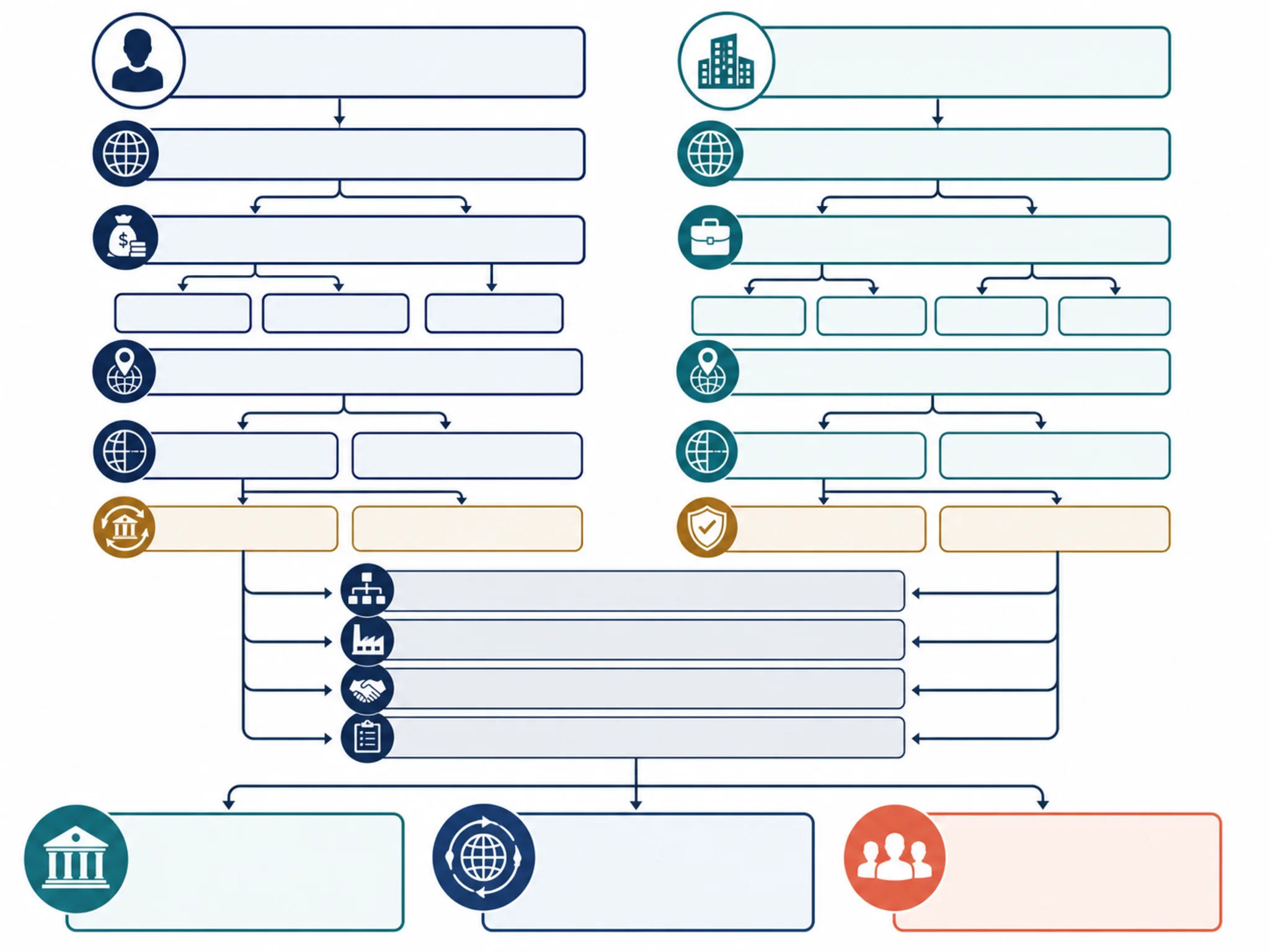
- List each taxpayer: individual, operating company, holding company, trust or partnership.
- Determine domestic-law residence for each one, then check dual-residence treaty rules.
- Classify every material income stream and determine its source under each relevant country's law.
- Apply the basic scope rule: domestic source, worldwide income, remittance, participation exemption or another exclusion.
- Test CFC, permanent establishment, management, substance, transfer-pricing and anti-abuse rules.
- Calculate withholding and foreign tax, then apply treaty, credit or exemption relief with its limits.
- Add payroll, social security, indirect taxes, wealth or property taxes, exit taxes and reporting costs.
- Stress-test the facts: a move, a new employee, local contract signing, a dividend, a remittance or a sale.
The output should map who pays, to which country, on which income, when, at what effective rate, and with what filing burden. Compare jurisdictions only after that work is complete. A low headline rate cannot repair a structure whose residence, source or substance facts point elsewhere.
Build the map with evidence. Record travel days, homes available, board meetings, contract approvals, work locations, employees, invoices, bank flows and taxes paid. Those facts support residence, source, substance and credit claims. Revisit the map before a move, distribution, company sale or new hire because one changed fact can alter several tax connections at once.
Important: This guide provides general educational information, current to July 22, 2026. It is not legal, tax or accounting advice. Cross-border outcomes depend on facts, domestic law, treaty eligibility and later changes. Obtain advice from qualified professionals in every jurisdiction involved before acting.
Frequently Asked Questions
What is the main difference between territorial and worldwide taxation?
Territorial taxation generally focuses on income sourced inside the country and excludes qualifying foreign-source income. Worldwide taxation generally brings a resident's domestic and foreign income into the tax base, then may grant credits or exemptions for foreign tax. Both systems normally tax non-residents on defined local-source income.
Does a territorial tax system mean foreign income is always tax-free?
No. Source rules may classify the income as local, receipt or remittance can trigger tax, and exemptions can require substance or prior foreign tax. CFC, permanent establishment, anti-abuse and treaty rules can also override the expected exemption.
Can an individual and their company be in different tax systems?
Yes. The owner may live in a worldwide-tax country while the company is resident in a territorial country. Each is tested separately, and salary, dividends, gains, management and CFC rules connect the two layers.
Does paying foreign tax prevent double taxation?
It may reduce double taxation, but not automatically or completely. A credit can be limited to domestic tax on the same income, while an exemption may cover only qualifying categories. Filing can remain required even when relief removes the final liability.
Is the 183-day rule enough to determine tax residence?
No. Some countries use day counts, but homes, family ties, management, habitual presence, deemed-residence provisions and treaty tie-breakers may also matter. Immigration residence and tax residence are separate concepts.
Sources Used in This Guide
- OECD, Corporate Tax Statistics 2026: BEPS actions
- OECD, Tax treaties
- OECD, Model Tax Convention on Income and on Capital
- OECD, Attribution of profits to a permanent establishment
- OECD, Preventing tax treaty abuse
- OECD, Elimination of double taxation
- IRS, U.S. citizens and resident aliens abroad
- IRS, Foreign earned income exclusion
- IRS, Foreign tax credit
- HMRC, Remittance basis changes
- HMRC, Four-year foreign income and gains regime
- IRAS, Income received from overseas
- IRAS, Companies receiving foreign income
- Hong Kong IRD, Territorial source principle of taxation
- Hong Kong IRD, Foreign-sourced income exemption
- ATO, Foreign and worldwide income
- ATO, Working out business and company residency
- CRA, Determining an individual's residence status
- CRA, Non-residents of Canada
- European Commission, Anti-Tax Avoidance Directive
Related Articles
- Territorial Tax Systems Explained covers country examples and the exceptions behind the label.
- International Tax Structures for Service Businesses applies residence, PE, VAT and reporting rules to consultants and coaches.
- How to Structure a SaaS Company Across Jurisdictions focuses on management, operating companies, transfer pricing and VAT.