
In This Guide
- Panama and the UAE are not selling the same product
- Panama works best when income is genuinely foreign-source
- The UAE stays cleaner for salary, but business activity has thresholds
- Residence permits and tax residency certificates are separate jobs
- Treaty depth changes how portable the structure feels
- Which base fits which founder?
- Bottom line
- Frequently Asked Questions
- Sources Used in This Guide
- Related Articles
Panama and the UAE are not selling the same product
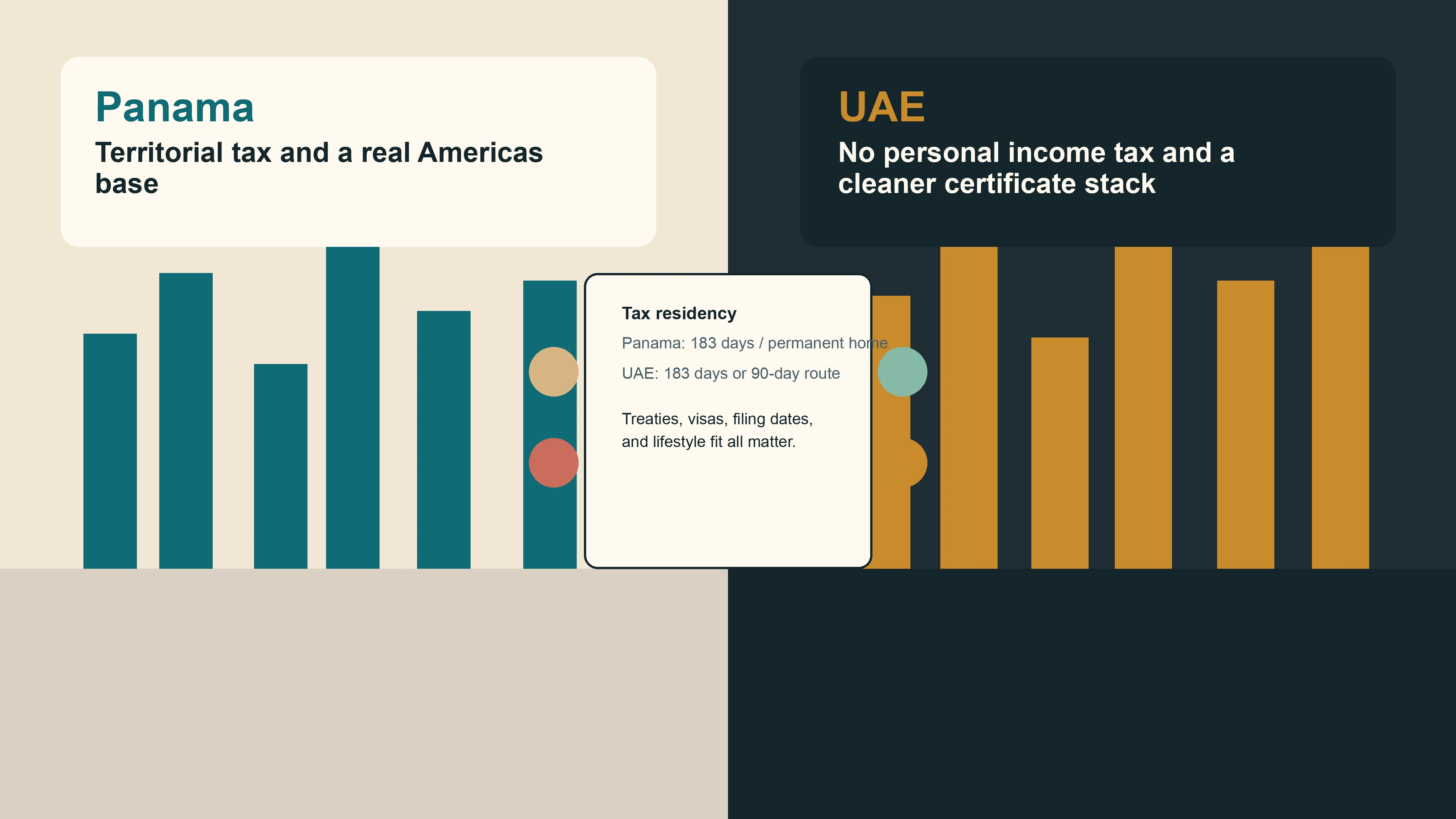
Panama vs UAE for tax residency looks like a straight low-tax fight, but the two jurisdictions solve different problems. Panama is mainly a territorial-tax story. The UAE is mainly a no-personal-income-tax plus treaty-certificate story. Those are close enough to confuse people and different enough to change the answer completely.
If you are comparing Panama and Dubai on Tax Haven Directory, start with the real question: do you want a place that generally leaves foreign-source income alone, or do you want a place where salary and personal investment income stay outside personal income tax and the tax residency certificate system is easier to export? Panama usually wins the first argument. The UAE usually wins the second.
The official sources make that split clear. Panama's tax authority says the system follows the territoriality principle in Article 694 of the Fiscal Code and taxes only Panamanian-source income. The UAE government, by contrast, states that the country does not levy income tax on individuals, while the Federal Tax Authority separately explains when a natural person carrying on business can fall into corporate tax.
That difference changes how you should think about risk:
| Question | Panama | UAE |
|---|---|---|
| Headline pitch | Territorial tax on foreign-source income | No personal income tax on individuals |
| What usually creates the tax result | Source of income | Nature of income plus whether business activity crosses corporate-tax rules |
| Tax residency certificate logic | DGI certificate tied to 183 days or permanent home evidence | FTA certificate tied to 183 days, a 90-day route, or center-of-interests style tests |
| Immigration feel | Broader permanent-residence menu, more category matching | Cleaner residence-product stack for workers, freelancers, and investors |
| Treaty depth | Smaller network, but UAE treaty is in force | Much broader network and a mature TRC process |
| Best fit | Founders with genuinely foreign-source income who want an Americas base | Salaried executives, treaty users, and founders who want a portable residence certificate |
Panama is easier to like when your income is already foreign-source. The UAE is easier to like when you want the cleanest possible personal tax story and a certificate that travels better.
Panama works best when income is genuinely foreign-source
Panama's appeal is unusually specific. The DGI guidance on natural-person tax registration says the system follows the territoriality principle in Article 694 and taxes only Panamanian-source income. If your clients, assets, and payment flows stay outside Panama, the local income-tax answer can be very light.
That does not mean Panama is a blanket no-tax jurisdiction. The DGI income-tax rate page shows that natural persons pay 0% up to B/.11,000, 15% on income between B/.11,000 and B/.50,000, and 25% above B/.50,000. Those rates matter whenever the income is actually Panamanian-source. If you build a local consulting desk, bill Panamanian clients, or earn Panama real-estate income, you are back inside the normal tax system quickly.
For tax residency, Panama's own CRS/FATCA orientation guide says an individual is resident if they remain in Panama for more than 183 days, continuous or alternate, in the calendar year, or if they maintain a permanent home in Panama. That sounds simple, but it is not the same thing as holding a migration card. The DGI's resolution framework then asks for documentary proof before it issues a tax-residency certificate.
Panama rewards a clean fact pattern. A remote founder with foreign clients, foreign securities, and no Panama-source trade can often keep the tax answer clean. A founder who lives in Panama but delivers most services physically from Panama to local or regional clients has a much harder source-of-income argument.
| Income type | Likely Panama reading | Why it matters |
|---|---|---|
| Fees from foreign clients, work managed outside Panama's local market | Often outside Panama income tax if truly foreign-source | Territoriality is the whole appeal |
| Dividends and gains from foreign assets | Often outside Panama income tax | Good fit for investors and holding structures |
| Panama real-estate income | Taxable in Panama | Local source is clear |
| Services delivered in Panama to Panamanian customers | Usually taxable in Panama | Physical delivery and local source line up |
There is also more administration than the marketing brochures admit. The DGI filing guide says the annual return is ordinarily due by 15 March of the following year. Even when tax due is low, Panama is a better choice for people who are comfortable with a formal local file, local advisers, and source analysis that would survive questions later.
Panama gives you a real residential base in the Americas, broad permanent-residence categories, and a tax system that can stay very light without pretending local income does not exist.
The UAE stays cleaner for salary, but business activity has thresholds
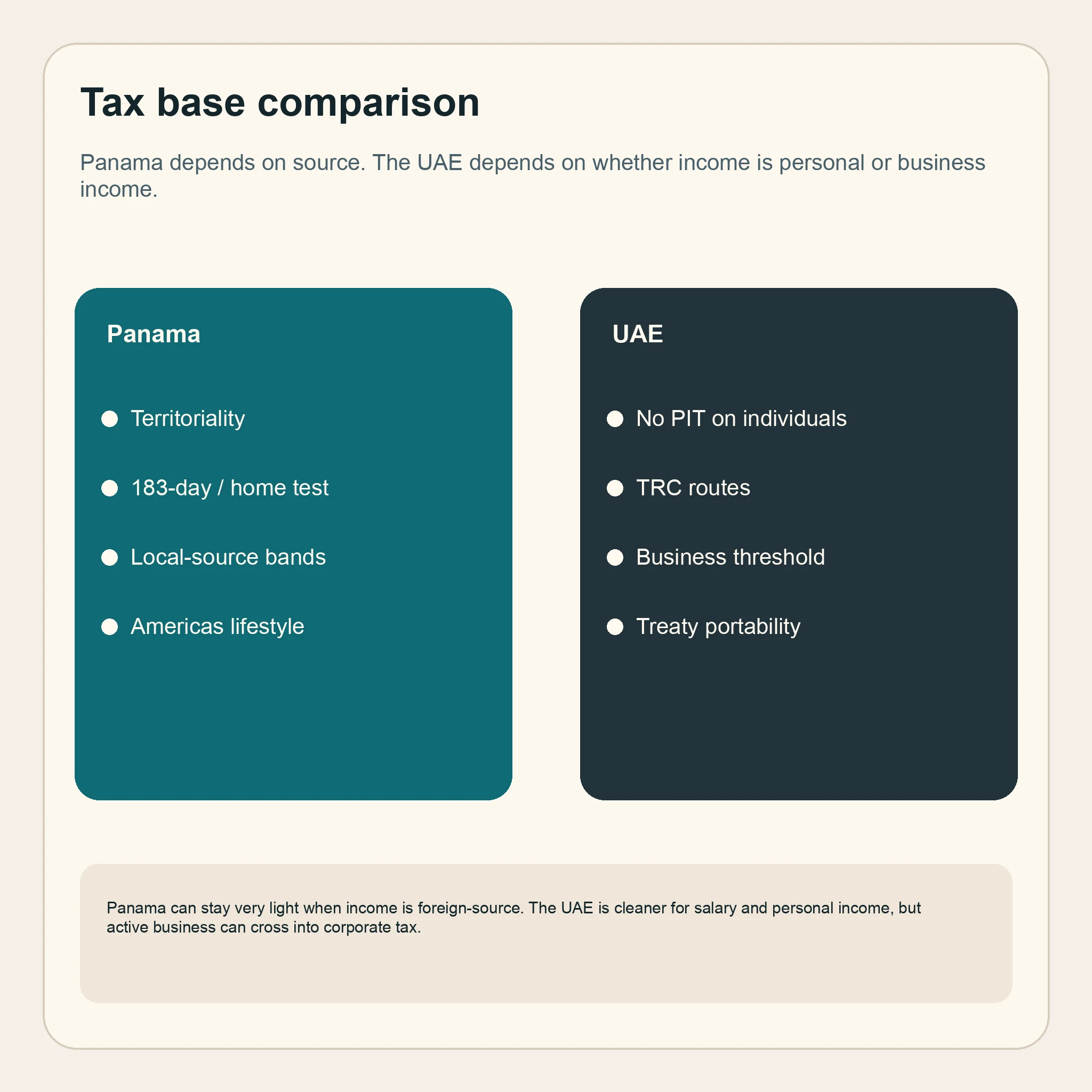
The UAE wins a different argument. The official UAE government tax overview says the country does not levy income tax on individuals. If you are a salaried executive, a remote employee paid by a foreign employer, or an investor living off foreign portfolio income, that headline matters immediately. You are not trying to prove foreign source the way you often are in Panama. The ordinary personal-income-tax layer is simply not there.
Where people get sloppy is assuming that the same answer applies to every freelancer and solo founder. It does not. The Federal Tax Authority page on natural persons says a natural person conducting business in the UAE comes into corporate tax only when total turnover from the business exceeds AED 1,000,000 in a Gregorian year. Once you are inside the corporate-tax system, the UAE corporate-tax page says taxable income up to AED 375,000 is taxed at 0% and the amount above that at 9%.
That is still a low-tax environment. It is just not the same as saying every freelancer in Dubai is on a permanent 0% rate. The right reading is more practical: employment income and personal investment income usually stay outside personal income tax, while serious self-employed business activity may move into corporate tax once turnover gets large enough.
The UAE also has a more structured tax-residency-certificate process than Panama. The FTA tax-certificate service page allows applications for treaty purposes and for domestic purposes. The same official guidance describes residence tests built around 183 days, a 90-day route with residence and home or work/business connections, and a center-of-interests style route.
For day-to-day life, the UAE also feels more productized. You can line up a residence permit, Emirates ID, bank account, and then a formal tax-residency-certificate application without having to build a Panama-style source-of-income story first.
If your income is mostly salary or personal investment income, the UAE usually feels simpler than Panama. If your income is active business income, the UAE is still attractive, but you need to model the AED 1 million turnover threshold honestly.
Residence permits and tax residency certificates are separate jobs
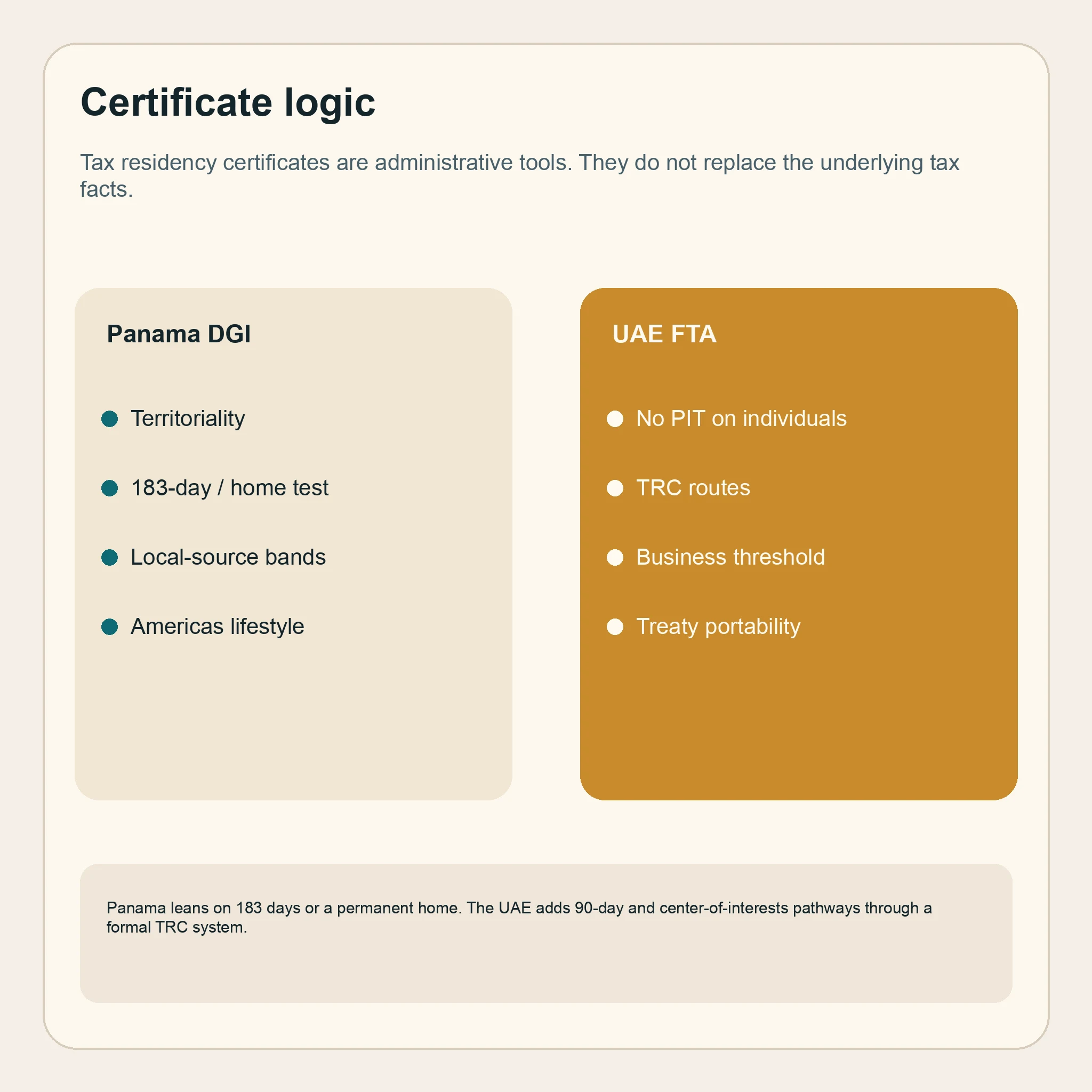
This is where most comparisons go off the rails. Immigration and tax are related, but they are not interchangeable.
Panama's migration-permits page lists a broad set of residence routes, including categories tied to specific countries, pensioners, Panama-Italy, own economic solvency, and investment mixes. The same official system also lists a short-stay remote-worker category. That breadth is useful if you want Panama to become a genuine second home and not just a certificate factory. The tradeoff is complexity: you need the right migration channel, and then you still need the tax facts to line up with the DGI certificate rules.
The UAE takes a more packaged approach. The official residence-visa guide for working in the UAE says Green Residence can run for 5 years. For freelancers and self-employed people, the page requires a bachelor's or specialized diploma and annual self-employment income of AED 360,000 over the previous two years, or proof of financial solvency. The official Golden Visa page says investor routes can run for 10 years, and one public-investment route requires at least AED 2 million.
That does not mean UAE residence is infinitely loose. The ICP service for staying outside the UAE for more than six months exists for a reason: the baseline assumption is that ordinary residence permits expect physical continuity. That is not fatal, but it matters if your plan is to collect a UAE residence card and spend most of the year somewhere else.
Panama and the UAE therefore reward different lifestyles:
| Residence route | What it gives you | Main constraint | Better for |
|---|---|---|---|
| Panama permanent residence categories | A longer-term Americas base with multiple eligibility routes | Category matching and separate DGI tax-certificate work | Families, investors, and founders who want a real foothold in Latin America |
| Panama short-stay remote-worker route | Fast legal presence for foreign remote work | Not the same as long-term permanence | Trial runs and short relocation experiments |
| UAE Green Residence | 5-year status with a clean self-employed/freelancer route | Income, qualification, and physical-presence expectations still matter | Independent professionals who want a packaged UAE base |
| UAE Golden Visa | 10-year residence with strong investor branding | Higher capital threshold | Investors and higher-net-worth operators |
A useful shorthand is this: Panama feels broader and more residential. The UAE feels more systematized and certificate-friendly. If your main goal is tax residency only, the UAE often gets there faster. If your main goal is building a durable life base in the Americas, Panama has a stronger emotional and legal fit.
Treaty depth changes how portable the structure feels
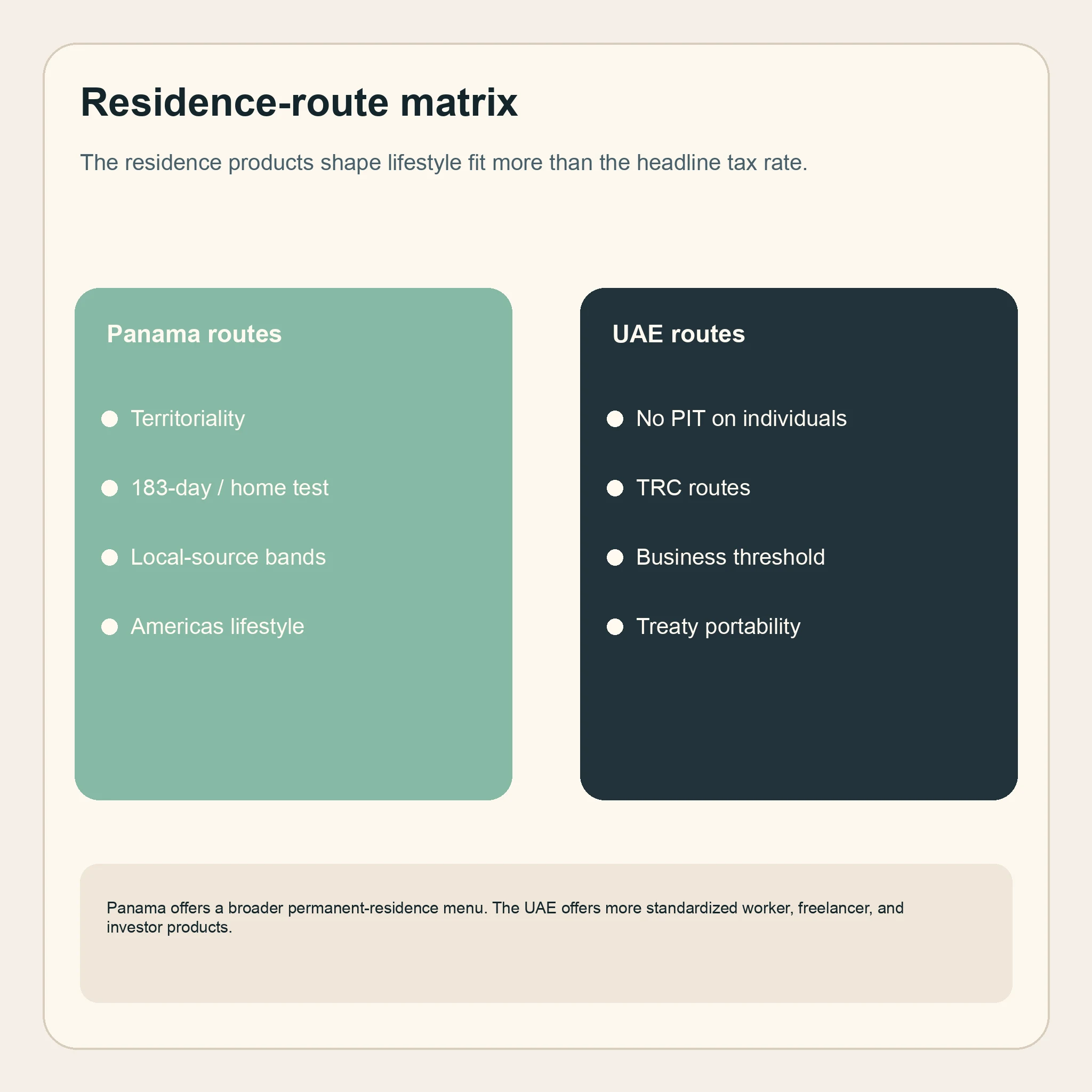
Treaty depth is where the two jurisdictions stop looking close.
The Panama DGI FAQ on double-tax treaties says Panama has 17 ratified treaties and 20 negotiated agreements. One of those is the Panama-UAE treaty, which Panama says took effect on 1 January 2012. That is enough for many investors and consultants, especially if they only need one or two treaty corridors.
The UAE is operating on a different scale. The Ministry of Finance's double-taxation-agreements page says the UAE had signed 146 double-taxation agreements as of the page's June 2024 update, and the current MoF DTA and BIT portal reflects a far wider overall network of tax and investment agreements. That network depth does not guarantee a specific treaty result, but it does make a UAE tax-residency certificate more useful across more counterparties and jurisdictions.
This is one place where an inference from the official sources is reasonable. When one jurisdiction offers a much broader treaty network and a formal TRC service, it is usually the more portable jurisdiction for dividend, royalty, and cross-border structuring work.
For bankability and paperwork, that distinction matters. A UAE file usually reads more clearly to international banks and counterparties because the residence-certificate process is standardized and the treaty ecosystem is larger. A Panama file usually reads better when the commercial story is simple: foreign-source income, regional lifestyle base, limited need for treaty claims, and no attempt to disguise local-source business as foreign income.
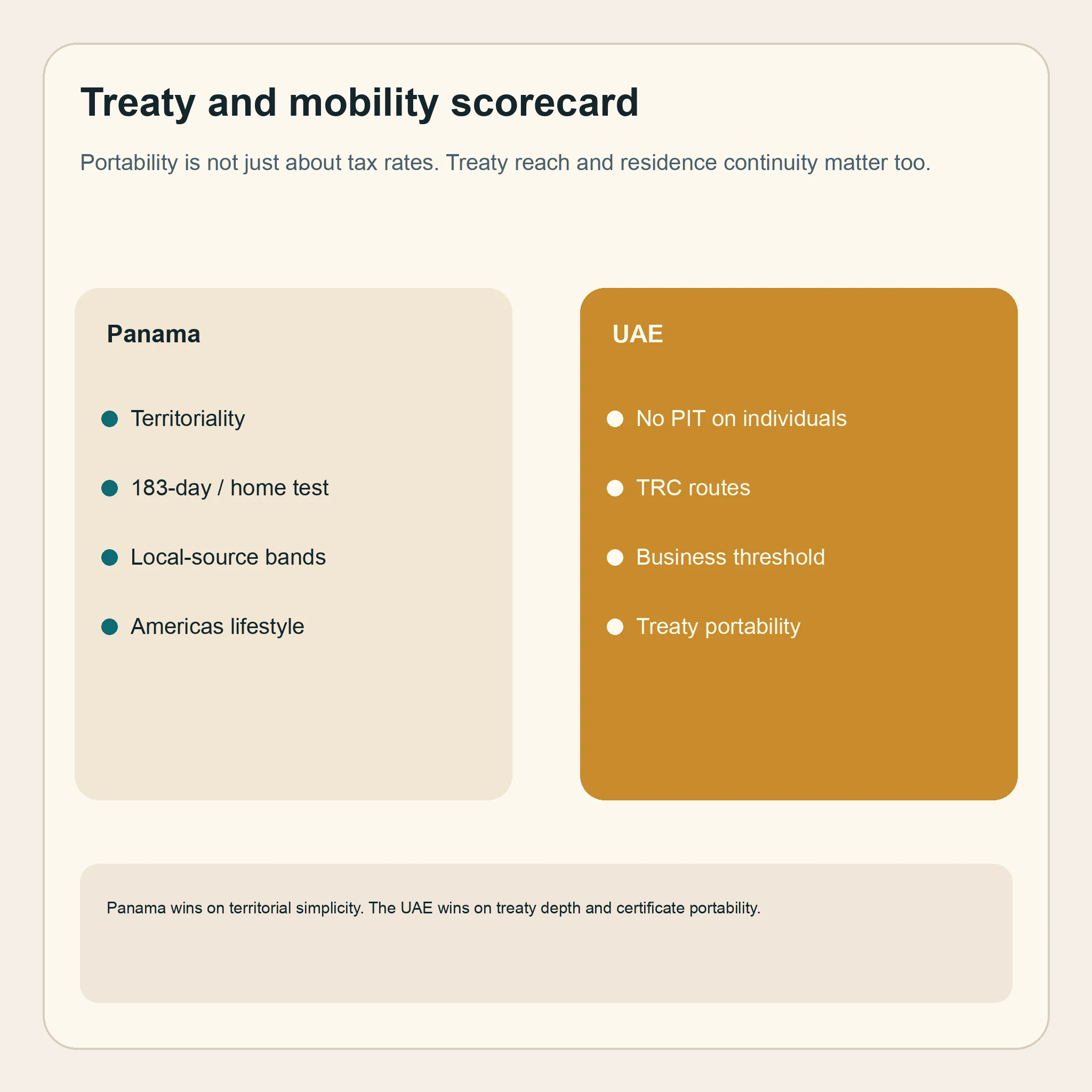
If you want the blunt version, it is this: Panama is better at territorial simplicity. The UAE is better at global portability.
Which base fits which founder?
The answer gets easier once you stop asking which jurisdiction is "better" in the abstract and start matching it to the person actually using it.
| Founder profile | Better fit | Why | Main warning |
|---|---|---|---|
| Foreign employee paid salary by a non-UAE, non-Panama employer | UAE | No personal income tax on individuals is cleaner than Panama's source analysis | Do not confuse salary with business income if you start freelancing on the side |
| Solo consultant serving foreign clients from an Americas time zone | Panama | Territoriality can keep foreign-source fees outside Panama tax if the facts stay clean | Panama-source work and local clients can collapse the strategy |
| Freelancer or independent professional who wants a formal certificate and broad treaty reach | UAE | Green Residence plus the TRC process are easier to deploy internationally | Once turnover crosses AED 1 million, corporate-tax modeling matters |
| Investor or family office with large global holdings | UAE | Deeper treaty network and stronger certificate portability | Immigration continuity still needs attention if you travel heavily |
| Founder who wants a real life base in Latin America, not just a certificate | Panama | Migration categories are broader and the residential logic is more lifestyle-friendly | The tax win depends on income staying foreign-source |
| Hyper-mobile founder who wants to spend very little time in the base | Neither by default | Panama usually wants a 183-day or permanent-home case; UAE has physical-continuity expectations and a six-month outside-country permit process | This profile needs a custom plan, not marketing slogans |
For most people, the real decision tree is shorter than it looks:
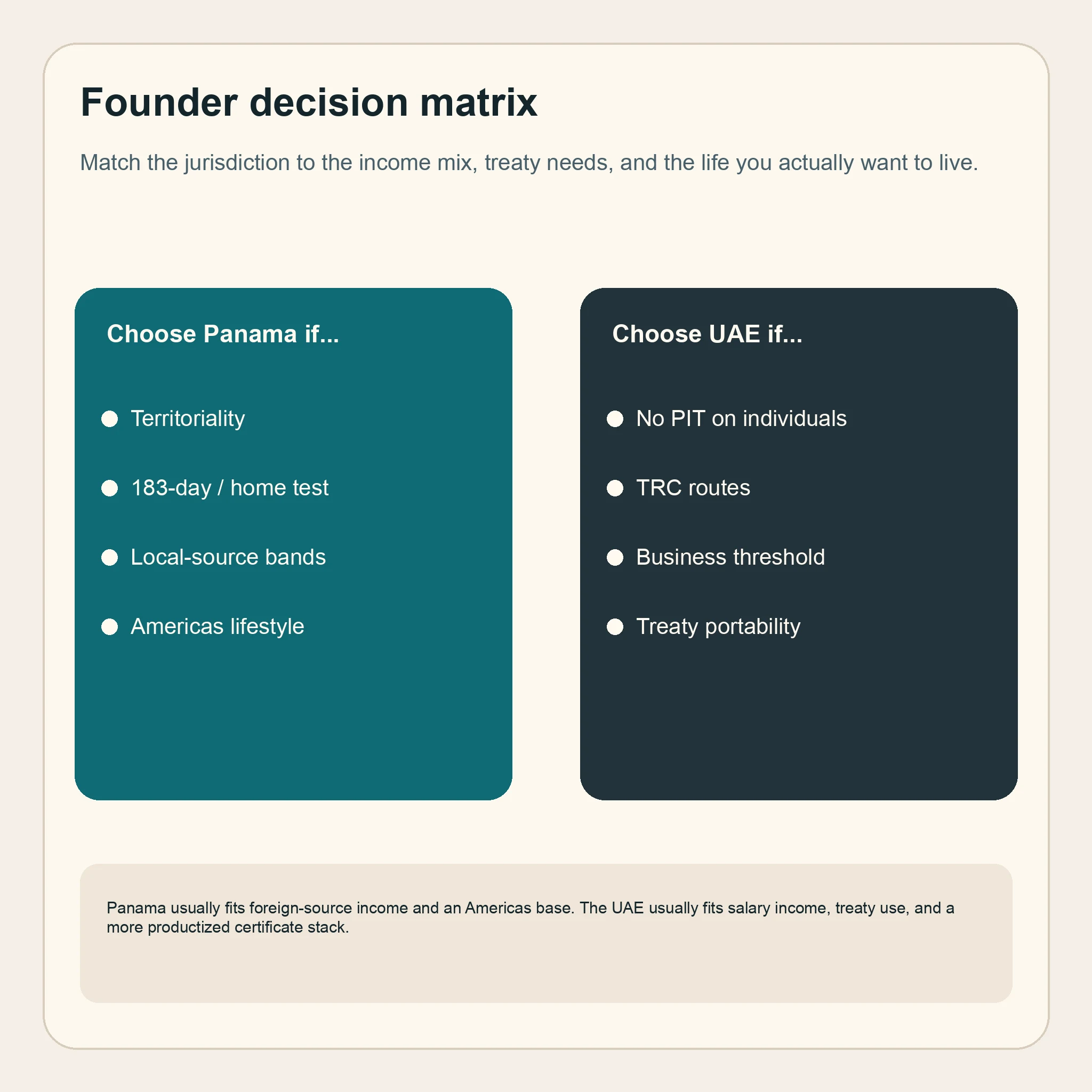
- If you want a clean salary-and-certificate jurisdiction with broad treaty reach, start with the UAE.
- If you want a territorial jurisdiction in the Americas and your income is actually foreign-source, start with Panama.
- If you need both a deep treaty network and a Latin American family base, you are no longer choosing a jurisdiction. You are designing a structure.
That is where the site's compare tool, calculator, and the broader international tax planning guide become useful.
Bottom line
Panama wins when the value proposition is territoriality. If your income can honestly stay foreign-source, and you want a stable base in the Americas with a broader menu of long-term residence categories, Panama is hard to beat.
The UAE wins when the value proposition is clarity. No personal income tax on individuals, a formal tax-residency-certificate process, and deeper treaty reach make it the cleaner platform for salaried executives, treaty users, and founders who need their residence story to travel well.
Disclaimer: This article is for general information only. Tax residency, source of income, treaty benefits, and immigration outcomes depend on exact facts. Get jurisdiction-specific legal and tax advice before acting.
Frequently Asked Questions
Can I be a Panama tax resident and still pay no Panama income tax?
Yes, that can happen if your income is genuinely foreign-source and your facts fit Panama's territorial system. The mistake is assuming tax residency alone creates that result. It does not. Source analysis still does the heavy lifting.
Does the UAE really stay tax-free for freelancers?
Not automatically. The UAE does not levy personal income tax on individuals, but a natural person carrying on business can come into corporate tax once turnover exceeds AED 1,000,000. At that point, the 0% and 9% corporate-tax bands matter.
Is a residence permit the same thing as a tax residency certificate?
No. A residence permit lets you live in the country. A tax residency certificate is proof used for treaty or domestic tax purposes. In both Panama and the UAE, those are connected but separate processes.
Which jurisdiction is easier for treaty claims and international bank KYC?
Usually the UAE. That is an inference from the official sources showing a deeper treaty network and a more formal certificate process. Panama can still work well when the structure is simple and the need for treaty relief is limited.
Which one is better for someone who wants a long-term family base in the Americas?
Usually Panama. Its residence categories are broader, and the overall proposition is more about building a real second home than holding a globally portable tax certificate.
Sources Used in This Guide
- Panama DGI: Tax registration for natural persons and Article 694 territoriality
- Panama DGI: CRS/FATCA orientation guide with tax-residency criteria
- Panama DGI: Income-tax rates for natural persons
- Panama DGI: Annual tax-return presentation guide
- Panama DGI: FAQ on double-tax treaties
- Panama DGI: Treaty list
- Panama DGI: Panama-UAE double-tax treaty
- Panama National Migration Service: Migration permits
- UAE Government: Other taxes in the UAE
- UAE Federal Tax Authority: Issuance of tax certificates
- UAE Federal Tax Authority: Natural persons under Corporate Tax
- UAE Ministry of Finance: Corporate Tax in the UAE
- UAE Ministry of Finance: Double taxation agreements
- UAE Government: Residence visa for working in the UAE
- UAE Government: Golden visa
- UAE ICP: Permit to stay outside the UAE for more than 6 months