
In This Guide
- The short answer: compare the full return
- Run the return in this order
- Three worked examples
- Housing changes both sides of the calculation
- Carryovers and elections make this a multi-year choice
- Children, self-employment, and mixed income
- A practical decision checklist
- Frequently asked questions
- Sources used in this guide
- Related articles
The short answer: compare the full return
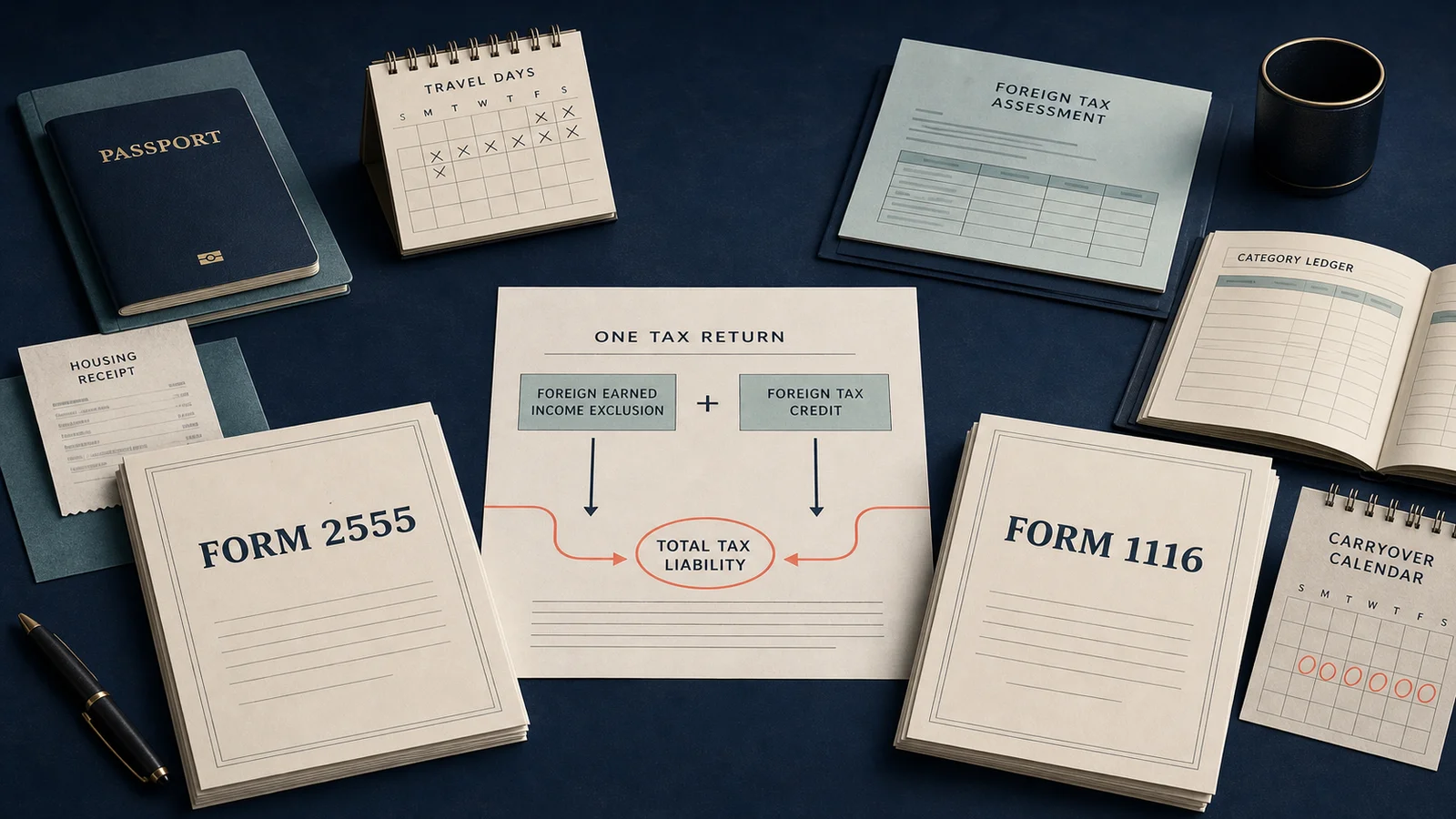
The foreign earned income exclusion (FEIE) removes qualifying earned income from U.S. taxable income through Form 2555. The foreign tax credit (FTC) uses qualifying foreign income tax to reduce U.S. tax, usually through Form 1116. A low- or zero-tax country often favors the FEIE. A higher-tax country often favors the FTC. That rule of thumb is useful, but it is not a filing decision.
The better method is the one that produces the strongest result across several years after stacking, credit limits, housing, refundable credits, and payroll taxes are included. For 2026, the IRS sets the maximum FEIE at $132,900 per qualifying person. The exclusion covers foreign earned income, not interest, dividends, capital gains, pensions, or rent merely because the owner lives abroad. The FTC instead follows qualifying foreign tax and foreign-source income, subject to separate limits.
Accuracy and scope: Tax rules and figures were checked against primary IRS material available through July 22, 2026. This is general information, not tax, legal, or financial advice. The examples are simplified and should not be used as completed returns.
| Question | FEIE / Form 2555 | FTC / Form 1116 |
|---|---|---|
| What creates the benefit? | Qualifying foreign earned income is excluded | Qualifying foreign income tax offsets limited U.S. tax |
| Typical fit | Low-tax country; mostly wages or active service income | Moderate- or high-tax country; income above the FEIE cap; mixed income |
| Residence test | Foreign tax home plus bona fide residence or physical presence test | No Section 911 residence test, though income sourcing and tax-credit rules still apply |
| Unused benefit | No carryforward of unused annual FEIE capacity | Excess foreign taxes may be carried back one year and forward ten years |
| Main tradeoff | Stacking, loss of credit for tax on excluded income, election constraints | Form 1116 limits, baskets, sourcing, expense allocation, and carryover tracking |
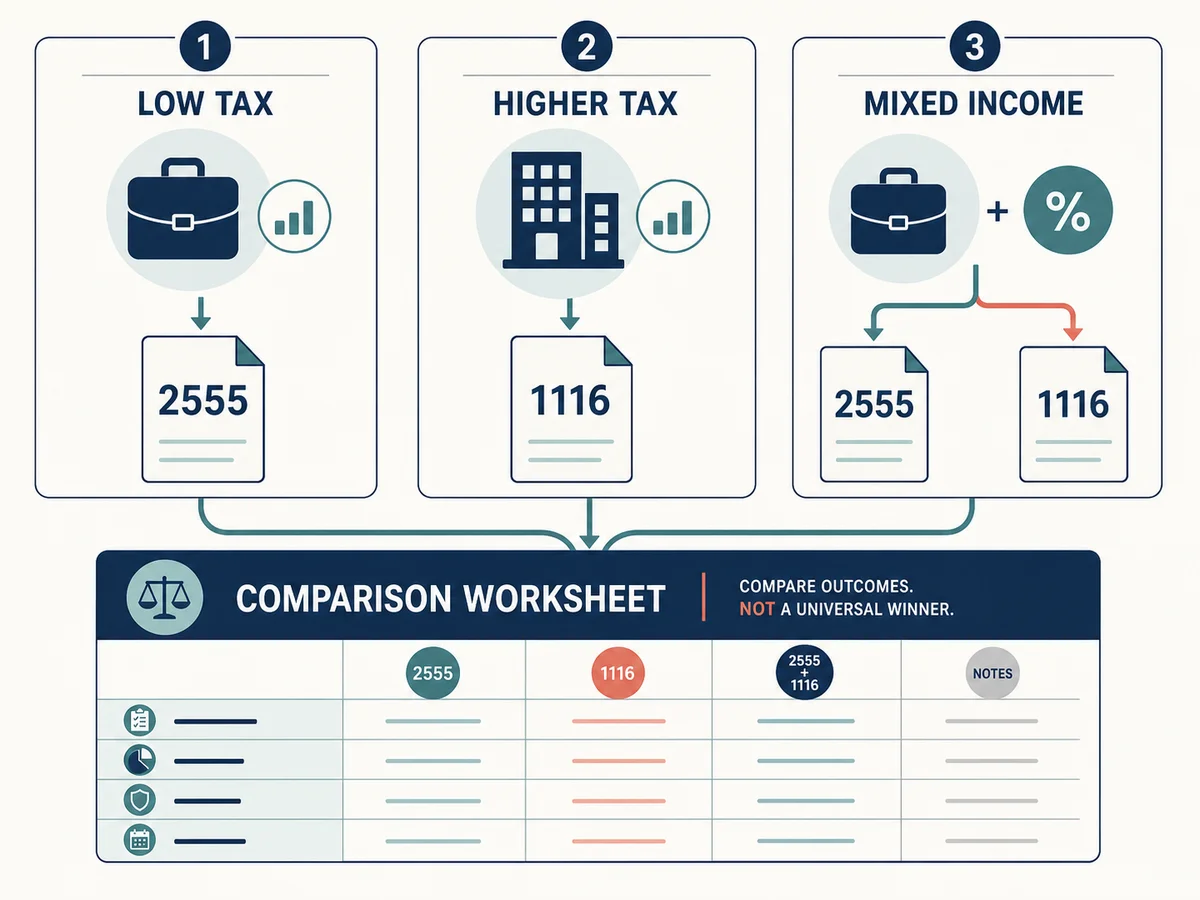
Qualification for Section 911 is covered in the site's general FEIE guide. The comparison below starts after eligibility is established.
Run the return in this order
A hybrid return may use both methods, but never on the same slice of income. The Form 2555 instructions say foreign tax allocable to excluded income cannot be credited or deducted. Tax on foreign earned income above the exclusion may still enter the Form 1116 calculation.
- Classify the income. Wages and active service income are usually general-category income. Interest and many dividends are passive-category income. The IRS definition of foreign earned income controls what can reach Form 2555.
- Compute the housing exclusion first, if applicable. It reduces the foreign earned income still available for the FEIE.
- Apply the FEIE to eligible earned income. Do not apply it to passive income.
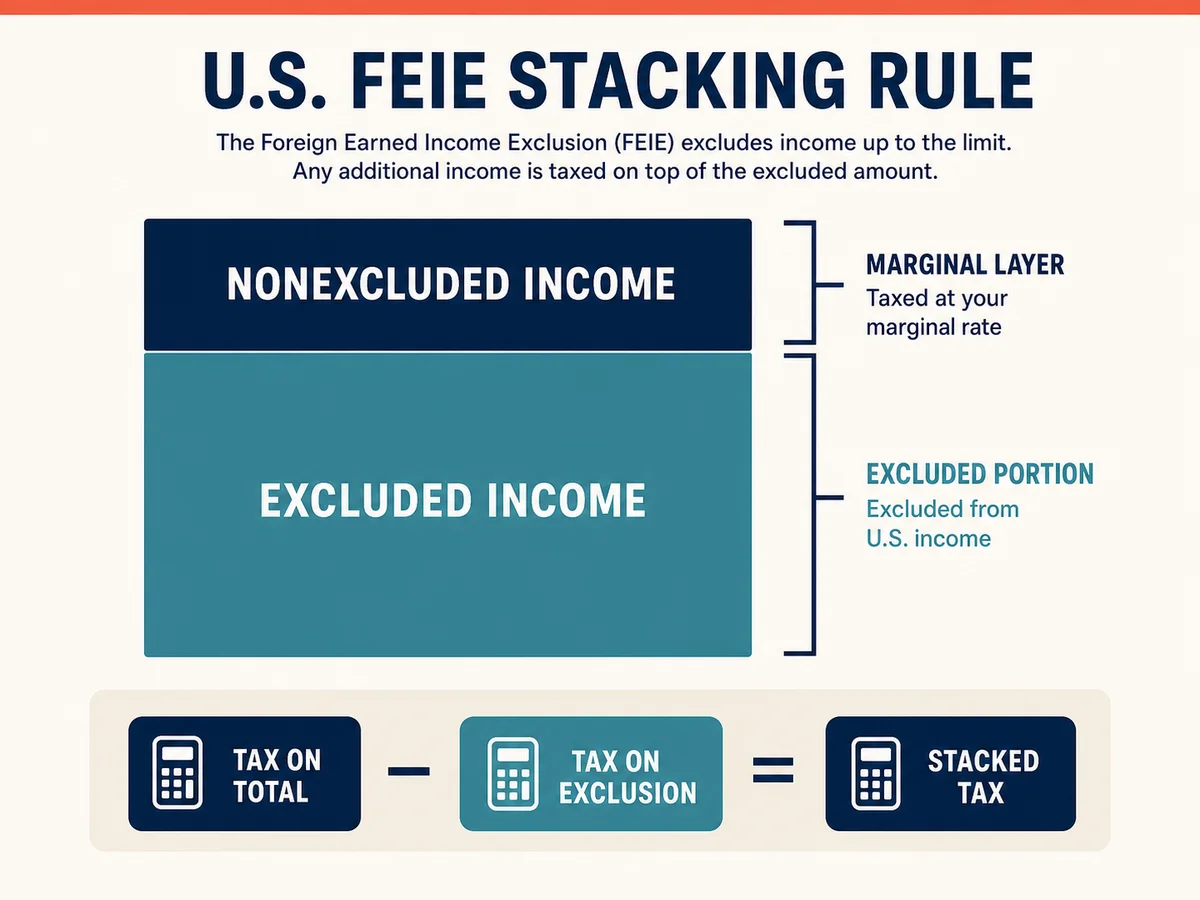
- Use the Foreign Earned Income Tax Worksheet. Stacking means the tax rate on nonexcluded income is calculated as though excluded income sat underneath it.
- Remove foreign tax allocable to excluded income. With no related expenses, a simplified allocation is foreign tax multiplied by excluded wages divided by total foreign wages. The actual Publication 514 formula also accounts for deductions allocated to the income.
- Complete a Form 1116 for each applicable category. The credit limit is broadly U.S. income tax multiplied by foreign-source taxable income in that category divided by worldwide taxable income, with statutory adjustments.
- Track unused foreign taxes on Schedule B (Form 1116) by category and year.
| Sequence | Form or worksheet | What can reduce the next step |
|---|---|---|
| 1. Housing | Form 2555 Parts VI, VIII, IX | Uses some foreign earned income before FEIE |
| 2. Earned-income exclusion | Form 2555 | Removes eligible income; disallows related tax and deductions |
| 3. Stacked U.S. tax | Foreign Earned Income Tax Worksheet | Sets pre-credit tax on what remains |
| 4. Foreign tax credit | Form 1116 by category | Offsets only limited U.S. tax on foreign-source taxable income |
| 5. Carryover | Schedule B (Form 1116) | Preserves eligible excess foreign taxes for other years |
Three worked examples show where the winner changes
All three examples use a single filer, the verified 2026 standard deduction of $16,100 and ordinary 2026 rates. They ignore state tax, alternative minimum tax, net investment income tax, treaty resourcing, currency movements, payroll tax, and other credits. Foreign taxes are assumed creditable. Dollar amounts are rounded.
Example 1: $100,000 salary in a no-tax country. The taxpayer qualifies for the full-year FEIE and has no other income. Form 2555 can exclude the entire $100,000, leaving no regular federal income tax in this simplified case. Without the FEIE, taxable income after the standard deduction is $83,900 and regular U.S. income tax is $13,170. The FTC offers nothing because no foreign income tax was paid. FEIE wins on current-year income tax.
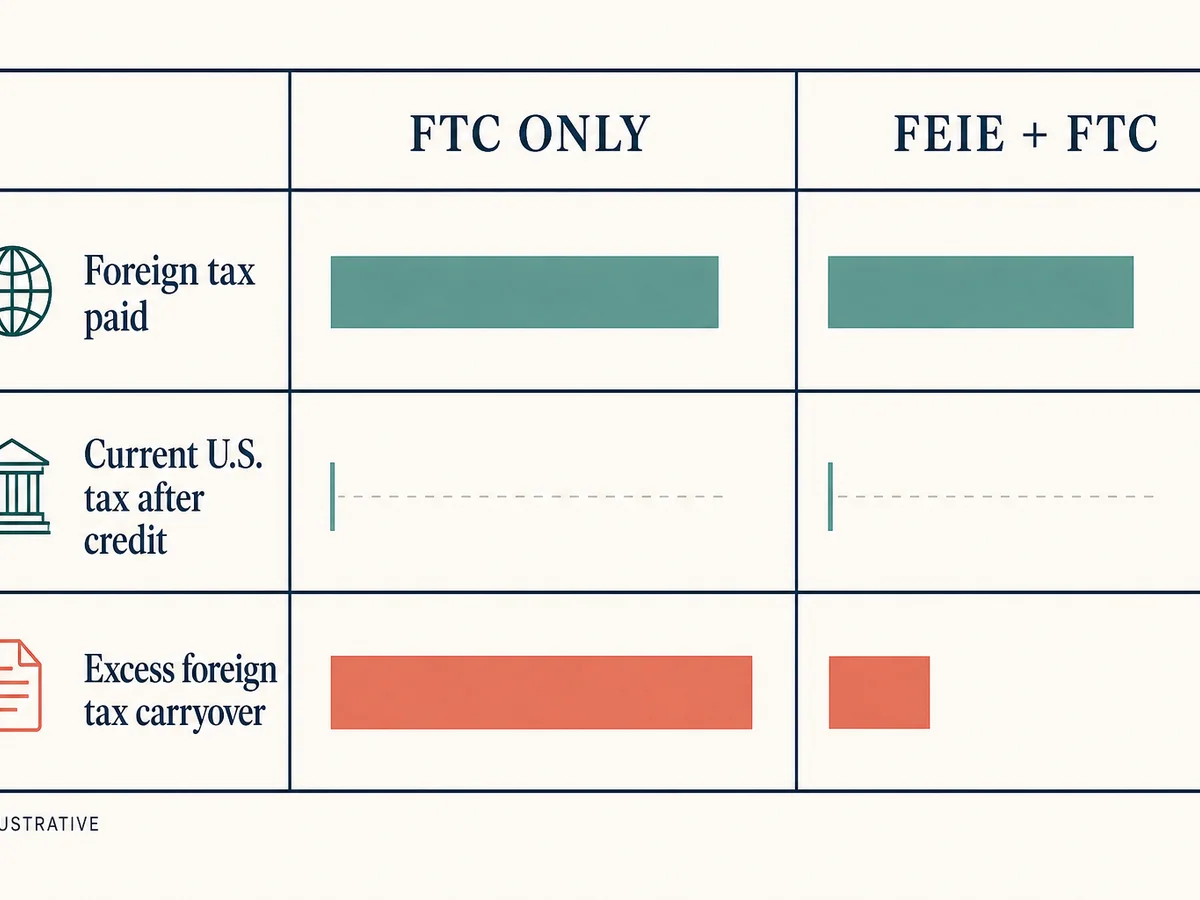
Example 2: $180,000 salary taxed abroad at 35%. The foreign tax is $63,000. An FTC-only return has $163,900 of taxable income after the standard deduction and $31,934 of regular U.S. tax. Because all taxable income is assumed foreign-source general-category income, the simplified FTC limit equals that $31,934. The credit reduces current U.S. income tax to zero, leaving $31,066 of excess foreign taxes for the carryover rules.
Now add the $132,900 FEIE. Remaining salary is $47,100 and taxable income after the standard deduction is $31,000. Stacking produces $7,440 of U.S. tax: tax on $163,900 minus tax on the $132,900 exclusion. With no related expenses, $46,515 of foreign tax is allocable to excluded wages and unavailable; $16,485 remains for Form 1116. The credit still removes the $7,440 U.S. tax, but only $9,045 remains as an excess foreign-tax carryover. Both routes reach zero current U.S. income tax. FTC-only preserves $22,021 more carryover.
Example 3: $120,000 salary plus $20,000 of foreign interest. Assume 10% foreign tax on salary ($12,000) and 15% on interest ($3,000). The interest cannot be excluded. Under FTC-only, total taxable income is $123,900 and regular U.S. tax is $22,334. A simplified allocation of the standard deduction produces a general-category limit of about $19,143 and a passive-category limit of about $3,191. All $15,000 of foreign tax is usable, leaving $7,334 of U.S. tax.
With Form 2555, the $120,000 salary is fully excluded. Stacking leaves $936 of regular U.S. tax on the interest after the standard deduction. The $12,000 tax on excluded salary is unavailable, but the passive-category FTC can use $936 of the $3,000 interest tax. Current U.S. tax falls to zero and about $2,064 remains in the passive-category carryover. The hybrid route wins this year because low-tax salary is excluded while separately taxed passive income earns a credit.
| Example | Method | Current U.S. income tax | Excess foreign taxes after limit |
|---|---|---|---|
| No-tax $100,000 salary | FEIE | $0 | $0 |
| 35%-taxed $180,000 salary | FTC only | $0 | $31,066 general category |
| 35%-taxed $180,000 salary | FEIE + FTC | $0 | $9,045 general category |
| Low-tax salary + interest | FTC only | $7,334 | $0 in this simplified case |
| Low-tax salary + interest | FEIE + passive FTC | $0 | $2,064 passive category |
Housing changes both sides of the calculation
The foreign housing benefit is not a flat rent deduction. For a full qualifying 2026 year, IRS Notice 2026-25 sets a $21,264 base housing amount and a general $39,870 housing-expense ceiling. The maximum housing amount under that general ceiling is therefore $18,606, although specified high-cost locations have higher expense limits.
The housing exclusion applies to employer-provided amounts. The housing deduction applies to amounts paid from self-employment earnings. Housing is computed before the FEIE, and the FEIE cannot exceed foreign earned income left after the housing exclusion. A taxpayer cannot deliberately claim less than the full housing exclusion to preserve more income for the FTC.
Housing can improve the Section 911 result, but it also increases excluded income. More foreign tax may then be allocated away from Form 1116. The housing deduction is further limited by foreign earned income remaining after the FEIE and any housing exclusion. Neither housing benefit reduces self-employment tax.
Carryovers and elections make this a multi-year choice
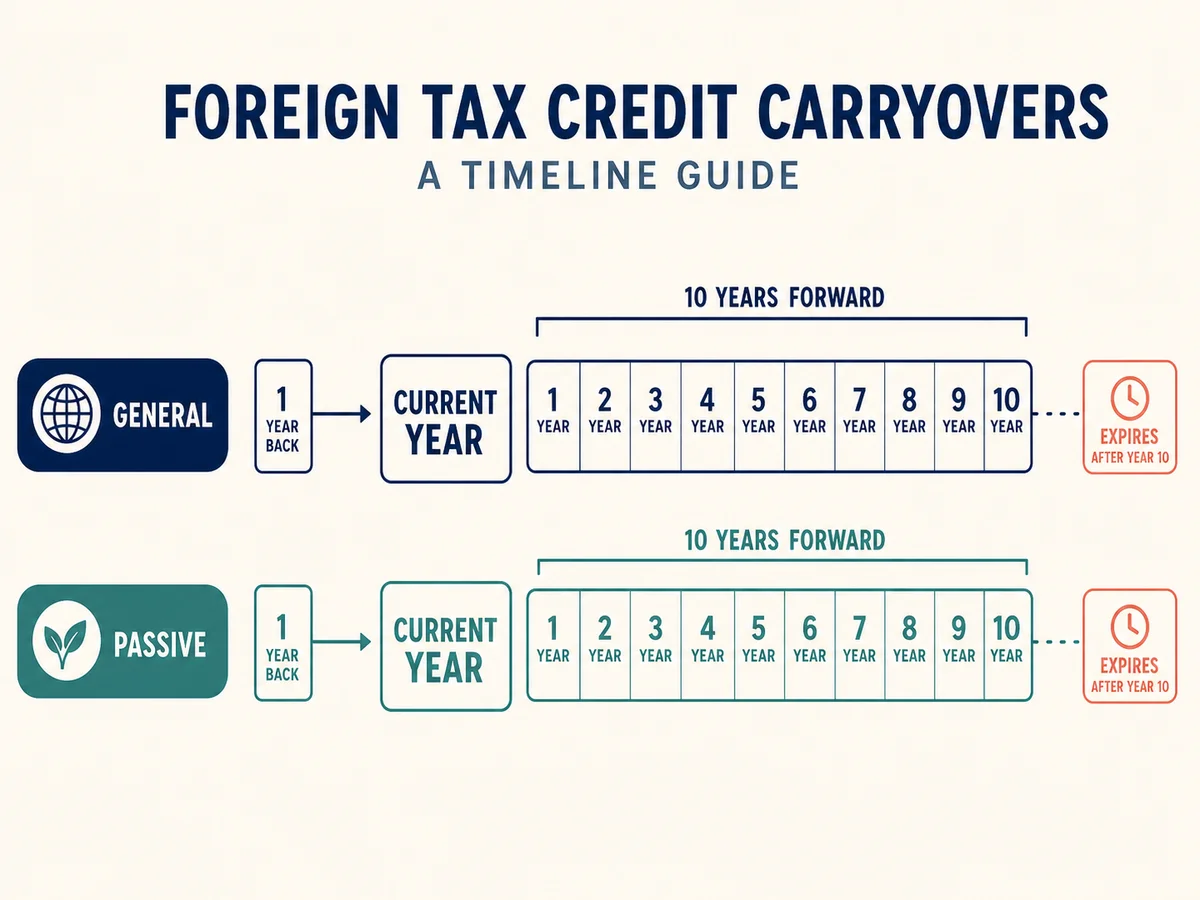
The FTC limit can strand foreign tax in a high-tax year. Publication 514 permits eligible excess foreign taxes to be carried back to the preceding year and then forward for ten years. The balances stay in their own categories. Excess passive tax does not become general-category credit, and vice versa. The Schedule B instructions require a separate reconciliation for each category with a prior- or current-year carryover.
| Year | Illustrative general-category limit | Current foreign tax | Carryover action |
|---|---|---|---|
| Year 1 | $20,000 | $32,000 | $12,000 excess; test one-year carryback first |
| Year 2 | $25,000 | $15,000 | Use up to $10,000 of eligible prior carryover |
| Later years | Varies | Varies | Track each vintage until used or expired after ten carryforward years |
FEIE continuity works differently. Once chosen, the exclusion remains in effect for later years unless revoked. The current Form 2555 instructions say a revocation statement is attached for the first year the taxpayer does not want the exclusion, and re-election generally requires IRS approval during the next five tax years. A year with no foreign earned income does not itself require revocation. Claiming a credit or deduction for tax on income that could have been excluded can also trigger revocation consequences.
The FTC choice is more flexible than Section 911. Publication 514 allows a taxpayer to elect or change from a deduction to a credit within the special ten-year period described there. That amendment window does not cancel the five-year Section 911 re-election rule. Model the FEIE decision before treating it as an annual toggle.
A carryover has value only if a later year has spare limitation in the same category. Someone who remains in a country where foreign tax consistently exceeds the U.S. tax on that income may accumulate balances that expire unused. A planned move to a lower-tax country, a reduced foreign rate, or a year with a larger U.S. limitation can make an older balance useful. The ordering rules generally consume older eligible carryovers before newer ones, which is why the Schedule B year columns matter.
Foreign tax can also change after the U.S. return is filed. A foreign audit, refund, amended assessment, or exchange-rate adjustment may create a foreign tax redetermination. Form 1116 and Publication 514 contain notification and recomputation rules for those events. Keep foreign assessments, payment receipts, refund notices, exchange-rate support, and the filed carryover schedule together. Treating withholding on a payslip as a permanently fixed credit is unsafe when the foreign return later refunds part of it.
Children, self-employment, and mixed income can change the winner
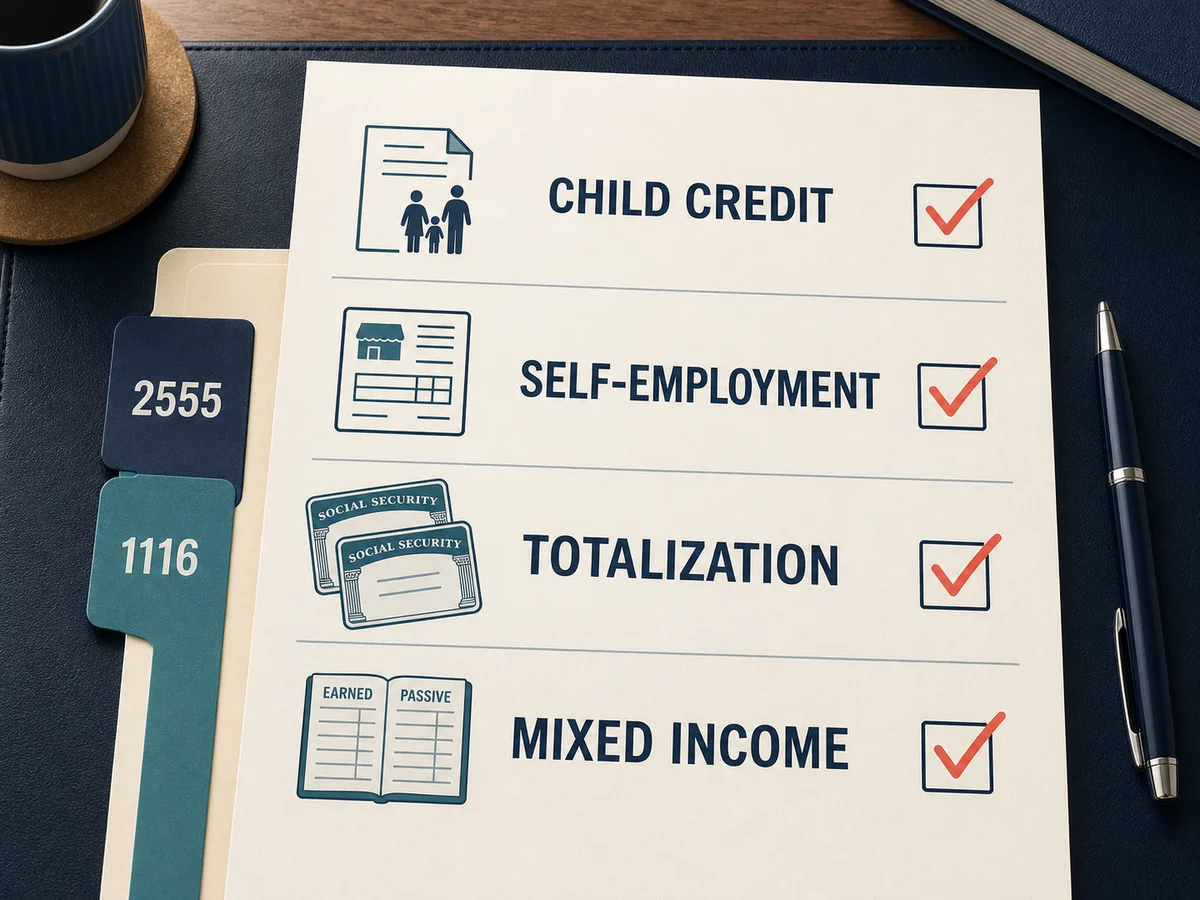
Child tax credit. The latest published 2025 Schedule 8812 instructions available at the accuracy cutoff state that a taxpayer filing Form 2555 cannot claim the additional child tax credit, the refundable portion. The nonrefundable child tax credit has separate requirements and may still be relevant. An FTC-only return can preserve access to the additional child tax credit if every other rule is met. Verify the instructions for the return year before relying on a refund.
Self-employment. The IRS says the FEIE does not reduce self-employment tax. The FTC generally offsets income tax, not U.S. Social Security and Medicare liability. A totalization agreement may assign social-security coverage to one country and prevent dual contributions, but coverage depends on the agreement and work facts. A consultant can owe no U.S. income tax and still face a substantial U.S. self-employment bill.
Mixed income. Salary, interest, qualified dividends, capital gains, stock compensation, and business income can produce different sourcing and category results. A credit on passive income cannot erase U.S. tax on U.S.-source income. Foreign taxes must also satisfy the IRS creditability rules. Run each basket separately instead of applying one blended foreign rate.
Form 2555 and Form 1116 do not replace account reporting. The site's FATCA guide explains Form 8938 and FBAR context. The separate zero-tax guide for U.S. citizens covers the broader limits of a zero federal income-tax result.
A practical decision checklist
- Confirm foreign earned income, tax home, and Section 911 qualification before modeling FEIE.
- Map every income item to U.S. or foreign source and to its Form 1116 category.
- Verify that each foreign levy qualifies for the credit and record whether it was paid or accrued.
- Calculate housing first, then FEIE, stacking tax, disallowed foreign tax, and Form 1116 limits.
- Compare current tax, child-credit effects, self-employment tax, and carryover value across several years.
- Check whether moving from FEIE to FTC requires a formal revocation and whether future re-election may need IRS consent.
Run the comparison with the same assumptions on both sides. Include the standard or itemized deduction, the Foreign Earned Income Tax Worksheet, foreign tax allocation, every Form 1116 category, and credits that depend on filing Form 2555. Then repeat the model for a plausible second year. A one-year tie can hide a large difference in carryover value or a five-year re-election constraint.
Keep a short decision memo with the return. Record the residence test, travel calendar, foreign-source analysis, taxes paid or accrued, housing calculation, carryover by category, and the reason the selected method beat the alternative. That file is useful when compensation changes or a different preparer handles the next return.
A spreadsheet comparison is useful, but it is not enough when stock compensation, foreign entities, treaty resourcing, PFICs, or multiple countries are involved. Those facts can change income source, timing, category, and creditability.
Frequently Asked Questions
Can I claim the FEIE and foreign tax credit in the same year?
Yes, on different income. You may exclude qualifying earned income and claim an FTC on foreign-source taxable income left above the exclusion or in another category. You cannot credit foreign tax allocated to income excluded under the FEIE or housing exclusion.
Is the foreign tax credit always better in a high-tax country?
Often, but not automatically. Check whether the tax qualifies, whether the income is foreign source, the applicable category limit, expense allocation, child credits, and carryovers. A hybrid can still help when low-tax earned income sits beside separately taxed passive income.
Does unused FEIE carry forward?
No. Unused annual exclusion capacity expires. Eligible excess foreign taxes can follow the FTC carryback and carryforward rules, which is one reason the FTC may have more long-term value.
Does either method eliminate self-employment tax?
Not by itself. FEIE and the FTC address federal income tax. U.S. self-employment tax can remain unless a totalization agreement or another specific rule changes social-security coverage.
This guide is for general information only and is not tax advice. A qualified U.S. international tax professional should review the actual return, foreign assessments, treaty position, and multi-year carryover schedule.
Sources Used in This Guide
- IRS: 2026 tax inflation adjustments
- IRS: Instructions for Form 2555
- IRS: Instructions for Form 1116
- IRS Publication 514: Foreign Tax Credit for Individuals
- IRS Publication 54: Tax Guide for U.S. Citizens and Resident Aliens Abroad
- IRS: Choosing the foreign earned income exclusion
- IRS: Foreign housing exclusion or deduction
- IRS Notice 2026-25: 2026 housing expense limits
- IRS: Instructions for Schedule B (Form 1116)
- IRS: Instructions for Schedule 8812
- IRS: Self-employment tax for businesses abroad
- IRS: Totalization agreements
Related Articles
- Foreign Earned Income Exclusion (FEIE) Guide, covering qualification tests, tax home, and earned-income rules.
- FATCA Explained for Americans Abroad, covering account and asset reporting outside the income-tax calculation.
- How to Legally Pay Zero Tax as a U.S. Citizen, covering broader federal, payroll, state, and filing limits.
- How Double Tax Treaties Actually Work, covering treaty residence, sourcing, and relief mechanics.