
In This Guide
- Filing one form never satisfies the other
- The $10,000 FBAR floor catches more people
- Form 8938 thresholds follow residence and filing status
- The accounts that land on only one form
- FBAR penalties did not rise in 2026
- Bittner changed the non-willful math only
- Crypto is an open question, not a safe harbor
- Two routes back if you are years behind
- Frequently Asked Questions
- Sources Used in This Guide
- Related Articles
Filing one form never satisfies the other
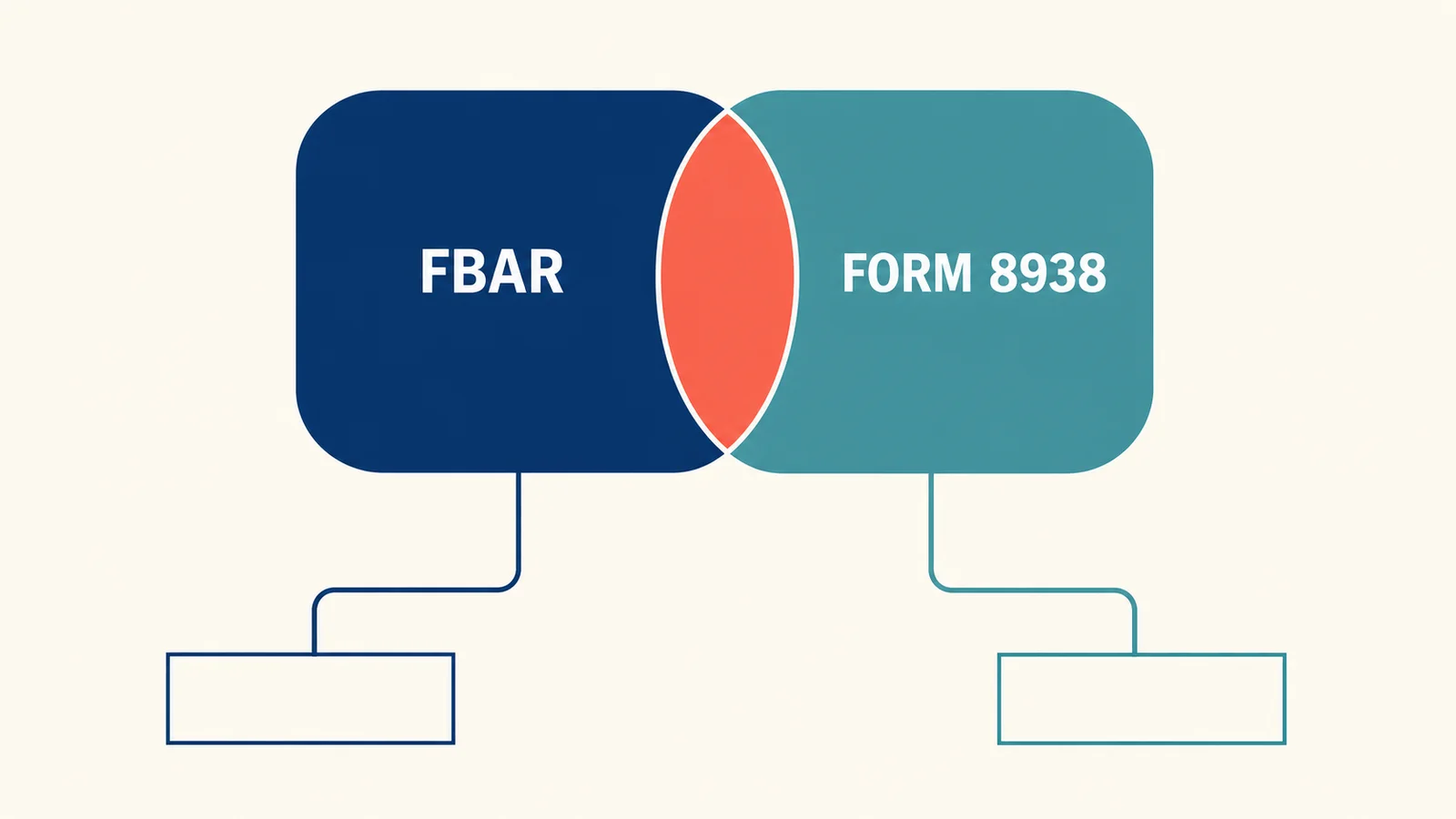
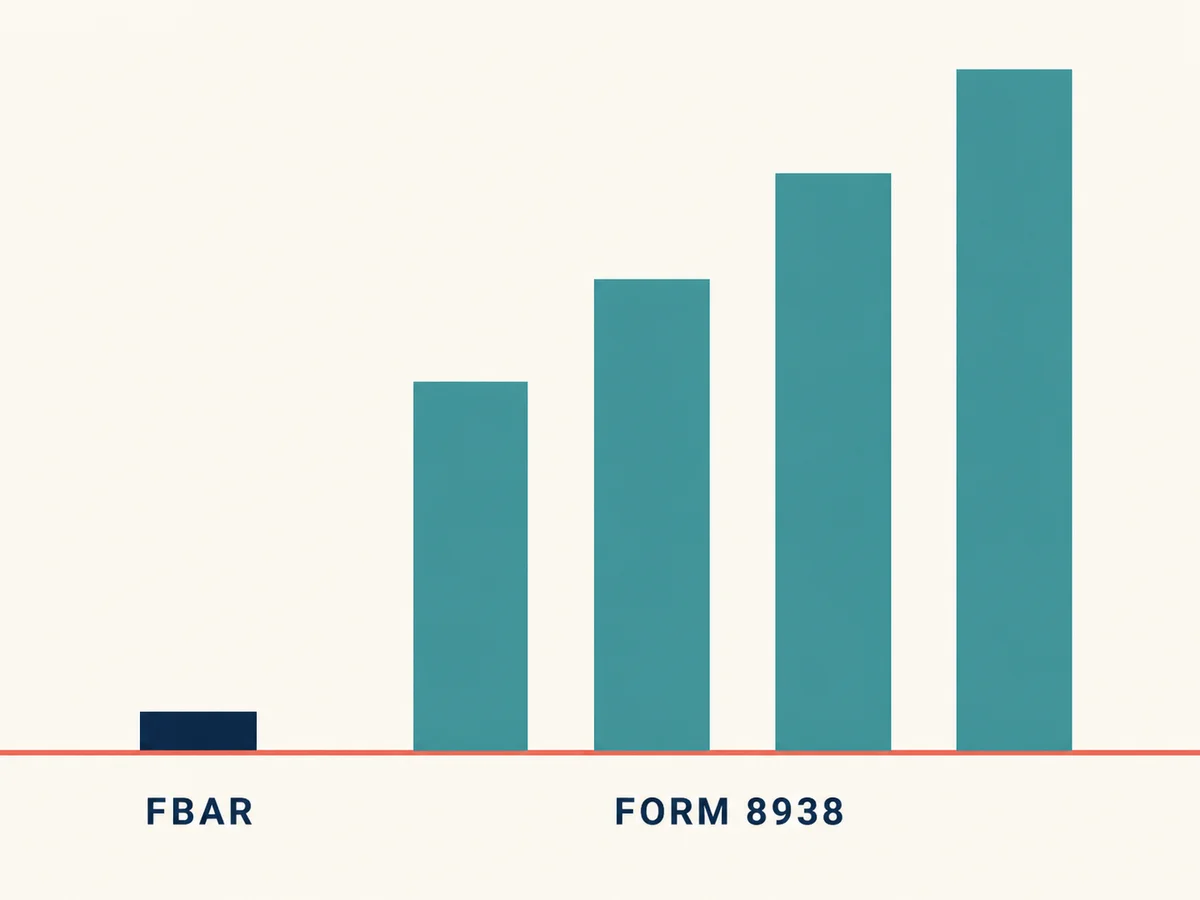
The FBAR catches people Form 8938 never touches. A US person must file FinCEN Form 114 once foreign financial accounts exceed $10,000 in aggregate at any time during the calendar year (IRS). That figure never moves: not for marital status, not because you live abroad (IRS comparison chart). Form 8938 starts at $50,000 and runs to $600,000 depending on filing status and residence (Instructions for Form 8938). One is a floor almost anyone with an overseas salary account crosses. The other is a bar most people never reach.
Neither form substitutes for the other. Filing Form 8938 "does not relieve you of the separate requirement to file the FBAR" (IRS). FinCEN owns the FBAR and takes it through its own electronic system. The IRS owns Form 8938 and takes it attached to your return. Different deadlines, different penalties, different definitions of an asset. Reporting the same Barclays account on both forms in one year is the ordinary outcome, not double counting.
Accuracy and scope: Rules and figures were checked against primary sources available through August 3, 2026. This is general information, not tax, legal, or financial advice.
| FBAR (FinCEN Form 114) | Form 8938 (FATCA) | |
|---|---|---|
| Who files | US persons: citizens, resident aliens, trusts, estates, domestic entities, plus US territory residents | Specified individuals and specified domestic entities |
| Threshold | $10,000 aggregate, any time in the year, same for everyone | $50,000 to $600,000, by filing status and residence |
| Triggering interest | Financial interest or signature authority | Interest producing income, gains, deductions, credits or proceeds on your return |
| What is reported | Accounts at an institution physically located abroad | Specified foreign financial assets, including non-account assets |
| Due date | April 15, automatic extension to October 15 | With your tax return, including extensions |
| Where it goes | Electronically to FinCEN via BSA E-Filing, not with your return | Attached to your federal income tax return |
| Owed with no tax return? | Yes, independent of any return | No |
| Non-willful penalty | Up to $16,536 per report after Bittner, capped at 50% of highest balance | $10,000, plus $10,000 per 30 days after notice, to $60,000 |
| Willful penalty | Greater of $165,353 or 50% of balances, assessed per account | Same $60,000 ceiling, plus 40% accuracy-related penalty |
Source: IRS comparison of Form 8938 and FBAR requirements.
Work it in order. Add the highest balance each foreign account reached during the year, whether or not the money is yours, and see whether the total crossed $10,000. That settles the FBAR. Then ask whether you must file a US income tax return at all, because if you do not, Form 8938 never applies regardless of asset size (IRS).
The $10,000 FBAR floor catches more people
The threshold is aggregate, not per account. Ten accounts holding $1,200 each trigger the same duty as one holding $12,000, and the test is the peak value each account reached at any point in the year (IRS). One day above the line is enough. A house sale that parks proceeds abroad for a week creates an FBAR year even if the balance is zero by December 31.
"US person" is broader than most assume: citizens, resident aliens, and also corporations, partnerships, LLCs, trusts and estates formed under US law (IRS comparison chart). The single-member LLC you set up for consulting work has its own FBAR obligation, separate from yours.
Signature authority alone triggers an FBAR, with no financial interest of any kind, and it never triggers a Form 8938. The finance director who can move money out of the company account in Singapore reports it. So does the American added to an elderly parent's account in Athens for convenience. Neither owns a dollar of it.
A short list sits outside the FBAR: correspondent and nostro accounts, accounts of governmental entities, US military banking facilities, IRAs and qualified retirement plans, and trust accounts already covered by a consolidated FBAR (IRS). That carve-out covers US-qualified plans, not a foreign employer's scheme.
The form is due April 15 with an automatic extension to October 15 that nobody has to request, and it goes electronically through FinCEN's BSA E-Filing System, never attached to a return (IRS). Spouses may file a single FBAR only if every reportable account is jointly owned, using Form 114a; otherwise each files separately for the full value. Keep account records five years from the due date.
Form 8938 thresholds follow residence and filing status
Six combinations, and the word "or" carries the weight. Exceeding either the year-end figure or the any-time figure creates the obligation (Instructions for Form 8938). An expat couple filing jointly who held $650,000 in March and $380,000 on December 31 have crossed the $600,000 any-time line, even though they finished below the $400,000 year-end line.
| Filing status | Residence | Value on last day of tax year | OR value at any time during year |
|---|---|---|---|
| Unmarried | Living in the US | More than $50,000 | More than $75,000 |
| Married filing jointly | Living in the US | More than $100,000 | More than $150,000 |
| Married filing separately | Living in the US | More than $50,000 | More than $75,000 |
| Unmarried | Living abroad | More than $200,000 | More than $300,000 |
| Married filing jointly | Living abroad | More than $400,000 | More than $600,000 |
| Married filing separately | Living abroad | More than $200,000 | More than $300,000 |
| Any status, any residence | FBAR: $10,000 aggregate, any time in the year | — | — |
Sources: IRS Instructions for Form 8938 (Rev. November 2021); IRS comparison chart.
The higher thresholds take more than a foreign address. You must be a US citizen who was a bona fide resident of a foreign country for an uninterrupted period covering an entire tax year, or present in a foreign country at least 330 full days in any 12 consecutive months (Instructions for Form 8938). Miss the day count in a year of heavy travel back to the US and your threshold falls from $200,000 to $50,000.
Specified individuals include US citizens, resident aliens, and bona fide residents of American Samoa or Puerto Rico; closely held domestic corporations and partnerships with at least 50% passive income or assets are caught too. One structural difference from the FBAR matters more than the definitions: taxpayers not required to file an income tax return need not file Form 8938 at all, whatever their assets (IRS).
Assets already disclosed on Forms 3520, 3520-A, 5471, 8621 or 8865 need not be described twice, provided you identify those forms in Part IV, though their values still count toward the threshold (Instructions for Form 8938). Omit more than $5,000 of income attributable to foreign financial assets and the limitations period extends to six years. The period for the whole return can stay open until Form 8938 is filed.
The accounts that land on only one form
The overlap is wide but not complete, and the gaps run both ways. A deposit account at a foreign bank appears on both forms. Foreign stock held outside any account appears only on Form 8938. An account at the London branch of a US bank appears only on the FBAR (IRS comparison chart).
| Asset | Form 8938 | FBAR |
|---|---|---|
| Deposit or custodial account at a foreign financial institution | Yes | Yes |
| Account at a foreign branch of a US financial institution | No | Yes |
| Account at a US branch of a foreign financial institution | No | No |
| Foreign account where you hold signature authority only | No | Yes |
| Foreign stock or securities not held in a financial account | Yes | No |
| Indirect interest through an entity you own more than 50% of | No, report the entity interest | Yes |
| Foreign mutual fund | Yes | Yes |
| Foreign-issued life insurance or annuity with cash value | Yes | Yes |
| Foreign real estate held directly | No | No |
| Foreign real estate held through a foreign entity | No, but the entity interest is | No |
| Foreign pension or deferred compensation plan | Yes, Part VI | Yes, if held in a foreign account |
| Foreign account holding only virtual currency | Not addressed in the instructions | Not currently reportable |
Sources: IRS comparison chart; IRS Form 8938 FAQ.
The foreign-branch row catches sophisticated filers. Your Citibank account in London sits at a US institution commercially, but it is still an account physically located in a foreign country, which is what the FBAR measures. FBAR-reportable, not 8938-reportable. The mirror case is equally odd: an account at HSBC's New York branch is reportable on neither.
Several holdings that feel offshore sit outside both regimes: directly held foreign real estate, foreign currency, gold bullion, and safe deposit box contents, which the IRS does not treat as a financial account (IRS). A gold certificate issued by a foreign person may be reportable, though. A Lisbon apartment in your own name is reportable nowhere; held through a Portuguese company, your interest in that company is.
FBAR penalties did not rise in 2026
Most 2026 coverage will quote inflated FBAR penalties. The 2025 amounts still govern. The non-willful maximum is $16,536, the inflation-adjusted form of the statutory $10,000, for penalties assessed on or after January 17, 2025. The willful maximum is the greater of $165,353 or 50% of the account balance at the time of the violation (31 CFR 1010.821).
The increase did not happen because the government-wide adjustment did not happen. OMB Memorandum M-26-11, issued April 17, 2026, suspended the annual civil monetary penalty adjustment: the Bureau of Labor Statistics never published October 2025 CPI-U data during the federal shutdown, leaving the statutory formula without an input (Baker McKenzie analysis of the memorandum). If a source quotes a higher FBAR ceiling this year, ask where it came from.
One structural point gets missed. Inflation adjustment reaches only the fixed $100,000 statutory component, not the 50%-of-balance alternative (IRM 4.26.7). On a $3 million account the 50% branch produces $1.5 million and the adjusted figure is irrelevant. Criminal exposure sits above all of it, at a fine and up to five years in prison (IRS).
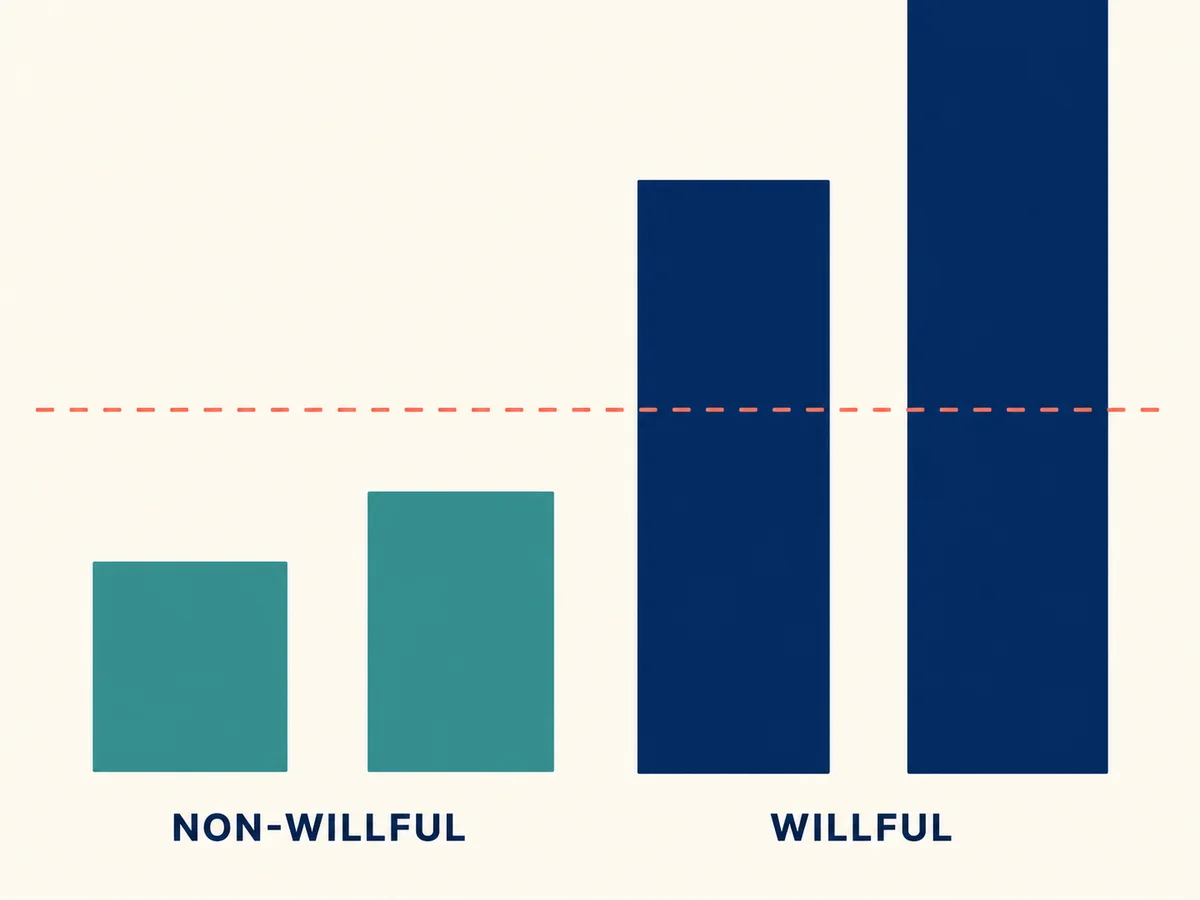
Form 8938 runs a flatter scale: $10,000 for failure to file, plus $10,000 per 30-day period after IRS notification, capped at $60,000 in total, with a 40% accuracy-related penalty on understatements attributable to undisclosed assets (IRS). The FBAR's reasonable cause relief has two limbs: the non-willful penalty "should not be imposed if (1) the violation was due to reasonable cause, and (2) accurate delinquent or amended FBAR(s) are filed" (IRM 4.26.16). Both limbs, not either.
Bittner changed the non-willful math only
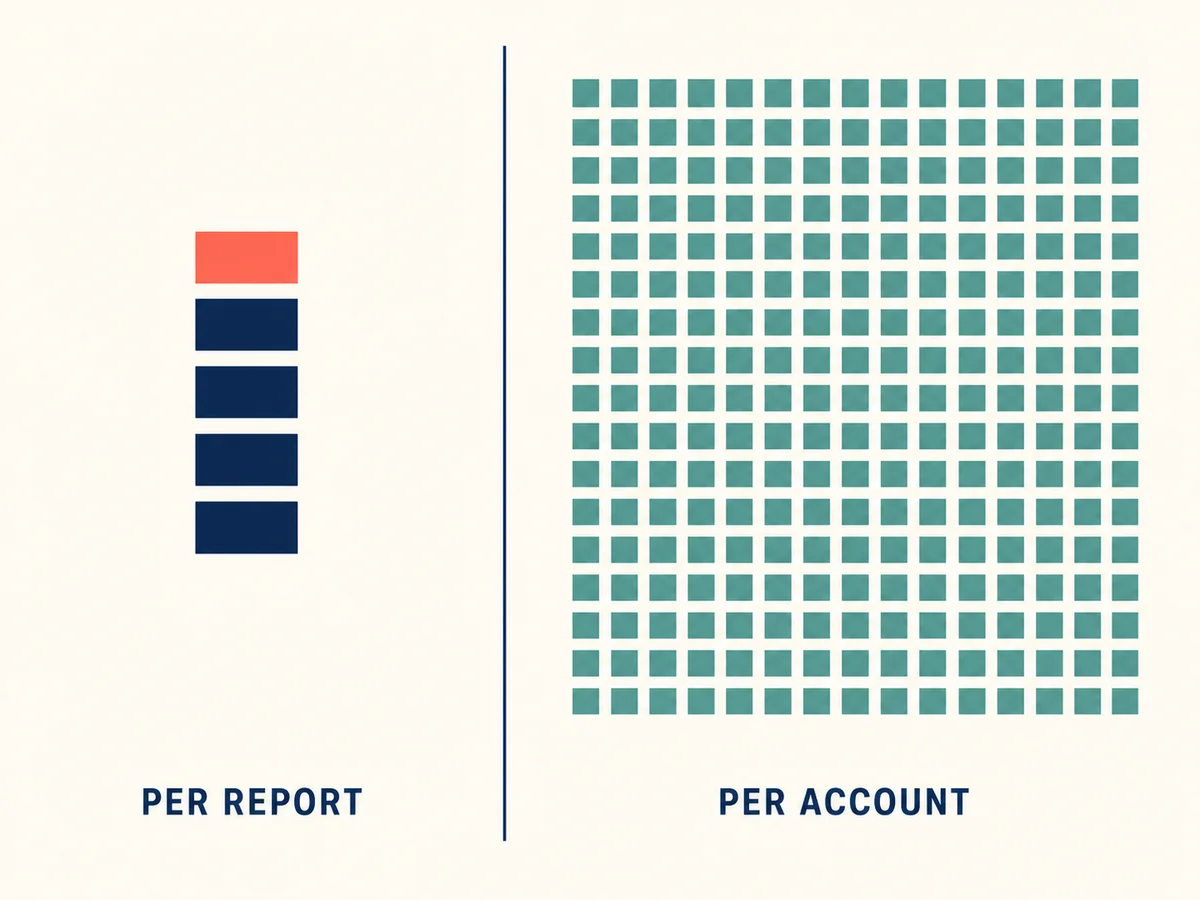
The Supreme Court decided Bittner v. United States on February 28, 2023, 6-3, Justice Gorsuch writing, holding that "penalties for nonwillful violations accrue on a per-report, not a per-account, basis" (598 U.S. 85). Alexandru Bittner, a dual US and Romanian citizen, missed FBARs covering 272 accounts over five years. The government assessed $2.72 million on a per-account theory; under the holding, exposure was $50,000, one $10,000 penalty per late annual report.
Here is where consumer coverage of the case goes wrong. Bittner addressed non-willful violations, and the IRS applies it only there. Under the Internal Revenue Manual, incorporating interim guidance SBSE-04-0723-0034, non-willful violations produce one penalty per filing violation while willful penalties are still assessed per account (IRM 4.26.16). A willful case involving 40 accounts remains a 40-penalty case.
The Manual also carries a limit that rarely appears in published summaries: "in no event will the total amount of the penalties for non-willful violations (among all open years) exceed 50 percent of the highest aggregate balance of all foreign financial accounts to which the violations relate" (IRM 4.26.16). Six open years at the $16,536 maximum computes to $99,216. If the highest aggregate balance was $80,000, the cap holds the total to $40,000.
Crypto is an open question, not a safe harbor
The governing statement is six years old and was never finalized as a rule. FinCEN Notice 2020-2, published December 30, 2020, said the FBAR regulations do not currently define a foreign account holding only virtual currency as reportable, and that FinCEN intends to propose amending them (FinCEN Notice 2020-2). As of August 2026 no such amendment has been finalized. The comfort rests on a notice announcing an intention to withdraw that comfort.
The exclusion also covers only an account holding nothing but virtual currency. If the same account holds fiat or securities, ordinary rules apply and the $10,000 aggregate test bites. Most exchange accounts anyone actually trades from hold a fiat balance at some point in the year.
Form 8938 gives no clarity either way. The current instructions, revised November 2021, do not address digital assets (Instructions for Form 8938). Silence is neither exemption nor inclusion. A future revision could answer it against positions taken today, so treat meaningful holdings on a non-US exchange as live risk.
Two routes back if you are years behind
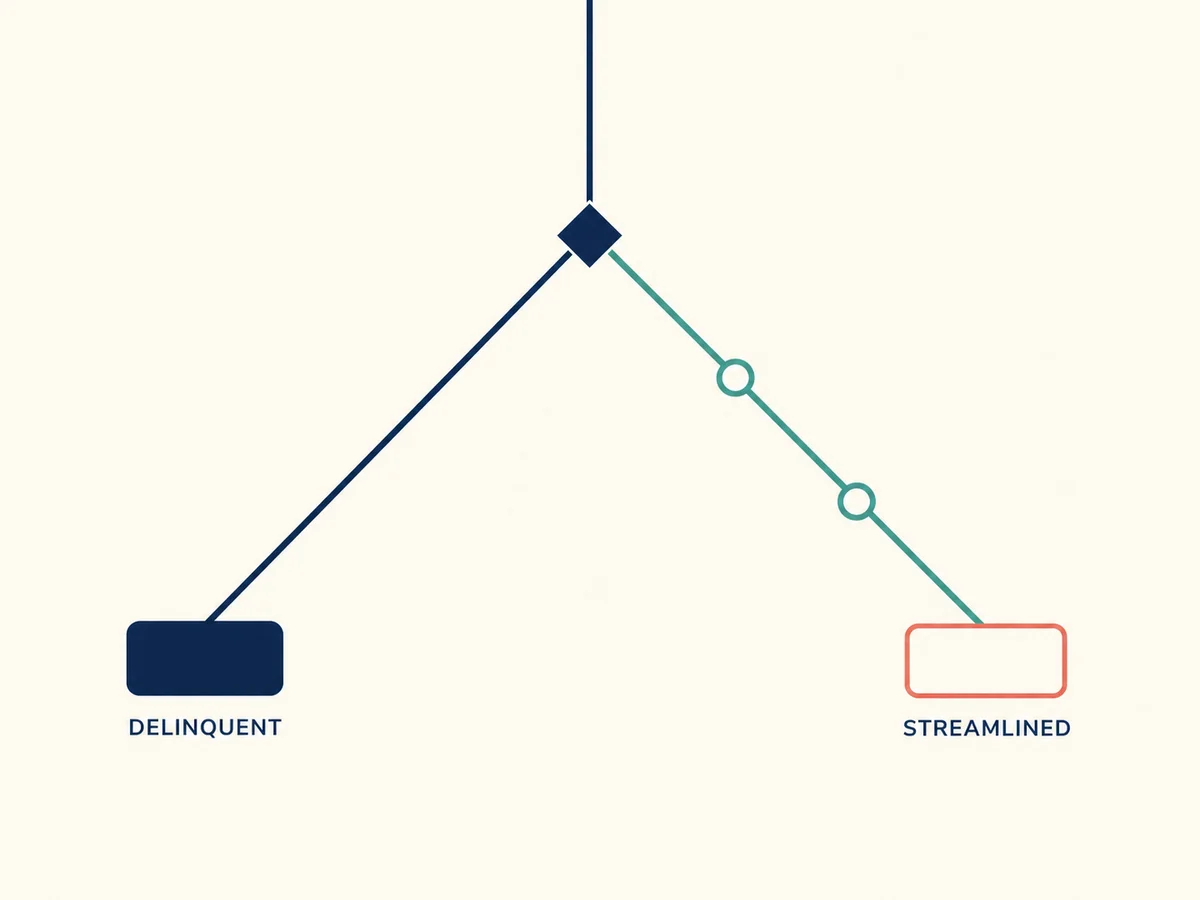
Two correction paths exist, and choosing turns on one question: did you report the income? If every dollar of foreign income was on your returns and the tax was paid, and you simply never filed the FBARs, the Delinquent FBAR Submission Procedures apply. File the late reports through BSA E-Filing with a reason for filing late, and the IRS will not impose a penalty (IRS). The route closes if you are under examination or the IRS contacted you first.
If income went unreported and the failure was non-willful, the Streamlined Filing Compliance Procedures apply, split by residence. Both tracks require certifying non-willful conduct, meaning "negligence, inadvertence, or mistake or conduct that is the result of a good faith misunderstanding of the requirements of the law" (IRS). That certification is signed under penalty of perjury.
The foreign track is materially better. Streamlined Foreign Offshore Procedures require 330 full days physically outside the United States and no US abode in one or more of the prior three years, then three years of returns, six years of FBARs and Form 14653. Qualifying filers face no failure-to-file, failure-to-pay, accuracy-related, information return or FBAR penalties, and no miscellaneous offshore penalty. Statutory interest still runs.
The domestic track costs 5%. It serves people who filed returns for the most recent three years but fail the non-residency test: three years of amended returns, six years of FBARs, Form 14654, and a 5% penalty on the highest aggregate year-end balance across the covered periods. On $500,000 of assets that is $25,000, against zero for someone who meets the presence test.
Both tracks remain active in 2026, and the older Offshore Voluntary Disclosure Program closed on September 28, 2018 (IRS). No termination date has been announced for the streamlined procedures, but OVDP was withdrawn with limited notice and nothing commits the IRS to keeping streamlined open. Treat continued availability as a planning assumption, not a fact.
Frequently Asked Questions
Is my cryptocurrency on a foreign exchange reportable?
Under FinCEN Notice 2020-2, an account holding only virtual currency is not currently FBAR-reportable. That rests on a 2020 notice rather than a final rule, and FinCEN said it intends to amend the regulations. If the account also holds fiat or securities, it is reportable once the $10,000 threshold is met.
I only have signature authority over my employer's foreign account. Do I file?
You file an FBAR if the aggregate exceeded $10,000, even with zero financial interest in the money (IRS comparison chart). You do not report it on Form 8938, which requires an interest producing reportable income, gains, losses, deductions, credits, gross proceeds or distributions. Signature authority produces none of those.
How large can the penalties actually get?
Non-willful FBAR penalties top out at $16,536 per annual report after Bittner, and the Internal Revenue Manual caps the total across all open years at 50% of the highest aggregate balance. Willful penalties are the greater of $165,353 or 50% of the balance, assessed per account. Form 8938 runs from $10,000 to $60,000, plus a 40% accuracy-related penalty.
Does my apartment in Portugal need to be reported?
Directly held foreign real estate is reportable on neither form. Hold it through a foreign company or trust, though, and your interest in that entity is a specified foreign financial asset on Form 8938 (IRS comparison chart). The structure, not the building, creates the filing.
This guide is for general information only and is not tax advice. A qualified professional should review your specific facts before you act.
Sources Used in This Guide
- IRS — Report of Foreign Bank and Financial Accounts (FBAR)
- IRS — Comparison of Form 8938 and FBAR Requirements
- IRS — How to Report Foreign Bank and Financial Accounts
- IRS — Instructions for Form 8938 (Rev. November 2021)
- IRS — Basic Questions and Answers on Form 8938
- IRS — Summary of FATCA Reporting for U.S. Taxpayers
- IRS — Internal Revenue Manual 4.26.16
- 31 CFR 1010.821 — Penalty Adjustment and Table (Cornell LII)
- Bittner v. United States, 598 U.S. 85 (2023) (Cornell LII)
- Baker McKenzie — Civil Monetary Penalty Inflation Adjustment Nixed for 2026
- FinCEN Notice 2020-2 — FBAR Filing Requirement for Virtual Currency
- IRS — Delinquent FBAR Submission Procedures
- IRS — Streamlined Filing Compliance Procedures
Related Articles
- FATCA Explained for Americans Abroad — covering the law behind Form 8938 and how foreign banks report you.
- The Common Reporting Standard, Explained — covering the rest-of-world equivalent outside the US system.
- Best Offshore Bank Accounts — covering the accounts that trigger these forms in the first place.
- How to Legally Pay Zero Tax as a US Citizen — covering the broader US expat tax picture these filings sit inside.