
In This Guide
- Why the zero-residency plan collapses
- Your departure country keeps you on a timer
- Residence tests bite long before 183 days
- No residence means no treaty, anywhere
- The CRS form has no box for nowhere
- What the litigation record shows
- US citizens are excluded entirely
- Flag theory never told you to live nowhere
- Frequently Asked Questions
- Sources Used in This Guide
- Related Articles
Why the zero-residency plan collapses
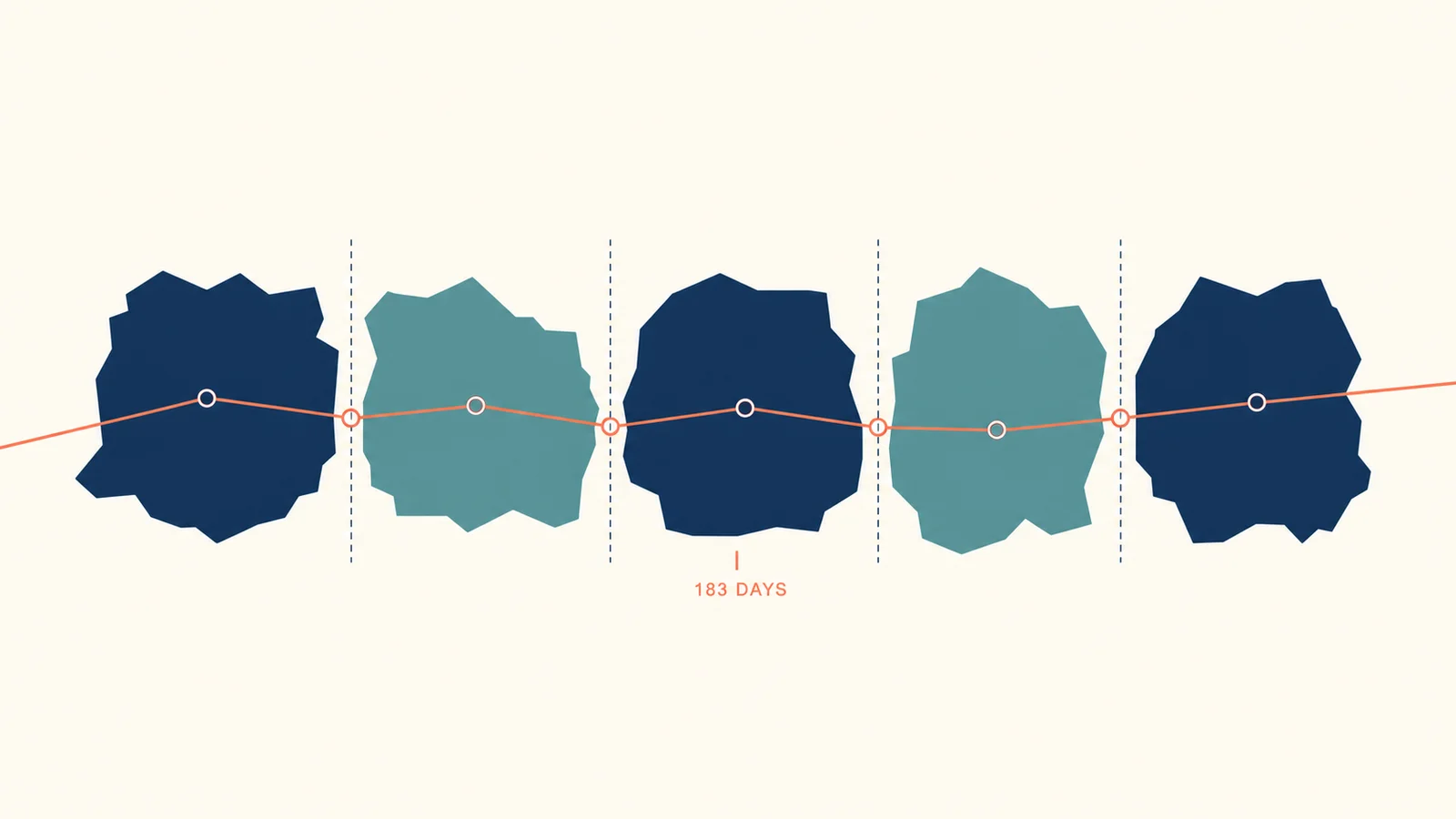
The plan is easy to state and wrong in four places. Stay under 183 days everywhere, claim tax residence nowhere, pay tax nowhere. It breaks on four independent legs, and any one is enough. Your departure country keeps you on a statutory timer, not a day count. Most residence tests trigger well below 183 days. Treaties apply only to residents. And the form your bank hands you has no answer that fits.
Start with the form. The OECD published two model self-certification forms for the Common Reporting Standard. The entity form contemplates an entity with no tax residence and routes it to the place of effective management. The individual form has no equivalent. The drafters considered the no-residence case and provided for it only for entities.
Accuracy and scope: Rules and figures were checked against primary sources available through August 3, 2026. This is general information, not tax, legal, or financial advice.
The real comparison is not nowhere against your home country. It is nowhere against a documented low-tax residency.
| Dimension | Resident of nowhere | Residency with a certificate |
|---|---|---|
| Treaty access | None; Article 1 covers residents | Full network |
| Withholding | Full rate, no reclaim | Reduced against a certificate |
| Certificate | No authority can issue one | Issued on meeting the test |
| CRS form | No valid answer exists | Clean answer with a TIN |
| Departure defence | None; fallbacks need proof | Proof defeats most fallbacks |
| Day requirement | Under 183 everywhere, forever | 183 days, or less |
| Audit posture | Ambiguity resolves against you | Burden shifts to the authority |
| De-risking risk | High and rising | Normal, with added diligence |
The left column lists things you cannot prove. Administrations need only observe that you have not proved them.
Your departure country keeps you on a timer
The first misreading is treating departure as an event. In much of Europe it is a period, during which the country you left keeps treating you as its taxpayer unless you produce something you do not have.
Spain runs the harshest version. Its filing with the OECD states that Spanish nationals who move their fiscal residence to a listed tax haven "will not lose their status as taxpayers for Individual Income Tax," applying "during the tax period in which the change of residence occurs and for the next four tax periods" (Spanish Tax Agency via OECD). Five tax years, by operation of law.
Spain then counts your travel days as Spanish days: "occasional absences are included, except if the taxpayer accredits their residency in another country" (Agencia Tributaria). The escape hatch is proof of residency elsewhere, which a perpetual traveler by design does not have. Absences fold back into the Spanish count, and 183 days arrives on time spent in a dozen other countries.
The Nordics and Ireland run timers of their own. Swedish citizens and anyone resident ten years or longer "must prove that you no longer have close ties to this country," for five years from departure (Skatteverket). A Finnish citizen stays tax resident for the year of relocation "and for the three following tax years" (Vero). Norway ends residence only on cumulative conditions, including no available home and "not stayed in Norway for more than 61 days in the year," plus a three-year wait for long-term residents (Skatteetaten). Ireland keeps you ordinarily resident, taxable on worldwide income, for three tax years after you leave (Revenue).
Germany runs the longest clock: ten years of extended limited liability under §2 AStG for citizens fully liable in five of the previous ten years who move somewhere taxing well below German levels and keep substantial German interests. In IX R 37/21, decided 14 January 2025, the Federal Fiscal Court read "preferential taxation" broadly enough to catch the UK remittance basis (Grant Thornton).
The UK runs two trails. Temporary non-residence catches anyone UK resident in four of the previous seven years whose absence is "less than 5 years": gains realised in the gap are taxed in the year of return (HMRC). Domicile was also abolished for inheritance tax on 6 April 2025, replaced by a long-term resident test keyed to residence in ten of the previous twenty tax years (Charles Russell Speechlys).
| Country | Mechanism | Who it catches | Duration |
|---|---|---|---|
| Spain | Tax-haven rule (Art. 8.2 PITL) | Nationals moving to a listed haven | Year of change plus 4 |
| Spain | Occasional-absence counting | Anyone lacking proof of residence | Indefinite |
| Sweden | Essential connection | Citizens; residents of 10+ years | 5 years |
| Finland | Three-year rule | Finnish citizens | Year of move plus 3 |
| Norway | Cessation conditions | 61-day cap; no available home | 3 years if resident 10+ |
| Ireland | Ordinary residence | Residents of 3 consecutive years | 3 tax years |
| Germany | §2 AStG extended liability | Citizens, low-tax destination | 10 years |
| UK | Temporary non-residence | Resident 4 of prior 7, absent under 5 | Year of return |
| UK | Long-term resident (IHT) | Resident 10 of previous 20 | 3 to 10 year tail |
| Australia | Domicile test | Domicile, no abode abroad | Indefinite |
| Canada | Factual residence | Anyone keeping a significant tie | Indefinite |
| USA | Citizenship taxation | Citizens and green-card holders | Until expatriation |
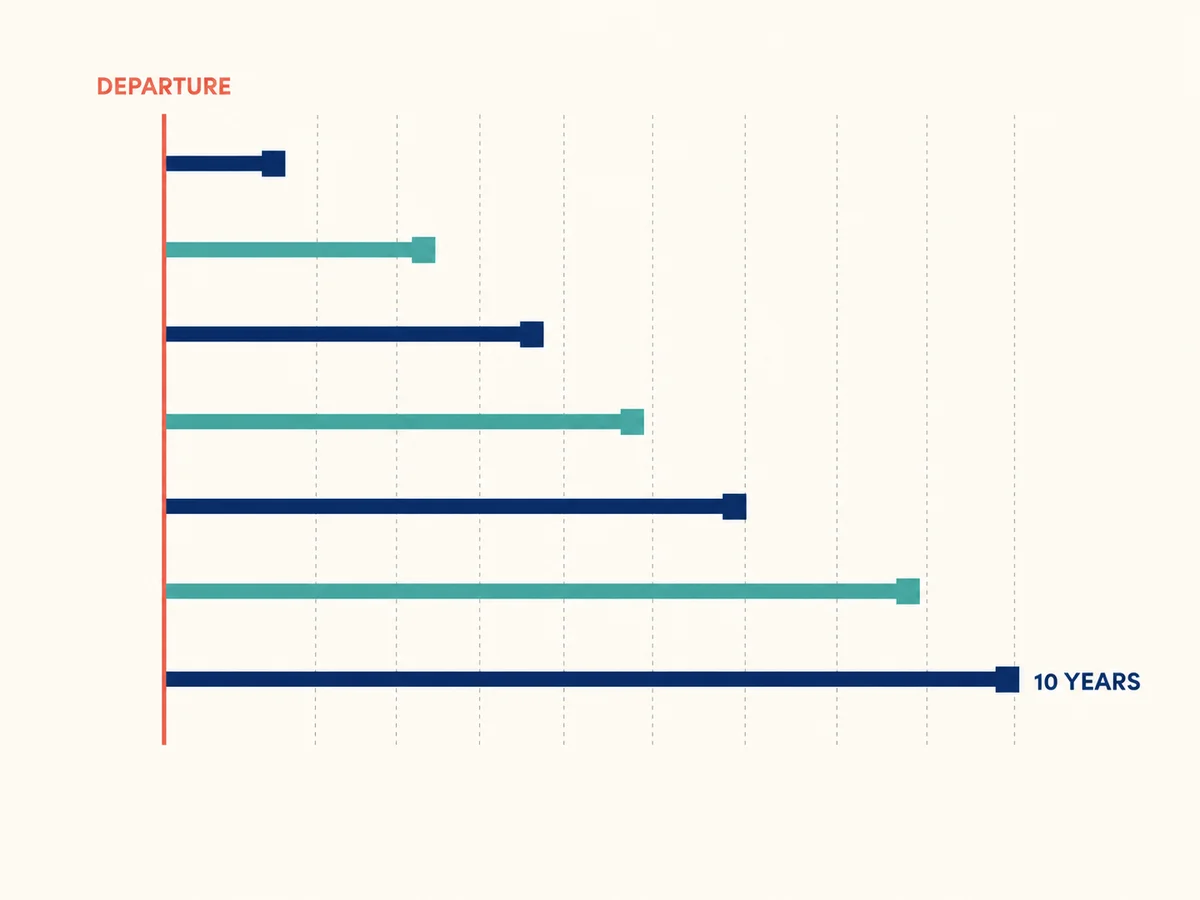
Each rule is written so that proof of residence somewhere else is the way out, which is the point of a non-residence checklist. The nowhere plan removes that exit from all of them at once.
Residence tests bite long before 183 days
The 183-day figure is one alternative test among several, and the others carry no day threshold. Treating it as the single gate is the core error, and it is a myth worth unpacking country by country.
The UK can make you resident on sixteen days. Under the sufficient ties test, someone UK resident in one of the three prior tax years with four UK ties is resident at 16 to 45 days of presence. Three ties suffice at 46 to 90 days, two at 91 to 120 (HMRC RDR3). The ties are family, accommodation, work, the 90-day tie and, for leavers, the country tie (Pinsent Masons). A spare room at a parent's house counts.
Canada makes days nearly irrelevant on exit. Its residence folio states that "unless an individual severs all significant residential ties with Canada upon leaving Canada, the individual will continue to be a factual resident" (CRA Folio S5-F1-C1). An available dwelling, a spouse and dependants each count. One surviving tie is enough.
Australia's domicile test does not ask whether you left. It asks where you arrived. Someone with Australian domicile stays resident unless a permanent place of abode abroad is established, meaning accommodation not temporary or transitory, and the burden sits with the taxpayer (Munro Doig on the ATO tests). A traveler with no fixed foreign home fails by definition, at zero days.
Spain adds two zero-day triggers. Centre of economic interests is an independent alternative to the day count. And a spouse not legally separated, plus minor children resident in Spain, creates a rebuttable presumption of residence (Agencia Tributaria).
| Breaker | Days | Mechanism |
|---|---|---|
| UK sufficient ties | 16 | 4 UK ties plus prior residence |
| UK sufficient ties | 46 | 3 ties plus prior residence |
| Norway re-entry | 62 | Breaks the cessation condition |
| Centre of vital interests | 0 | No day threshold in Article 4(2) |
| Centre of economic interests | 0 | Spain's alternative to the day test |
| Spouse and children in Spain | 0 | Rebuttable presumption of residence |
| Australian domicile | 0 | Resident unless abode proven abroad |
| Canadian dwelling available | 0 | Significant tie means factual resident |
| Work performed in a country | 1 | Article 15(1); 15(2) needs residence |
| Rental property abroad | 0 | Article 6(1) situs taxation |
| Opening a bank account | n/a | CRS form has no "none" option |
No residence means no treaty, anywhere
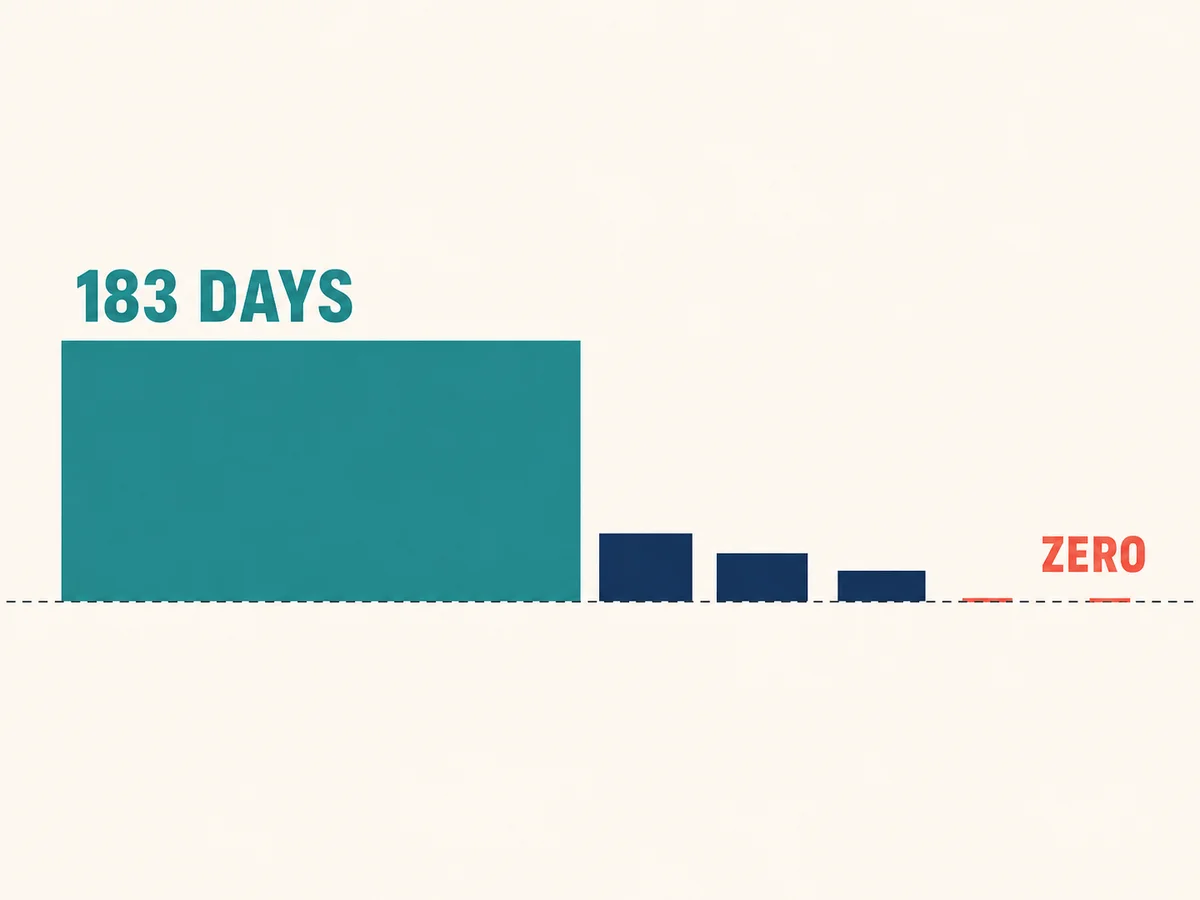
Roughly three thousand bilateral tax treaties exist, and every one opens with a scope article limiting it to residents.
Article 1 of the OECD Model applies the convention "to persons who are residents of one or both of the Contracting States." Article 4(1) defines a resident as any person "liable to tax therein by reason of his domicile, residence, place of management or any other criterion of a similar nature," and excludes anyone "liable to tax in that State in respect only of income from sources in that State" (OECD Model Tax Convention). You need a residence-type liability to qualify. A nowhere-person has source-only liability by construction.
The Article 4(2) tie-breaker does not rescue this. It runs only when you are resident in two states, and its job is to pick one, not to create a residence from none. Its hierarchy runs permanent home, centre of vital interests, habitual abode, nationality. Two of those carry no day threshold.
The source rules keep working regardless. Article 15(1) taxes employment income where the work is done, from day one. The 183-day exemption in Article 15(2) is open only to "a resident of a Contracting State," so a nowhere-person fails before the day count is reached. Article 6(1) taxes immovable property where it sits.
Norway lists plainly what a non-resident still owes: salary for work performed there, business income, "dividend on shares in Norwegian companies," directors' fees, pensions, rental income and gains on Norwegian property (Skatteetaten). All at the domestic rate. A resident of a treaty partner would cut several. A resident of nowhere cuts none.
The instrument that delivers those cuts is a certificate of residence. HMRC issues one only where officers "can see that the customer is… liable to UK tax by virtue of their residence" (HMRC INTM162040). No authority issues a certificate to someone not resident with it, and that document separates the two columns above.

The CRS form has no box for nowhere
This is where the theory meets a bank clerk. Opening or maintaining a financial account requires a self-certification, and the OECD publishes the model.
Part 2 of the individual form is headed "Country/Jurisdiction of Residence for Tax Purposes and related Taxpayer Identification Number," and instructs completion "indicating (i) where the Account Holder is tax resident and (ii) the Account Holder's TIN for each country/jurisdiction indicated." A valid self-certification must carry the holder's name, address, jurisdictions of tax residence, TIN for each reportable jurisdiction, and date of birth (OECD CRS-I form). Residence is an element of validity, not a best-efforts field.
The escape hatches sit at TIN level. Reasons A, B and C explain why no identification number is supplied: the jurisdiction does not issue them, you cannot obtain one, or it is not required. None lets you say you have no jurisdiction. The drafters knew a legal person can lack a tax residence and provided for it. They did not extend that to natural persons.
Writing an answer you cannot support does not help. Where an institution "knows or has reason to know that a self-certification is incorrect," OECD guidance expects it to obtain a valid one or "a reasonable explanation and documentation" supporting it. The result is a request for papers you do not have.
Buying a certificate from a low-presence program is not a clean fix either. In October 2018 the OECD analysed more than a hundred citizenship- and residence-by-investment schemes and treated as high-risk those combining a personal income tax rate under 10% on offshore financial assets with no requirement of significant physical presence of at least ninety days (OECD). Named jurisdictions included the UAE, Malta, Cyprus, Monaco, Panama and Vanuatu. Thinner presence means more documentation.

What the litigation record shows
Two cases are worth studying, for opposite reasons.
R (Davies) v HMRC; R (Gaines-Cooper) v HMRC [2011] UKSC 47 settled whether arithmetic alone produces non-residence. Gaines-Cooper moved to the Seychelles in 1976 but kept family, a substantial property and a car collection in the UK. HMRC assessed him as UK resident for 1993 to 2004 and won, four to one, in October 2011. The Supreme Court read the old IR20 guidance as requiring "a 'loosening' of family and social ties in the UK, but not a 'severing'" (Tax Journal). The test is qualitative: a distinct break in the pattern of your life, not a favourable spreadsheet.
The second case is about cost, not outcome. Spanish authorities pursued Shakira over tax residence for more than a decade. For 2011 she was acquitted, in a ruling announced on 18 May 2026: the court found she "spent 163 days in Spain that year, not the minimum 183 days required," and that authorities failed to show she "maintained her center of economic interests in Spain," with repayment reported by that outlet at over $60 million (ABC News). A separate November 2023 settlement covered 2012 to 2014.
She won on 2011. Read the rest anyway: the state litigated her residence for roughly twelve years, and what decided it was centre of economic interests, not the day count. The question is not whether you would be right, but whether you can afford to be.
US citizens are excluded entirely
If you hold a US passport, none of the above applies, because the plan is void from the first step. The IRS states that a citizen or resident alien is "subject to tax on worldwide income from all sources," and that the rules "are generally the same whether you are in the United States or abroad" (IRS). The connecting factor is citizenship. Eritrea is the only other state that taxes the income of its citizens living abroad.
Leaving is priced. You become a covered expatriate if average annual net income tax for the five prior years exceeds $206,000 (2025), or net worth is $2 million or more, or you fail to certify five years of compliance on Form 8854. Covered expatriates face mark-to-market taxation on a deemed sale of worldwide assets, with net gain reduced by an exclusion of $890,000 for 2025 (IRS Form 8854 instructions). Note the third trigger: non-compliance alone makes you covered, whatever your income.
Flag theory never told you to live nowhere
The doctrine cited in defence of this plan says the opposite of what it is used to support.
Harry D. Schultz's Three Flags Theory, from the 1960s, held that everyone should have a second passport and an address in a tax haven. W.G. Hill expanded it in PT, published around 1989 by Scope International, into five flags: citizenship in a jurisdiction that does not tax non-resident citizens, a tax residence in a tax haven, a business base in a low-corporate-tax jurisdiction, an asset haven, and a recreation base (the perpetual traveler concept). Flag two is a tax residence, not the absence of one. The doctrine as written states a positive requirement where the internet version finds a loophole.
The workable version is unglamorous: acquire a real residency in a low-tax jurisdiction, meet its test, hold the certificate. The UAE publishes three routes and only one needs 183 days. Under Cabinet Decision No. 85 of 2022, effective 1 March 2023, residency follows from 183 days or more; or 90 days in twelve months for a UAE or GCC citizen or permit holder with a home or business there; or where the UAE is where the individual "resides typically and spends most of his time" and is their "centre of financial and personal interests" (UAE Ministry of Finance; EY). Any one route supports a certificate application.
Ninety days is three months. That is the real price of what the nowhere plan tries to avoid: treaty access, a certificate, a valid CRS answer, a defence against your departure country's fallback test, and an audit posture where ambiguity does not resolve against you by default.

Frequently Asked Questions
If I spend fewer than 183 days in every country, am I tax resident nowhere?
No. The 183-day rule is one alternative test among several, and the others carry no day threshold. Spain taxes you if your centre of economic interests is there, the UK can make you resident on sixteen days, Australia keeps you resident on domicile alone, and Canada on one surviving tie.
Can I write "none" on a bank's tax residency form?
Not on the OECD's individual self-certification form. Part 2 requires jurisdictions of tax residence as an element of a valid certification, and the stated exceptions concern the identification number rather than the residence. The entity version does contemplate an entity with no tax residence; the individual version provides no such route.
Does having no tax residence mean I pay no withholding tax?
The opposite. Reduced withholding comes from treaties, and treaties apply only to residents of a contracting state. With no residence you cannot obtain a certificate of residence, so payers deduct at the full statutory rate on dividends, interest and royalties, with no reclaim route.
I am a US citizen. Does any of this change my position?
No. The IRS taxes citizens on worldwide income wherever they live. The only exit is formal expatriation, which carries covered-expatriate status at $206,000 average annual tax, $2 million net worth, or failed certification, plus mark-to-market taxation with an $890,000 exclusion (2025).
What does a real tax residency actually require?
The UAE shows the range: 183 days, or 90 days plus a permit plus a home or business, or usual residence combined with a centre of financial and personal interests. Any of the three supports a Tax Residency Certificate. The OECD has flagged low-presence investment routes as risks to CRS integrity.
This guide is for general information only and is not tax advice. A qualified professional should review your specific facts before you act.
Sources Used in This Guide
- OECD model CRS individual self-certification form
- OECD Model Tax Convention on Income and on Capital
- Spain: tax residency rules filed with the OECD
- Skatteetaten: tax emigration
- HMRC RDR3: statutory residence test guidance
- HMRC INTM162040: certificates of residence
- IRS: US citizens and resident aliens abroad
- UAE Ministry of Finance: Cabinet Decision No. 85 of 2022
Related Articles
- The 183-day rule tax residency myth — covering the myth this article demolishes.
- Flag theory and the permanent traveler, explained — covering the doctrine's actual content.
- How to get a tax residency certificate — covering the document nowhere-residents cannot obtain.
- How to become non-resident for tax: a checklist — covering departure done properly.