
In This Guide
- These two residencies are cheap, but not cheap in the same way
- Georgia is the faster on-ramp if you can live with source rules
- Paraguay is slower to set up, but cleaner on territorial tax
- The sub-$500 claim only works if you define the base honestly
- Paperwork, timing, and friction decide the real winner
- Which profile fits Georgia, and which profile fits Paraguay?
- Bottom line
- Frequently Asked Questions
- Sources Used in This Guide
- Related Articles
These two residencies are cheap, but not cheap in the same way
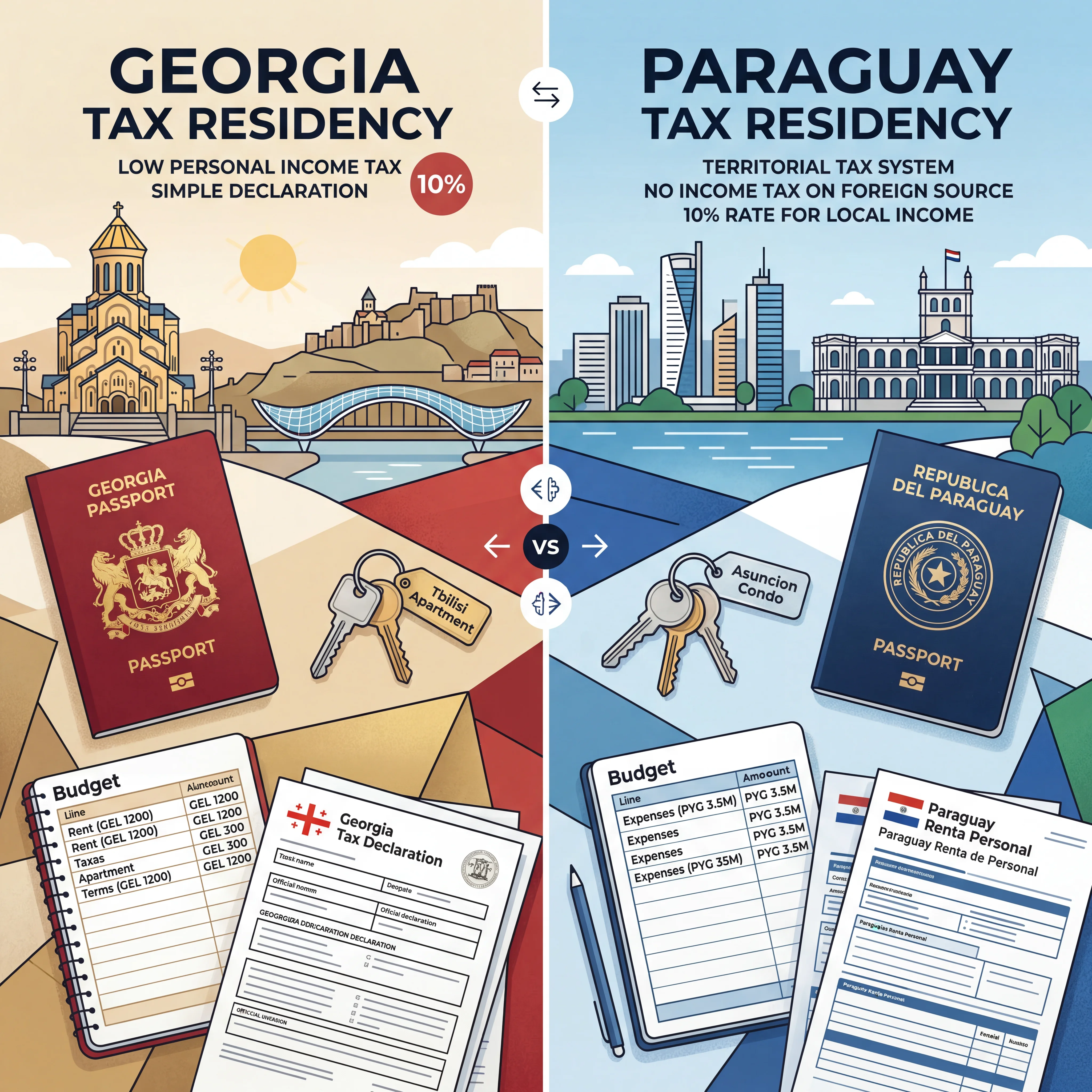
If you spend enough time around tax-residency content, you start seeing the same stale shortlist: Dubai, Panama, Portugal, maybe Malaysia if the speaker is feeling nostalgic. Georgia and Paraguay rarely get sold with the same polish. That is exactly why they matter. They are still two of the few places where a normal person can build a legitimate tax-residency base without wiring six figures into a visa product or committing to a big-city burn rate from day one.
The catch is that they are cheap in different ways. Georgia is cheap because the tax code's 183-day residence test is straightforward, and current English-language guidance from PwC Georgia still says resident individuals are exempt on income that does not have a Georgian source. Paraguay is cheap because the tax base is even more plainly territorial in current PwC Paraguay guidance, and the housing burn in cities like Encarnacion and Asuncion is still mild by international standards.
The phrase "sub-$500/month" needs one honest qualification before anything else. I am using it to mean the residency base: modest rent, utilities, internet, and the local admin burden annualized over a year. I am not claiming you will eat out, insure yourself, travel, and live like a Western expat on $500 total every month. The data does not support that. What the data does support is that both countries can still be run as low-cost tax bases if you pick the right city and do not confuse the capital with the whole country.
| Question | Georgia | Paraguay |
|---|---|---|
| Main tax-residence trigger | 183 days in any continuous 12-month period | More than 120 days in a year |
| Foreign-source income | Current guidance says resident individuals are exempt if the income is not Georgian-source | Current guidance says individuals are taxed on Paraguayan-source income |
| Local personal tax headline | 20% standard PIT, with 1%/3% small-business regime for eligible entrepreneurs | 8% to 10% PIT on personal-service income, 8% on capital gains |
| Cheap-city housing burn | Kutaisi rent and utilities: about $308 | Encarnacion rent and utilities: about $290 |
| Capital-city housing burn | Tbilisi rent and utilities: about $511 | Asuncion rent and utilities: about $348 |
| Main pain point | Source analysis and the line between foreign income and Georgian-source business | Migration paperwork and timing windows |
Georgia is the cheaper on-ramp. Paraguay is the cheaper steady-state base.
That is the frame I keep coming back to. If you want a tax residency you can reach fast and test cheaply, Georgia usually wins. If you want the cleaner territorial story once the paperwork is done, Paraguay usually does.
Georgia is the faster on-ramp if you can live with source rules
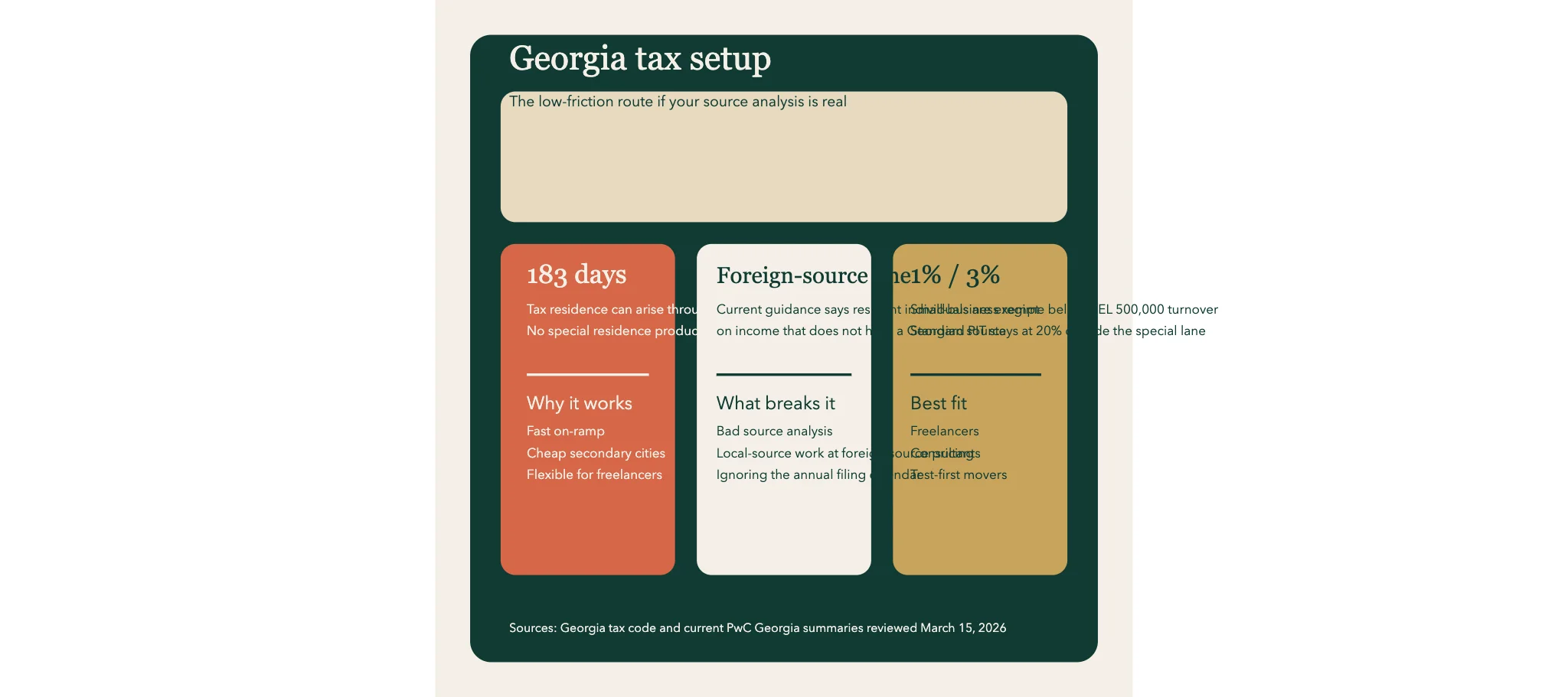
Georgia's appeal is not mysterious. The official Tax Code of Georgia sets the main individual residence test at 183 days in any continuous 12-month period. That is already easier to work with than the residence products many people obsess over elsewhere. You do not need a golden-visa brochure to understand it. You need a calendar.
The next part is what makes Georgia more interesting than a simple day-count jurisdiction. Current PwC guidance, last reviewed on January 21, 2026, says resident individuals are exempt from tax on income that does not have a Georgian source. The same page states the standard personal income tax rate at 20%, then lays out the special business regimes: micro business below GEL 30,000 with no employees, and the better-known small business regime at 1% on turnover below GEL 500,000, rising to 3% above that threshold.
That combination is why Georgia keeps showing up in real conversations between freelancers, solo consultants, and online operators. You have three practical lanes:
- Keep the income non-Georgian-source and stay in the resident exemption story.
- Use the small-business regime if the work is local enough to be Georgian-source but your activity fits the entrepreneur model.
- Accept the standard 20% rate if neither of the first two lanes fits cleanly.
The first lane is the one people like to romanticize, and it is also the one most likely to be abused in casual online advice. Georgia is not magic. If you physically perform the services in Georgia for Georgian clients, or the facts otherwise point to Georgian source, the 20% line matters. If you are an eligible entrepreneur and the business falls inside the regime, the small-business articles in the tax code matter. If you are neither, you are back in ordinary tax analysis. That is why I would call Georgia a clever jurisdiction, not a lazy one.
There is still routine admin. Current PwC tax-administration guidance says the tax year is the calendar year and individual returns for non-withheld income are due before 1 April of the following year. That is not heavy compliance, but it means Georgia works best for people who will keep proper records and not improvise later.
Where Georgia feels strongest is speed. You can become resident through presence alone. You do not need Paraguay-style category changes to get there. That is a real advantage if you want to test a low-cost base without turning the first year into an immigration project.
Paraguay is slower to set up, but cleaner on territorial tax
Paraguay wins a different argument. The current PwC residence summary, last reviewed on February 7, 2026, says an individual is tax resident if they spend more than 120 days in the country in a year. The current PwC personal-tax summary then says individuals are taxable on Paraguayan-source income. That is the part that makes Paraguay feel cleaner than Georgia. You are not leaning on a special entrepreneur regime to keep the rate low. You are starting from a territorial base.
Paraguay still taxes local income. The same PwC page lays out the current rate structure for personal-service income: 8% up to PYG 50 million, 9% from PYG 50,000,001 to PYG 150 million, and 10% above that. It also lists an 8% rate on capital gains. So the real Paraguay pitch is not "no tax." It is "local-source tax only, with moderate rates once you are inside the local-source bucket."
That is a better pitch than the internet usually gives it. Paraguay is not exciting. It is not trying to be. It is a low-drama territorial jurisdiction with still-reasonable city costs and a migration system that tells you, in plain language, what the sequence is.
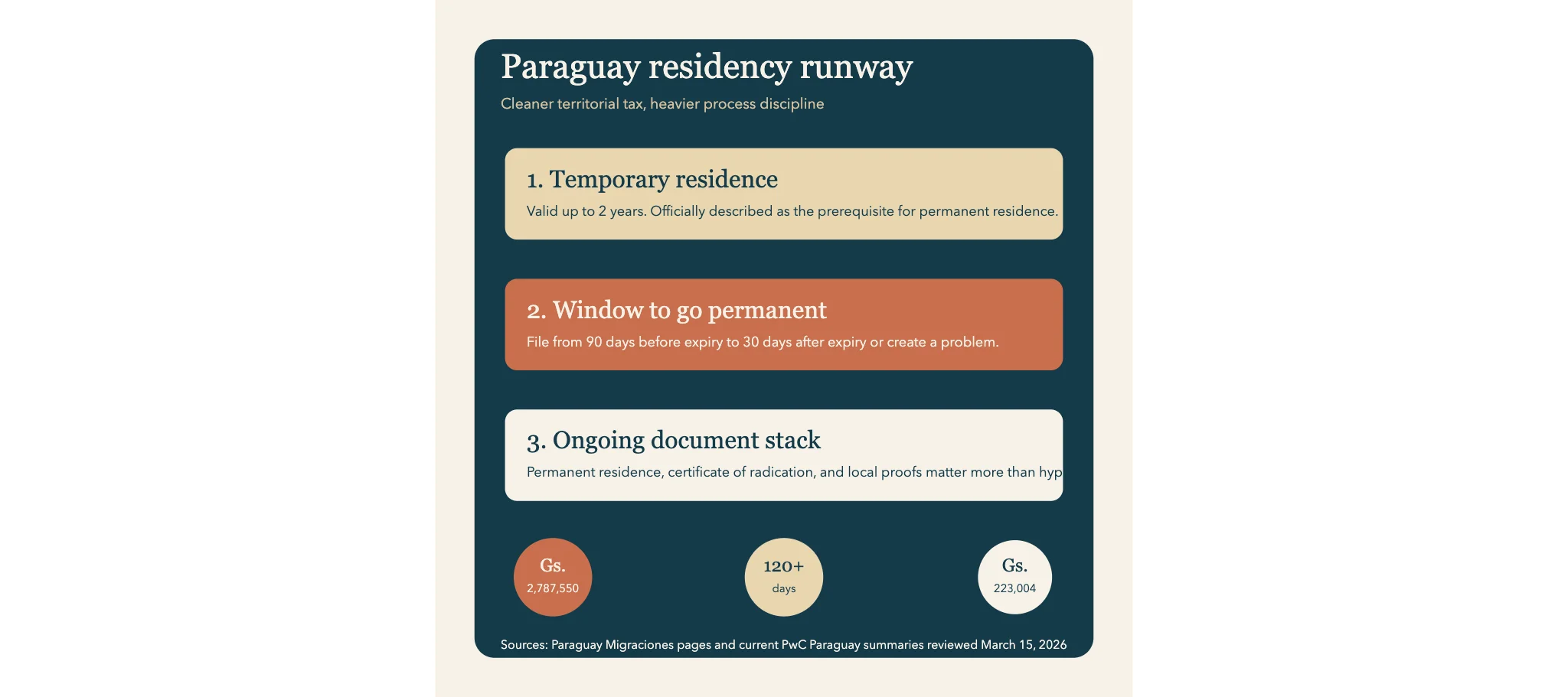
The official temporary-residence page says temporary residence under Law 6984/2022 is valid for up to two years and is the prerequisite for permanent residence. The permanent-residence page then lays out the current categories, including change-of-category, investor, MERCOSUR, and family tracks. On top of that, the October 13, 2025 Migraciones reminder says the move from temporary to permanent residence must be filed from 90 days before the temporary card expires to 30 days after. Miss that window and you create a problem for yourself.
That is the trade. Paraguay's tax story is cleaner, but the residency story is more procedural. You need to care about category, sequence, and deadlines in a way you usually do not with Georgia's pure day-count approach.
| Issue | Georgia | Paraguay |
|---|---|---|
| Core residence logic | Show up for 183 days | Show up for 120+ days and manage the migration path cleanly |
| Main tax trap | Misclassifying Georgian-source business as foreign-source | Assuming territorial tax means no paperwork or no local-source exposure |
| What needs active management | Source analysis and annual filing | Temporary-to-permanent timing and residence documents |
| What feels simpler after setup | Physical presence | Territorial tax story |
The sub-$500 claim only works if you define the base honestly
This is where most tax-residency content gets slippery. If someone says a country is a "$500/month base" without defining what is inside that number, they are usually selling mood, not facts.
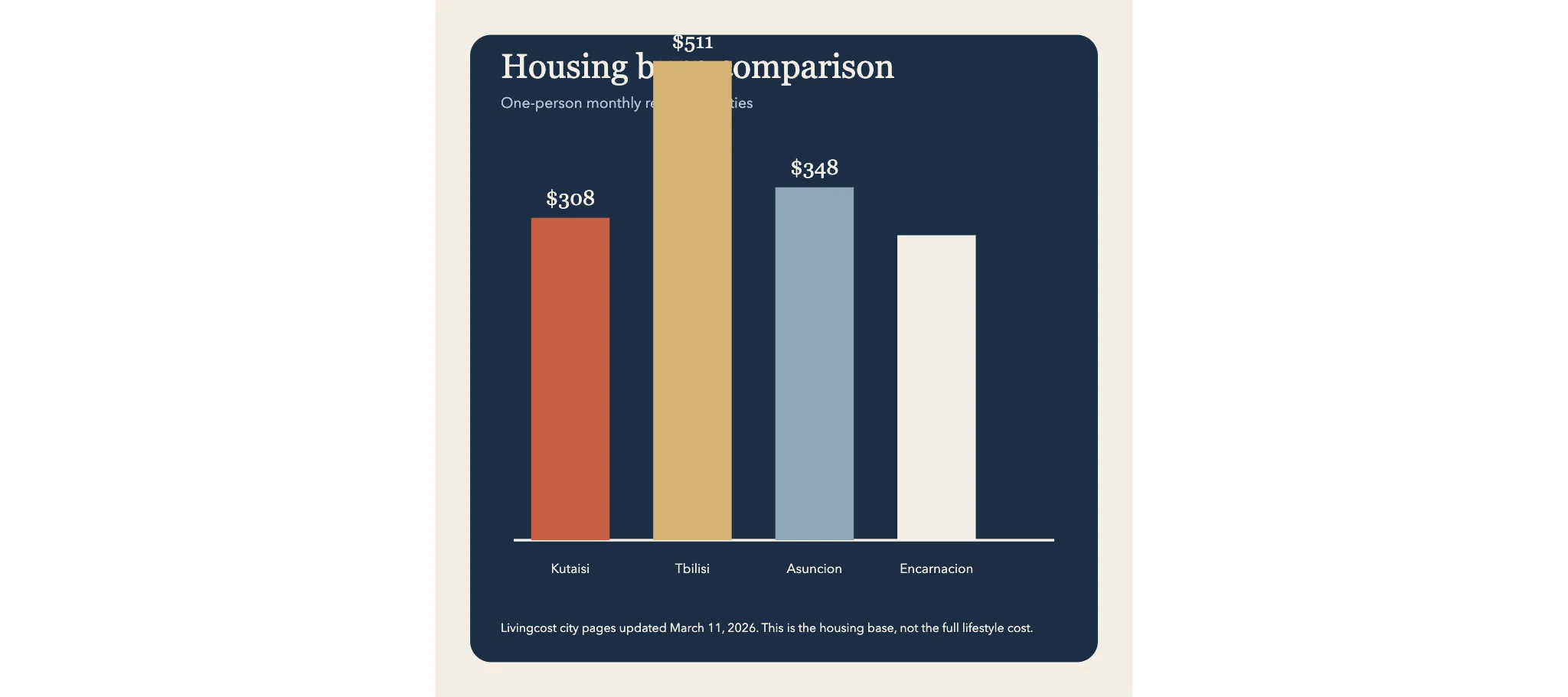
The current March 11, 2026 Livingcost Kutaisi page puts one-person rent and utilities at $308. The matching page for Tbilisi puts that line at $511. So Georgia only earns the headline if you treat the country as more than Tbilisi. That is not cheating. It is the whole point. Cheap tax residencies are usually won in secondary cities, not the district everyone posts on Instagram.
Paraguay is the easier case. The current Asuncion page puts one-person rent and utilities at $348, and Encarnacion is lower at $290. That means Paraguay can stay below the headline even in the capital on a housing-burn basis, while Georgia needs a cheaper city to do it cleanly.
Kutaisi Tbilisi Asuncion Encarnacion $308 $511 $348 $290 One-person monthly rent and utilities Source: Livingcost city pages updated March 11, 2026
There is a second honest point to make here. The full one-person monthly cost on those same pages is still $706 in Kutaisi, $1,028 in Tbilisi, $752 in Asuncion, and $619 in Encarnacion. So if you mean all-in lifestyle, none of these are truly sub-$500 in current city averages. If you mean residency base cost, Georgia and Paraguay still deserve to be in the conversation. That distinction matters, and I do not see enough people making it plainly.
| City | Rent and utilities | Total one-person monthly cost | What the number tells you |
|---|---|---|---|
| Kutaisi | $308 | $706 | Georgia works as a low-cost base outside the capital |
| Tbilisi | $511 | $1,028 | The capital already breaks the headline on housing alone |
| Asuncion | $348 | $752 | Paraguay's capital still clears the housing-burn test |
| Encarnacion | $290 | $619 | Paraguay gets even cheaper in secondary cities |
Paperwork, timing, and friction decide the real winner
This is the part the headline never captures. The tax rules only matter if the residency file around them is clean enough to survive scrutiny later.
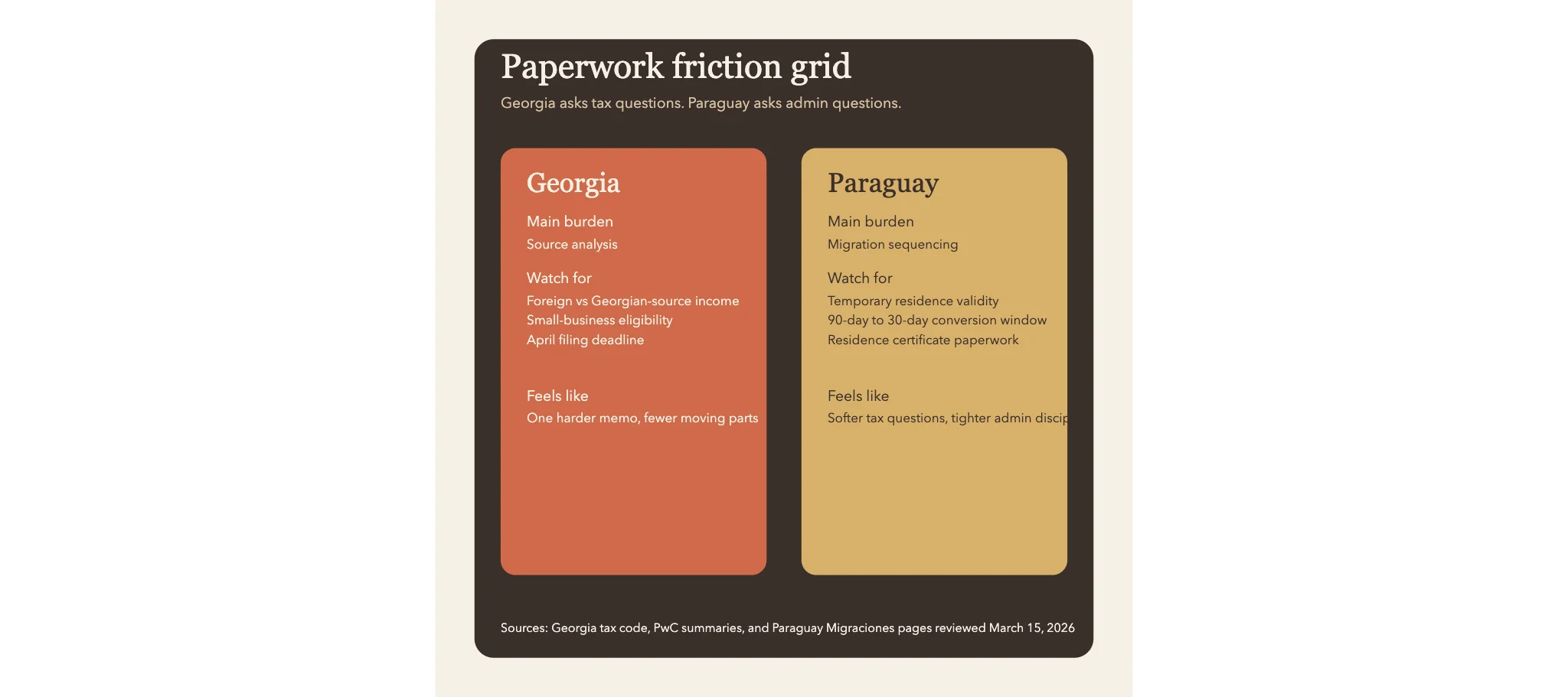
Georgia's friction is mostly analytical. You need to know whether your income is really foreign-source, whether your activity should be inside the small-business regime, and whether your filing position is consistent with how you actually work. That is subtle work, but it is front-loaded thinking, not months of state process.
Paraguay's friction is more bureaucratic. The official fee table shows both temporary and permanent residence at Gs. 2,787,550, with the certificate of radication at Gs. 223,004. Those are not big numbers by international migration standards. The real cost is attention. You need the right category, you need the documents, and you need to file the permanent-residence change in the window the authority spelled out.
Georgia asks harder tax questions. Paraguay asks harder administrative questions.
If you are organized, Paraguay is not frightening. If you are the kind of person who lets a residence card expire because you were "going to deal with it next month," Paraguay is the wrong jurisdiction. Georgia is more forgiving to that personality type because the core residence test is physical presence, not a category-switch timetable.
Which profile fits Georgia, and which profile fits Paraguay?
People usually ask which country is "better." That is the wrong question. The useful question is which country is less likely to break under your actual facts.
| Profile | Better fit | Why | Main warning |
|---|---|---|---|
| Freelancer who wants the fastest low-cost tax-residence on-ramp | Georgia | The 183-day route is simple, and the small-business regime can be very efficient if the facts fit | Do not assume every remote-income pattern is automatically non-Georgian-source |
| Investor or remote earner who wants a cleaner territorial story | Paraguay | Current guidance is more direct about taxing Paraguayan-source income | You still need to run the migration process properly |
| Person who wants capital-city life | Paraguay | Asuncion still clears the housing-burn test while Tbilisi does not | Capital-city cost is still above $500 all-in |
| Person happy to live in a secondary city | Tie | Kutaisi and Encarnacion both keep the base cheap | The lifestyle tradeoffs are very different |
| Someone who dislikes bureaucracy more than tax nuance | Georgia | The file is simpler if you can handle source analysis | Bad source analysis can cost more than a few forms ever would |
| Someone who wants the cleanest long-term territorial positioning | Paraguay | The tax story is easier to explain once residence is in place | Do not sleep through the category-change deadlines |
My own ranking is simple. If I wanted to test a cheap tax-residency base with minimum upfront friction, I would start with Georgia. If I wanted to settle into a low-cost territorial structure for the long run and I was willing to do the migration work properly, I would take Paraguay.
That is also where the rest of the site becomes useful. The Georgia profile, the Paraguay profile, the compare tool, and the calculator help once you stop reading article headlines and start modeling your actual case.

Bottom line
Georgia and Paraguay deserve this headline, but only if you read it precisely.
Georgia is one of the best sub-$500 residency-base options because you can become resident through a clean 183-day test, secondary cities like Kutaisi still keep the housing burn low, and the tax outcome can stay light if your income is genuinely non-Georgian-source or if you fit the small-business regime. The problem is not the sticker price. The problem is sloppy source analysis.
Paraguay is one of the best sub-$500 residency-base options because the territorial story is cleaner, Asuncion is still manageable on a housing basis, Encarnacion is cheaper still, and the migration fees are modest in absolute terms. The problem is not the tax code. The problem is paperwork, sequencing, and deadline discipline.
Disclaimer: This article is general information, not legal or tax advice. Source rules, local filings, and migration outcomes depend on the exact facts of your case.
Frequently Asked Questions
Does Georgia really exempt foreign-source income for residents?
Current English-language guidance from PwC says resident individuals are exempt on income that does not have a Georgian source. That does not remove the need to classify the income correctly. The fight is usually about source, not about the existence of the exemption.
Is Paraguay a no-tax country for residents?
No. Current guidance says individuals are taxed on Paraguayan-source income. Personal-service income is currently taxed at 8% to 10%, and capital gains at 8%.
Can I really live on $500 a month in these countries?
Not on a realistic all-in city budget, based on the March 2026 city-cost pages reviewed for this article. The sub-$500 claim works for the residency base, mainly rent, utilities, internet, and routine admin. It does not describe full lifestyle cost.
Which country is better if I want the simplest setup?
Georgia is usually simpler at the start because the residence story is mainly a day-count test. Paraguay is usually cleaner later if you want a more straightforward territorial tax story and you handle the migration process properly.
Which country is better if I want to live in the capital city?
Paraguay. The current Asuncion housing-burn numbers are still below the headline threshold, while Tbilisi's average rent-and-utilities line is already above it.
Sources Used in This Guide
- Tax Code of Georgia
- PwC Georgia: Individual Residence
- PwC Georgia: Taxes on Personal Income
- PwC Georgia: Tax Administration
- PwC Paraguay: Individual Residence
- PwC Paraguay: Taxes on Personal Income
- Paraguay Migraciones: Temporary Residence
- Paraguay Migraciones: Permanent Residence
- Paraguay Migraciones: Migration Fees
- Paraguay Migraciones: Certificate of Radication
- Paraguay Migraciones: Timing window for change to permanent residence
- Livingcost: Kutaisi
- Livingcost: Tbilisi
- Livingcost: Asuncion
- Livingcost: Encarnacion