
In This Guide
- Start with the inconvenient truth: CBI is not tax residency
- What the official price sheets say right now
- Vanuatu is still the cheapest, but it is no longer the cleanest passport
- St Kitts and Nevis is the credibility play, not the bargain play
- Antigua and Barbuda is the pragmatic family option
- Which one actually helps with tax planning?
- Bottom line
- Frequently Asked Questions
- Sources Used in This Guide
Start with the inconvenient truth: CBI is not tax residency
Vanuatu vs St Kitts vs Antigua sounds like a tax comparison, but the first job is to separate three things people constantly mash together: citizenship, immigration residence, and tax residence. A Caribbean or Pacific CBI passport can improve optionality. It can make it easier to enter countries, set up a second nationality, or reduce home-country political exposure. What it does not do by itself is give you a defensible tax-residency position.
The official pages are clear about investments, due diligence, and passport maintenance. They are not promising an off-the-shelf tax-residency certificate.
That matters because “tax planning” usually means one of four practical goals:
| Goal | What you actually need | Why a passport alone is not enough |
|---|---|---|
| Stop being taxed somewhere else | A valid exit plus non-residence facts | Your old country still looks at days, domicile, centre of interests, and source rules |
| Use treaty claims | Real tax residence somewhere | Treaties usually work through residence, not convenience citizenship |
| Pass bank KYC smoothly | A coherent life and tax story | Banks want substance, self-certification, and source-of-funds evidence |
| Travel while structuring a move | A passport that still travels well | Mobility problems can kill the practical value of the passport |
That last row is where the three programmes stop looking equal. Vanuatu is still materially cheaper on the official fee page than either Eastern Caribbean option. But as of 12 December 2024, the Council of the European Union says the EU ended Vanuatu’s visa exemption because of the risks posed by its investor-citizenship scheme. On the UK side, the Home Office’s visa requirements list, updated 5 March 2026, includes Vanuatu among nationalities that need a visa, while the UK’s ETA page still lists Antigua and Barbuda and St Kitts and Nevis as ETA-eligible.
That means the real question is not “Which passport is cheapest?” It is: Which passport still helps a tax plan survive contact with banks, counterparties, and border controls? On that narrower and more useful question, price is only one variable.
What the official price sheets say right now
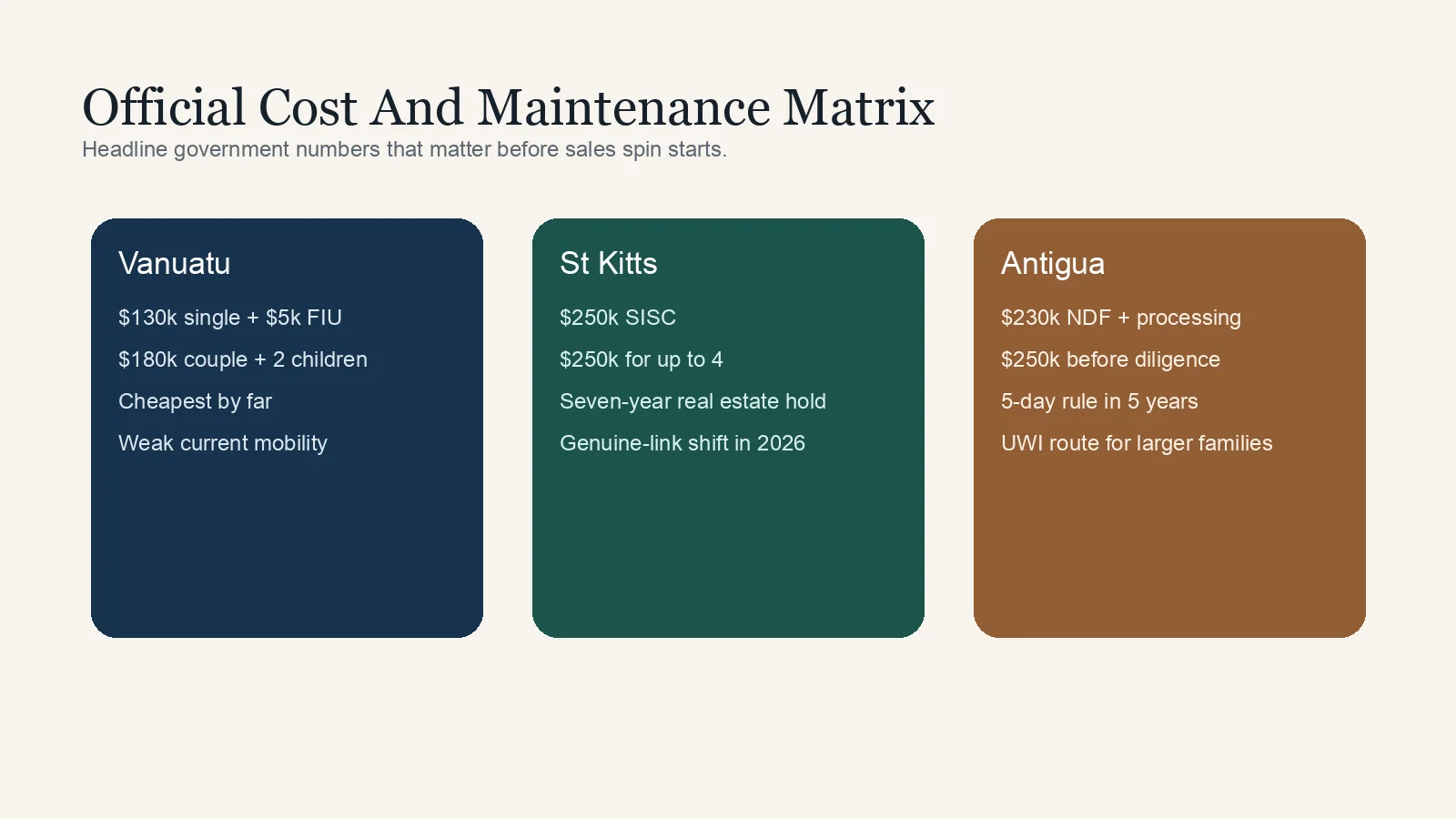
Vanuatu’s fees and charges page currently lists USD 130,000 for a single applicant, USD 150,000 for a married couple, USD 165,000 for a married couple plus one child, and USD 180,000 for a married couple plus two children, with a separate USD 5,000 FIU diligence fee. The same page also lists a Form D structure at USD 260,000 for an applicant, spouse, and one child under 18. The official site therefore still presents Vanuatu as the low-ticket entry point of the three.
Antigua’s numbers look cheap at first glance and then normalise once you include processing fees. The National Development Fund page says the contribution is USD 230,000 per application. But the same page and the schedule of fees show a USD 10,000 processing fee for a single applicant and USD 20,000 for a family of up to four, before due diligence and passport fees. So the true Antigua donation headline is effectively USD 240,000 for a single and USD 250,000 for up to four persons, before diligence and passports. The real-estate route sits at USD 300,000 with a five-year hold, while the UWI fund is USD 260,000 for a family of six or more.
St Kitts is no longer meaningfully cheaper or more expensive than Antigua on the contribution route. Its official FAQ page says the Sustainable Island State Contribution starts at USD 250,000 for a main applicant or a family of up to four persons. The same official page lists the Public Benefit Option starting at USD 250,000, developer real estate from USD 325,000, and private real estate at USD 325,000 for a condo/share or USD 600,000 for a single-family home. The official FAQ says the real-estate routes are generally resaleable after seven years.
| Programme | Cheapest official headline | Family-of-4 donation logic | Hold / maintenance rule highlighted on official site |
|---|---|---|---|
| Vanuatu | USD 130,000 single applicant + USD 5,000 FIU diligence | USD 180,000 for married couple + 2 children, plus diligence | No comparable physical-presence maintenance rule was obvious on the cited core pages |
| Antigua and Barbuda | USD 230,000 contribution + USD 10,000 processing for single | USD 230,000 + USD 20,000 processing for up to 4, before diligence | 5 days in Antigua and Barbuda during the first 5 calendar years after citizenship |
| St Kitts and Nevis | USD 250,000 SISC | USD 250,000 SISC for up to 4 persons, before other fees | FAQ still says no residence requirement to maintain citizenship |
The key pricing insight is simple: Antigua and St Kitts now live in basically the same donation band. Vanuatu is still the outlier on cost.
Vanuatu is still the cheapest, but it is no longer the cleanest passport
Vanuatu’s pitch is still clear on price. The official fee page undercuts the Eastern Caribbean programmes. And the types page shows the government still publicly recognises several investor-linked routes, including the Vanuatu Development Support Program, the Vanuatu Contribution Program, CIIP, and a real-estate option.
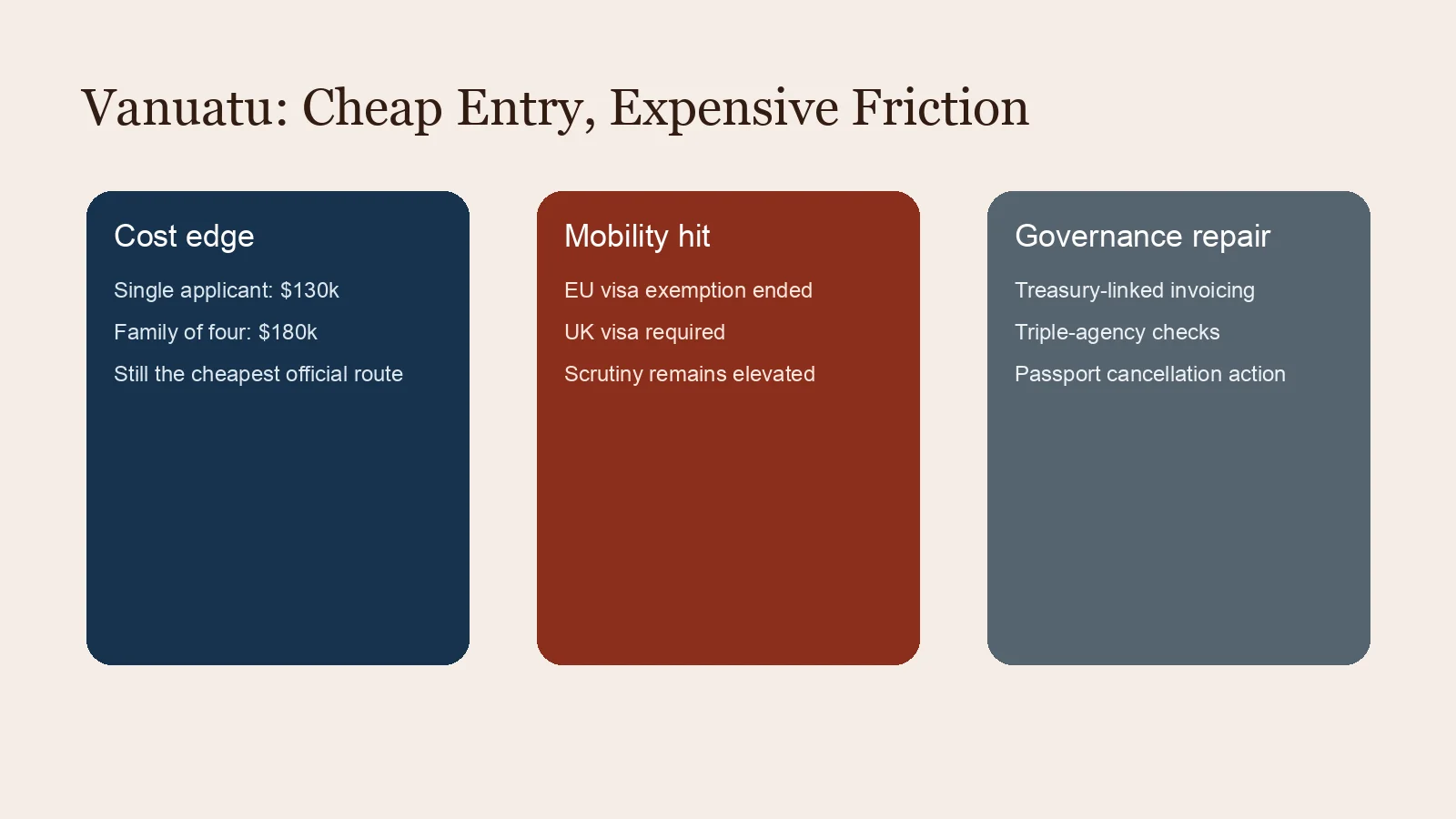
But tax planning is not a spreadsheet exercise. It is a credibility exercise. On that score, Vanuatu is now carrying the heaviest baggage of the three. The EU Council’s official press release dated 12 December 2024 says it removed Vanuatu from the visa-exempt list because the investor-citizenship scheme created security and migration risks for the Union. The UK’s visa-national guidance updated 5 March 2026 lists Vanuatu as needing a visa to enter or transit the UK. Those are not blog opinions. They are primary-source mobility downgrades.
The domestic official messaging also reads differently from the Eastern Caribbean material. On 10 March 2025, the Prime Minister’s Office published a release ordering cancellation of a passport and said Vanuatu had strengthened due diligence, including triple-agency checks and Interpol verification. On 18 March 2025, the PMO responded to reporting about a draft U.S. immigration watchlist. On 25 March 2025, it announced treasury-integrated invoicing and “enhanced compliance” to close loopholes in the citizenship-by-investment programme. Those are all good reforms. They are also signs of a programme still trying to repair external confidence.
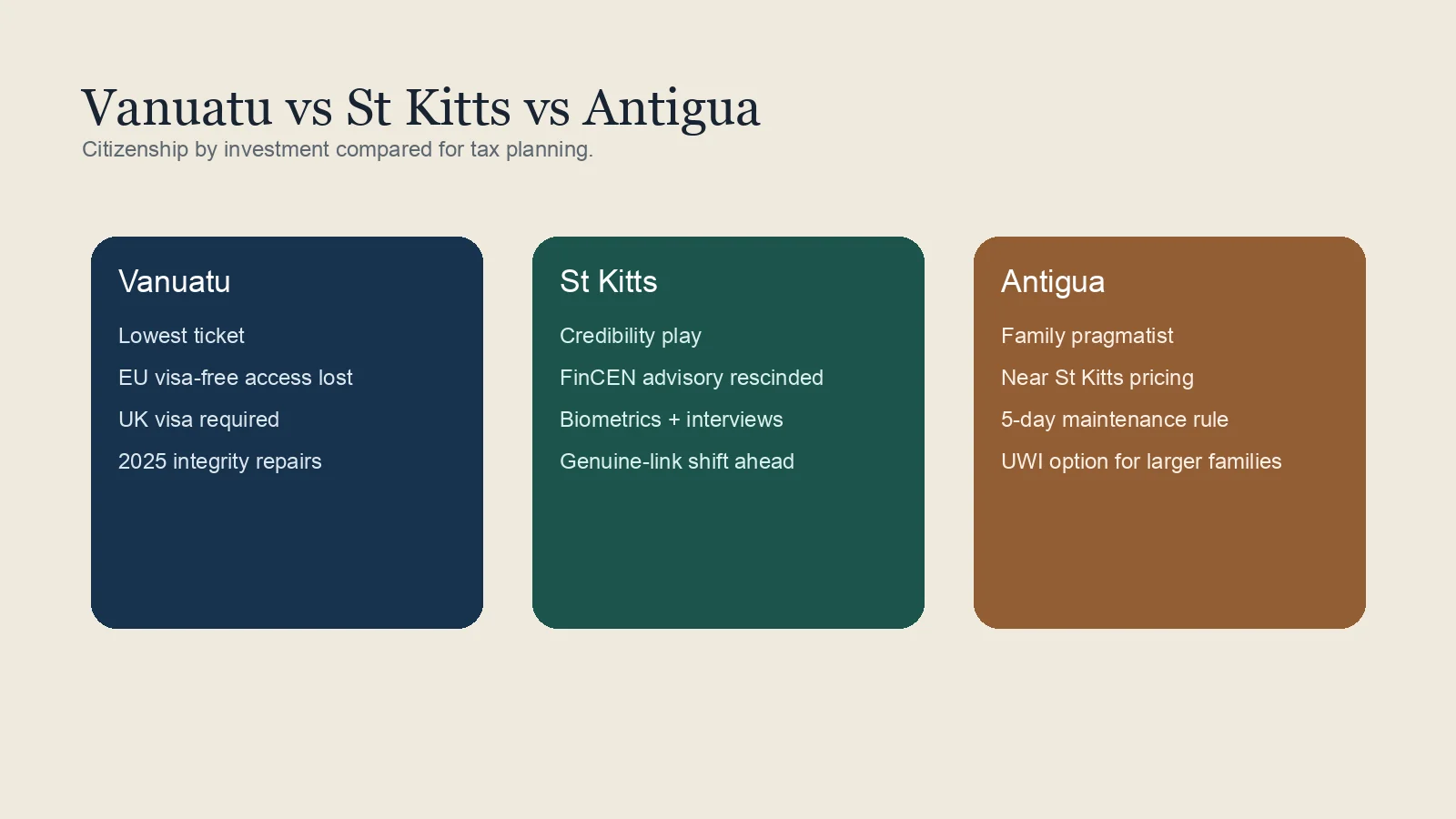
That creates a blunt tradeoff. If your use case is simply “I want the cheapest second citizenship and I do not care much about UK or EU short-stay mobility,” Vanuatu still has a market. If you want a passport that reads cleanly to banks, counterparties, and immigration desks, Vanuatu is the weakest of the three.
The tax angle is narrower than marketing often suggests. The official Vanuatu tax authority page I reviewed is focused on VAT at 15% and business thresholds, not a polished tax-residence story. My inference from the source set is that Vanuatu works better as a backup nationality than as a serious tax-planning anchor.
St Kitts and Nevis is the credibility play, not the bargain play
St Kitts is now selling something different from “cheap.” Its official about page leans into the programme’s 1984 start date, Board-of-Governors oversight, and a favourable tax regime with no income, inheritance, or wealth taxes. Its FAQ page repeats the no-personal-income-tax, no-wealth-tax, no-inheritance-tax message and still says there is no residence requirement to maintain citizenship.
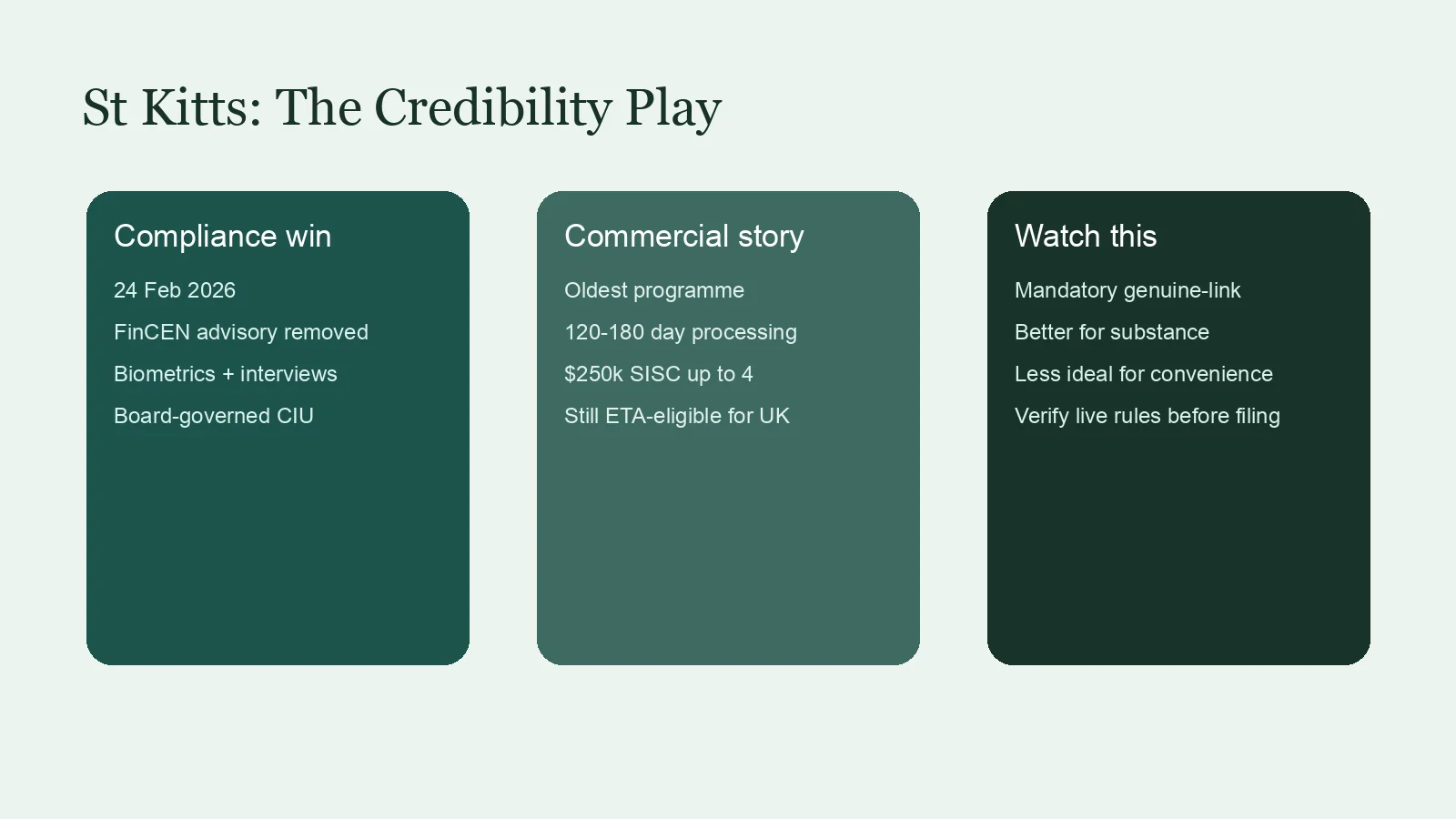
On raw cost, St Kitts no longer beats Antigua. On programme signalling, though, it has arguably moved into first place among these three. The biggest official development is the Citizenship Unit’s 27 February 2026 release confirming that FinCEN rescinded its advisory on 24 February 2026. That release does not just celebrate the rescission. It lists the reforms St Kitts says it implemented: mandatory applicant interviews, biometric identity verification, enhanced governance under a statutory body, stronger inter-agency cooperation, and wider due-diligence upgrades.
That is the kind of official compliance narrative banks and advisers prefer to see. This next point is an inference from the sources, but a reasonable one: among these three, St Kitts currently has the strongest public case for being the “most bankable” CBI passport. Not because it is the oldest programme in the Caribbean. Because as of February 2026 it is explicitly telling the market that it has upgraded oversight, biometric checks, mandatory interviews, and international compliance cooperation.
There is one catch, and it is not small. That same February 2026 CIU release says that in 2026 the programme will be redesigned to introduce a mandatory genuine-link requirement, including structured physical presence or residency, meaningful economic activity, productive investment, and longer-term engagement. If that change is fully implemented, St Kitts becomes better for people who want substance and worse for people who just want a pure convenience passport.
So the right way to read St Kitts in March 2026 is this:
| What St Kitts does well | What you need to watch |
|---|---|
| Officially stronger compliance narrative than the other two | The genuine-link requirement announced on 27 February 2026 may materially change the “hands-off” value proposition |
| Donation route now clean and simple at USD 250,000 for up to 4 people | It is no longer a bargain relative to Antigua |
| Still on the UK ETA list as of 5 March 2026 | You should verify live rules before filing because 2026 reform language is forward-looking and important |
If your version of tax planning includes long-term KYC hygiene, lower reputational friction, and the option of building genuine economic substance later, St Kitts is the strongest of the three. If your version of tax planning means “I want the fastest, cheapest passport with the fewest future obligations,” the programme is moving in the opposite direction.
Antigua and Barbuda is the pragmatic family option
Antigua sits in the middle. It does not have Vanuatu’s price edge. It does not have St Kitts’ February 2026 “we fixed the governance problem” moment. What it does have is a clean official family proposition and a more practical maintenance burden than most people expect.
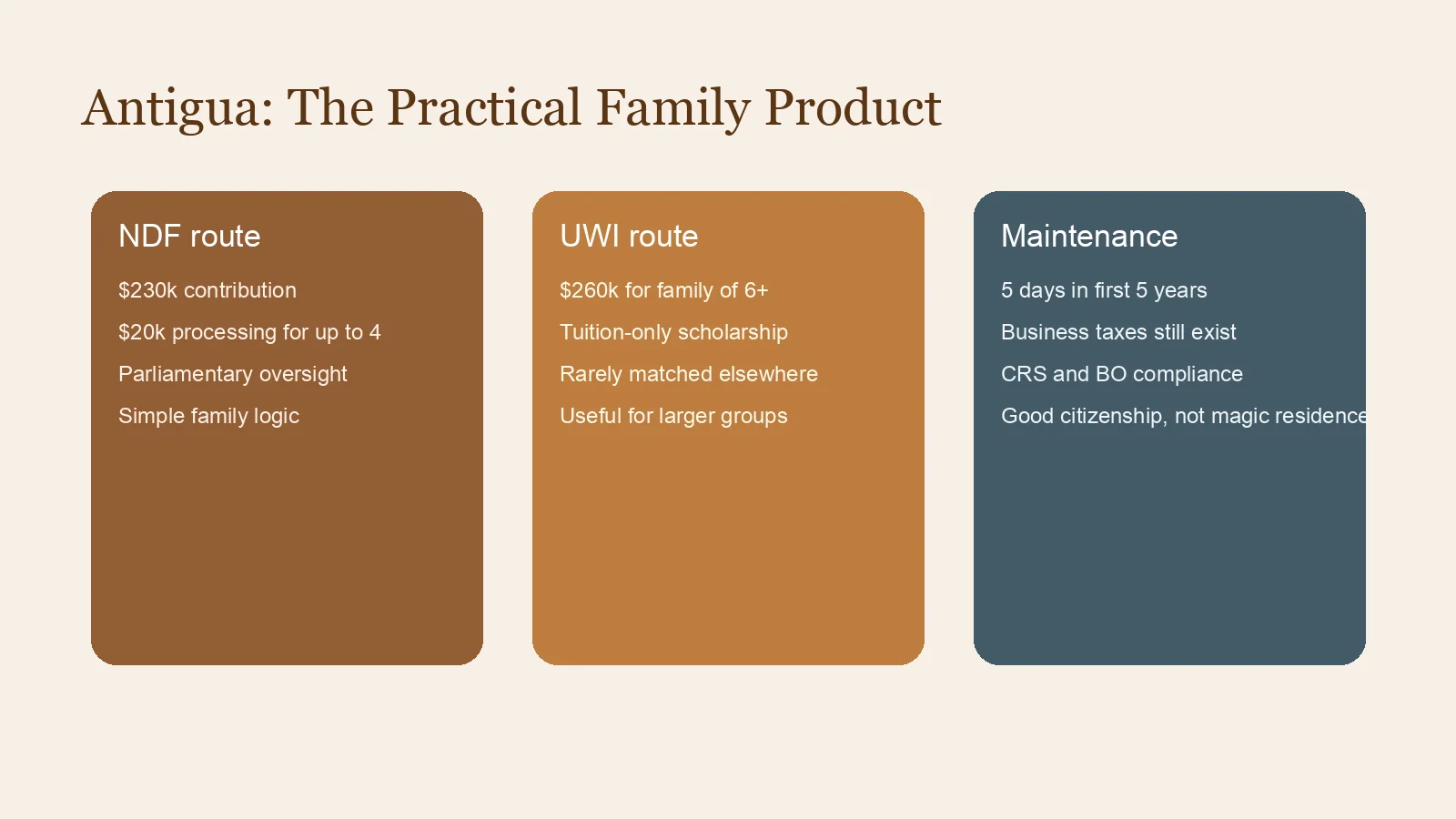
Start with the official numbers. Antigua’s NDF page says the fund is under parliamentary oversight and requires a minimum contribution of USD 230,000 per application. Once you add the official processing fees, the NDF route is effectively USD 250,000 for a family of up to four before due diligence and passports. That puts Antigua almost exactly beside St Kitts on price. For larger families, the UWI option is still one of the most distinctive structures in the CBI market because it works at USD 260,000 for a family of six or more and includes a one-year tuition-only scholarship for one family member.
Antigua’s main maintenance rule is also clear and manageable. The official citizenship page says citizenship can be deprived if the citizen does not spend at least 5 days in Antigua and Barbuda during the first five calendar years after obtaining citizenship. That is not a tax-residence rule. It is a passport-maintenance rule. But it is also not an onerous one.
The tax story needs more precision. Antigua’s official CIU brochure dated 17 September 2024 markets the jurisdiction as having no tax on worldwide income, inheritance, capital gains or investment returns. But it should be read alongside the Inland Revenue Department’s own pages, which visibly administer unincorporated business tax, corporation tax, and a broad CRS / beneficial ownership compliance framework. In plain English: Antigua may be a good place to hold citizenship or potentially structure a low-tax personal life, but it is not a magical place where all economic activity disappears from view.
That is why Antigua makes the most sense for three profiles:
| Profile | Why Antigua fits | Main warning |
|---|---|---|
| Family buyer | The NDF and UWI structures are unusually family-friendly | Do not ignore due-diligence and passport fees when comparing price |
| Investor living on external capital income | The official CIU material markets Antigua as tax-light on worldwide income and investment returns | That is not the same as a confirmed tax-residence certificate strategy |
| Person who wants a maintainable second passport | The 5-day-in-5-years rule is easy to satisfy | Easy passport maintenance still does not create treaty substance |
My inference from the official source set is that Antigua is the most pragmatic consumer product of the three. It is not the cheapest. It is not the most compliance-theatrical. It is the one that most cleanly says: here are the routes, here is the family logic, here are the fees, here is the maintenance rule.
Which one actually helps with tax planning?
If by “tax planning” you mean real residence planning, treaty claims, and long-term bankability, citizenship by investment is only a supporting tool. You still need a place you actually live in, file from, or can defend under local law. None of the three programmes, standing alone, solves that problem.
If by “tax planning” you mean second-passport optionality while you build a broader non-residence or relocation strategy, then the ranking is clearer:
| Use case | Best fit | Why |
|---|---|---|
| I want the lowest official entry cost | Vanuatu | Its official fee page is still materially below Antigua and St Kitts |
| I want the strongest official compliance story | St Kitts and Nevis | FinCEN rescission, biometrics, interviews, statutory governance and a more mature reform narrative |
| I want the most practical family purchase | Antigua and Barbuda | NDF and UWI routes are straightforward, and the five-day maintenance rule is modest |
| I want the best travel utility of these three on the current source set | St Kitts or Antigua | Both remain on the UK's ETA list, while Vanuatu has lost EU visa exemption and needs a UK visa |
| I want a passport that can support a substance-based long game | St Kitts and Nevis | The announced genuine-link direction makes it more defensible if you actually intend to build ties |
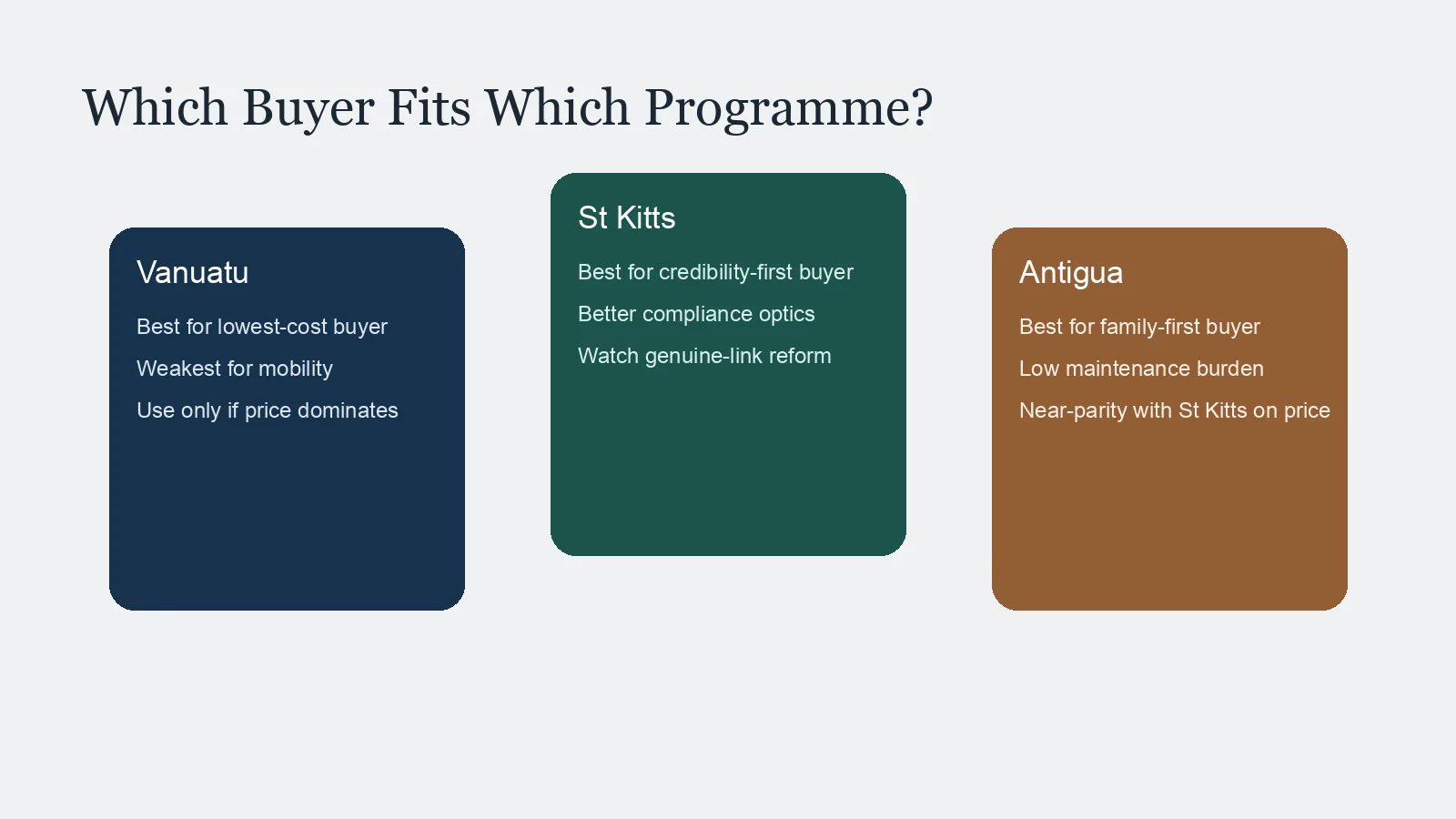
The harsh but useful conclusion is that Vanuatu is the price play, St Kitts is the credibility play, and Antigua is the family play. Which one is “best” depends on which of those three words matters most to you.
Inference from sources: if the plan involves future treaty residence, serious bank onboarding, or explaining why you are not tax resident elsewhere, St Kitts looks strongest, Antigua looks workable, and Vanuatu looks weakest.
Bottom line
Vanuatu is still the lowest official ticket, but the programme now comes with the largest mobility and credibility discount. For pure tax planning, that is usually a bad trade unless your real objective is just cheap second nationality.
St Kitts and Nevis is no longer the bargain option. It is the option with the best current official compliance narrative. If you want the cleanest programme story and can live with the possibility of a genuine-link requirement becoming real in 2026, it is the strongest of the three.
Antigua and Barbuda is the sensible middle ground. Its maintenance burden is low. But it is still citizenship, not turnkey tax residence.
Disclaimer: This article is for general information only. Tax residence, exit tax exposure, treaty entitlement, CRS self-certification, and banking outcomes depend on your exact facts. Get jurisdiction-specific legal and tax advice before filing any CBI application.
Frequently Asked Questions
Does buying one of these passports make me tax resident there?
No. None of the official programme pages I reviewed says citizenship by investment automatically creates tax residence. Citizenship can support optionality. It does not replace residence facts, filings, or treaty tests.
Which one is currently cheapest on official government pages?
Vanuatu. Its official fee page still lists USD 130,000 for a single applicant and USD 180,000 for a married couple with two children, plus the FIU diligence fee. Antigua and St Kitts are now much closer to each other than to Vanuatu.
Which passport is currently strongest for travel utility?
On the official sources reviewed, Antigua and St Kitts are clearly stronger than Vanuatu. The UK ETA page updated on 5 March 2026 includes Antigua and Barbuda and St Kitts and Nevis. The UK visa list updated the same day includes Vanuatu, and the EU ended Vanuatu’s visa exemption on 12 December 2024.
Is St Kitts still a pure no-strings-attached passport?
Not necessarily. The public FAQ still says there is no residence requirement to maintain citizenship, but the CIU’s 27 February 2026 FinCEN rescission release says a mandatory genuine-link requirement will be introduced in 2026. Anyone applying should verify the live rules before filing.
Why might Antigua be better than St Kitts for some families?
Because Antigua’s NDF route is effectively in the same price band for a family of four, its five-day maintenance rule is modest, and the UWI option is unusually attractive for larger families. If you do not specifically need St Kitts’ stronger compliance signalling, Antigua can be the more practical buy.
Sources Used in This Guide
- Vanuatu Citizenship Office: Fees and Charges
- Vanuatu Citizenship Office: Types of Citizenship
- Vanuatu PMO: Enhanced financial integration for all citizenship applications
- Vanuatu PMO: Prime Minister orders cancellation of passport
- Vanuatu PMO: Govt responds to US immigration watchlist report
- Vanuatu Customs and Inland Revenue: VAT
- Council of the EU: Vanuatu: Council ends visa exemption
- GOV.UK: Check if you can get an ETA
- GOV.UK: UK visa requirements (accessible version)
- Antigua and Barbuda CIP: Citizenship
- Antigua and Barbuda CIP: NDF
- Antigua and Barbuda CIP: Real Estate
- Antigua and Barbuda CIP: UWI Fund
- Antigua and Barbuda CIP: Schedule of Fees
- Antigua and Barbuda CIP: Official brochure dated 17 September 2024
- Antigua and Barbuda IRD: UBT Tax Bracket
- Antigua and Barbuda IRD: Corporation Tax
- Antigua and Barbuda IRD: FATCA, CRS, EOI
- St Kitts and Nevis CIU: Citizenship by Investment FAQs
- St Kitts and Nevis CIU: Application Process
- St Kitts and Nevis CIU: About
- St Kitts and Nevis CIU: Rescission of FinCEN Advisory