

In This Guide
- The decision starts with the work, not the invoice
- Employer of record vs contractor vs subsidiary at a glance
- When contractor status can survive scrutiny
- What an EOR solves, and what it does not
- When a local subsidiary becomes the cleaner answer
- Compare total cost across the same risk categories
- Use a staged decision and transition framework
- Frequently asked questions
- Sources used in this guide
The decision starts with the work, not the invoice
Choosing an employer of record vs contractor arrangement is not primarily a vendor or payroll decision. It begins with the job you expect the person to do. A specialist hired for a defined result, free to choose the method and able to serve other clients may be operating an independent business. A person working indefinitely inside your team, under a manager's direction and using your systems looks more like an employee. Calling the second person a contractor does not settle the issue.
Regulators do not apply one global test. The U.S. Internal Revenue Service considers behavioral control, financial control and the parties' relationship. Canada's tax authority examines intent alongside the actual terms and conditions. New Zealand now has a statutory gateway for specified contractors, followed by common-law tests where the gateway is not met. Australia currently places particular weight on the legal rights and obligations created by the whole contract, while rejecting the parties' chosen label as determinative. These are related ideas, not interchangeable rules. See the current guidance from the IRS, Canada Revenue Agency, Employment New Zealand and Australian Taxation Office.
A contract is evidence. It is not a permission slip to run an employee relationship through contractor invoices. The weight given to written rights, actual conduct and economic dependence varies by country.
This guide provides general information current to July 23, 2026. It is not tax, legal, employment, immigration or accounting advice. Have advisers in the worker's country and the hiring company's country review the facts before onboarding or changing a model.
Employer of record vs contractor vs subsidiary at a glance
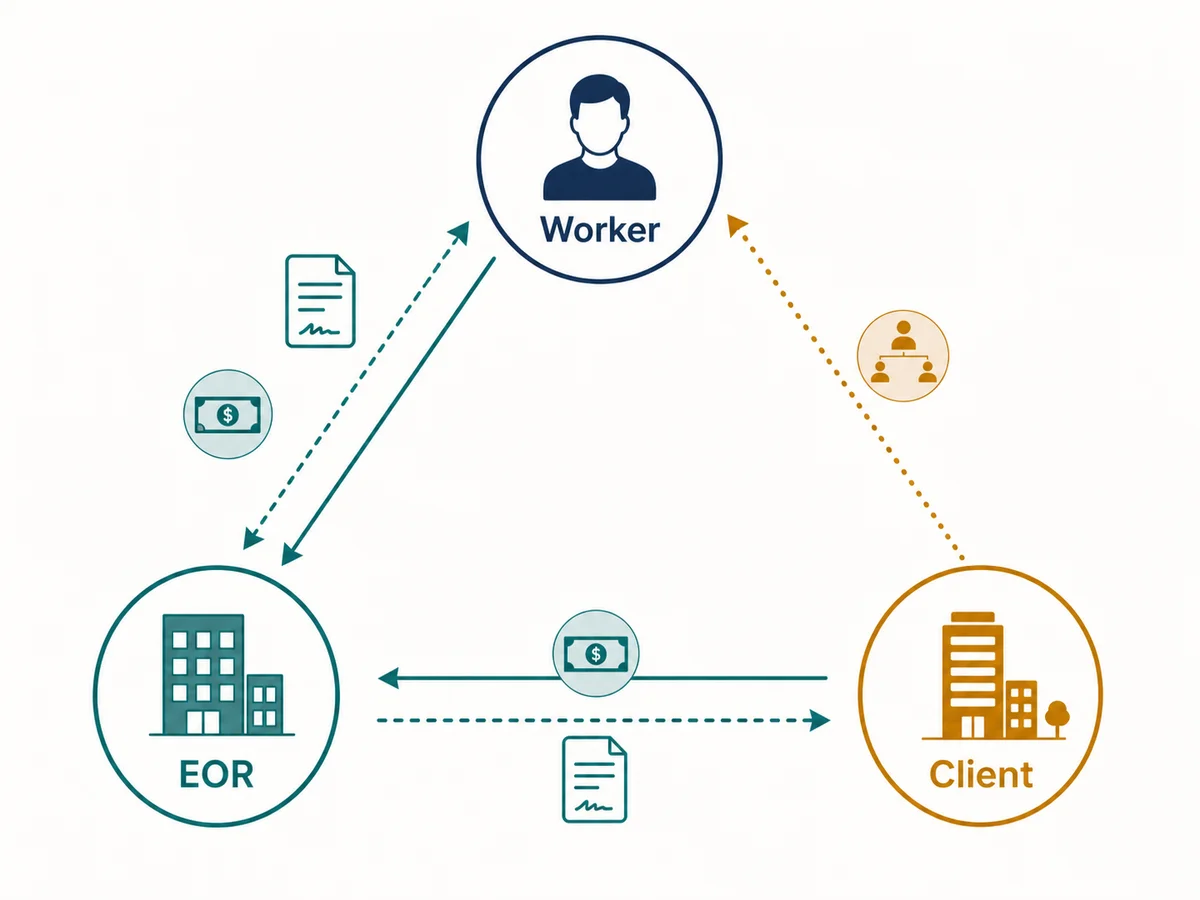
A contractor sells services as an independent business. Under an EOR arrangement, a local provider employs the worker and assigns the worker's services to the client. A local subsidiary employs the worker within a company the client group owns or controls.
| Decision point | Independent contractor | EOR employee | Subsidiary employee |
|---|---|---|---|
| Best fit | Independent, outcome-based service | Employee relationship before a local operation is justified | Durable local team or business operation |
| Day-to-day control | Contractor controls method, subject to deliverables | Client usually directs work; EOR is contractual employer | Local company directs and employs |
| Payroll and withholding | Contractor generally handles own business taxes, subject to local exceptions | EOR runs local payroll and employer filings | Subsidiary runs or outsources payroll and filings |
| Statutory employment rights | Usually not employee benefits, if status is valid | Apply under local employment law | Apply under local employment law |
| Invoice and indirect tax | Service invoice may involve VAT, GST or sales-tax analysis | EOR invoices the client; payroll remains employment compensation | Intercompany funding and local expenses need tax and accounting treatment |
| Corporate footprint | Low setup, but PE and registration risk can remain | No client subsidiary, but PE and other client obligations can remain | Intentional local corporate and tax presence |
Before buying EOR services, ask whether the foreign company can register directly as an employer without forming a subsidiary. In the EU, official guidance states that an employer hiring in another member country needs local employer and employee registration, with procedures set by each country. That route is an employee model, not contractor status, and it can be cheaper than an EOR in some countries. It also leaves the company responsible for local payroll administration and employment compliance. The EU employer-registration guidance illustrates why this option belongs in the country memo.
When contractor status can survive scrutiny
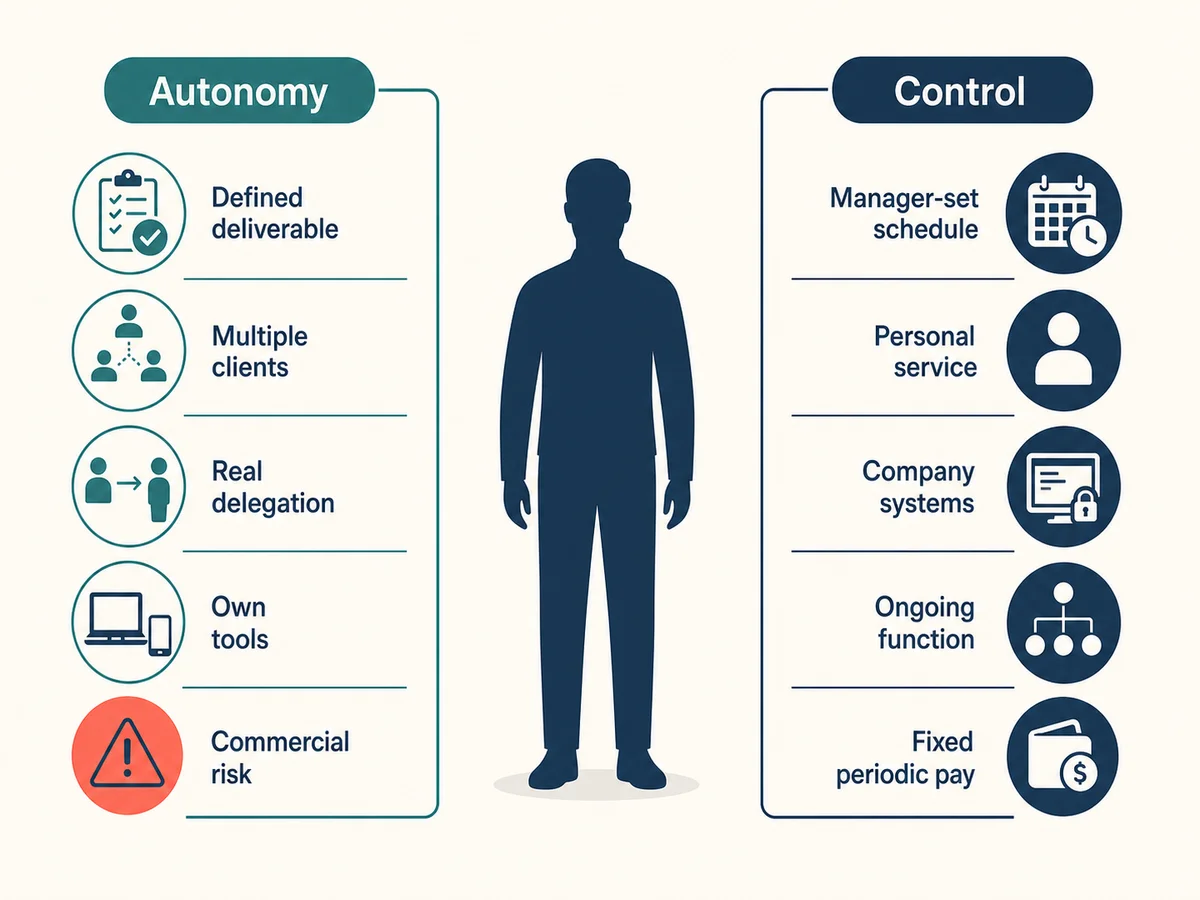
A defensible contractor engagement is built around an independent business, not an employee-shaped role with fewer protections. The exact test is local, but the following facts deserve attention before anyone drafts the agreement.
| Fact | More consistent with contracting | More consistent with employment |
|---|---|---|
| Scope | Defined deliverable, project or result | Open-ended responsibility for a function |
| Control | Provider chooses method, sequence and working time | Manager sets hours, methods and routine priorities |
| Personal service | Real right to delegate or use qualified substitutes | Named person must perform the work |
| Commercial risk | Provider prices work, corrects defects and bears expenses | Regular pay with little risk beyond continued employment |
| Market presence | Multiple clients, own branding, tools and insurance | Integrated title, company email and exclusive availability |
The ILO describes disguised employment as an arrangement whose appearance differs from its underlying reality, weakening worker protection. Its Employment Relationship Recommendation No. 198 calls for clear national methods that use relevant facts. U.S. labor guidance likewise says a title, an agreement or a particular tax form does not decide status under the federal economic-realities analysis. The governing test may differ for tax, wage law, benefits and unemployment insurance even within one country.
Contractor status also changes the payment workflow. The contractor may need local business registration, tax invoices and VAT or GST registration. The customer may need to apply a reverse charge, withholding or reporting rule. Under the EU's general place-of-supply framework, B2B services are usually taxed where the business customer is established, but exceptions and evidence requirements apply. Review the European Commission's place-of-taxation guidance and invoice requirements as representative rules, not a worldwide answer.
Write the contract to match the intended relationship. Cover deliverables, acceptance, substitution where genuine, fees, expenses, tax responsibility, insurance, confidentiality, data handling and termination. Deal with intellectual property directly. UK guidance, for example, says an employer is generally first owner of copyright created by an employee in the course of employment, while a freelancer usually retains copyright unless the parties agree otherwise in writing. Other countries use different defaults, so an express assignment or licence, treatment of prior IP and moral-rights language need local review. The UK Intellectual Property Office guidance is a warning against assuming that payment transfers ownership.
What an EOR solves, and what it does not
An EOR can put an employee on compliant local payroll without asking the client to incorporate immediately. The EOR normally signs the employment agreement, calculates withholding and employer contributions, administers statutory leave and issues local payroll records. The client selects the person, funds the employment cost and directs day-to-day work under a services agreement with the EOR.
That split is why an EOR needs more diligence than a payroll software purchase. "Employer of record" is a commercial description, not a passport valid under every labor code. A country may analyze the service as temporary agency work, labor leasing, personnel supply, a professional employer arrangement or direct employment by the client. Licensing, equal-treatment duties, permitted roles, assignment duration, collective agreements or restrictions on replacing permanent staff may apply. EU agency-work rules, for example, describe a three-party structure and generally require equal treatment on basic working and employment conditions, subject to national implementation. Read the EUR-Lex agency-work summary before assuming that a provider's standard contract covers the host-country rule.
Co-employment language needs the same care. In the United States, the IRS describes several third-party payer and professional employer organization arrangements, and certified PEO status produces specified federal employment-tax consequences. It is not a global EOR licence and does not decide every wage, benefits, immigration or employment-law duty. The IRS PEO guidance and CPEO customer guidance show how narrow a provider credential can be. Elsewhere, a client that controls work may still carry duties as a host, user undertaking, joint employer or actual employer under the law being applied.
An EOR also does not guarantee that the client has avoided permanent establishment, corporate registration, immigration or regulated-activity exposure. The OECD's updated Model Tax Convention commentary treats cross-border home-office PE as fact-dependent. Working from a home abroad for less than half of total working time generally would not, on its own, create a place of business under that commentary; more intensive use still requires a commercial-reason analysis. Treat this as treaty-model guidance, not a domestic safe harbor. The applicable treaty and local practice control. Our separate guide explains permanent-establishment risk for remote teams in detail.
Ask an EOR candidate for the legal employing entity, licence or registration basis, payroll-tax accounts, worker-benefit schedule, insurance, subcontractors, service locations, data-transfer map, termination funding and indemnity limits. Confirm who handles employee claims, government audits, workplace safety, expenses, equity compensation and immigration. If the provider will process payroll or HR records across borders, identify whether each party is a controller or processor and check transfer mechanisms. The UK ICO's international-transfer guide and processor-contract checklist provide a useful diligence pattern.
When a local subsidiary becomes the cleaner answer
A subsidiary is usually the heavier setup and the clearest operating model. The local company becomes the employer, contracts with suppliers and may contract with customers. Payroll, benefits, terminations and employee records sit within the entity the group controls. That can remove the artificial split between a provider's employment contract and the client's daily management.
The price is continuing administration: incorporation, beneficial-owner filings, capital or director requirements where applicable, a bank account, bookkeeping, corporate tax returns, statutory accounts, payroll, insurance and local governance. Regulated activities may need permits before trading. The EU's company registration and licensing guidance points businesses back to country-specific registers and points of single contact, which is the correct level of analysis.

A subsidiary becomes easier to justify when the country is part of the operating plan rather than a temporary talent location. Signals include several core employees under common management, a local executive with contracting authority, customer revenue, regulated work, premises, stock, local grants or a need to sponsor workers directly. None is a universal headcount or month threshold. A single senior commercial hire can create more tax and agency risk than a larger technical team with no authority, while one short project may still require employee treatment.
Plan the EOR-to-entity move before the first EOR hire if local growth is plausible. Check whether continuity of service, accrued leave, notice, severance, probation, benefits or employee-consent rules carry across. An administrative termination and rehire may create avoidable cost or break continuity. Contract for usable payroll data, employment records and cooperation at exit.
Compare total cost across the same risk categories
Comparing an hourly contractor rate with an EOR invoice or gross employee salary produces a false bargain. Build a country-specific cost sheet over the expected life of the relationship and use the same categories for all three models.
| Cost category | Contractor | EOR | Subsidiary |
|---|---|---|---|
| Cash compensation | Service fee, expenses and price increases | Salary, bonus and reimbursed expenses | Salary, bonus and reimbursed expenses |
| Employment on-cost | Possible deemed payroll, benefits or social contributions if rules apply | Employer contributions, statutory benefits and provider fee | Employer contributions and statutory benefits |
| Tax administration | Withholding, reporting, VAT/GST and invoice review | EOR invoice tax, payroll funding and residual client tax review | Payroll, corporate tax, transfer pricing and statutory accounts |
| Risk and change | Classification audit, back pay, IP cleanup and conversion | Deposits, termination funding, provider failure and transfer to entity | Setup, governance, audit, restructuring and wind-down |
| Internal effort | Contractor vetting and periodic status review | Vendor oversight and split-responsibility case management | Finance, legal, HR and local director time |

Include downside scenarios rather than assigning them a zero value. What would a reclassification assessment cover? Who funds unused leave and statutory severance? Can the EOR raise its fee or demand a payroll reserve? How much does an entity cost to maintain in a quiet year and to liquidate? A range with documented assumptions is more useful than a single global cost percentage.
Social security deserves its own line. In the EU coordination system, a person is generally subject to one country's legislation at a time, but postings, frontier work and work in several countries have separate rules. An employer may need an A1 or local registration; an invoice does not answer the question. Start with the European Commission's applicable-legislation guidance and the posted-worker checklist, then verify the worker's exact pattern.
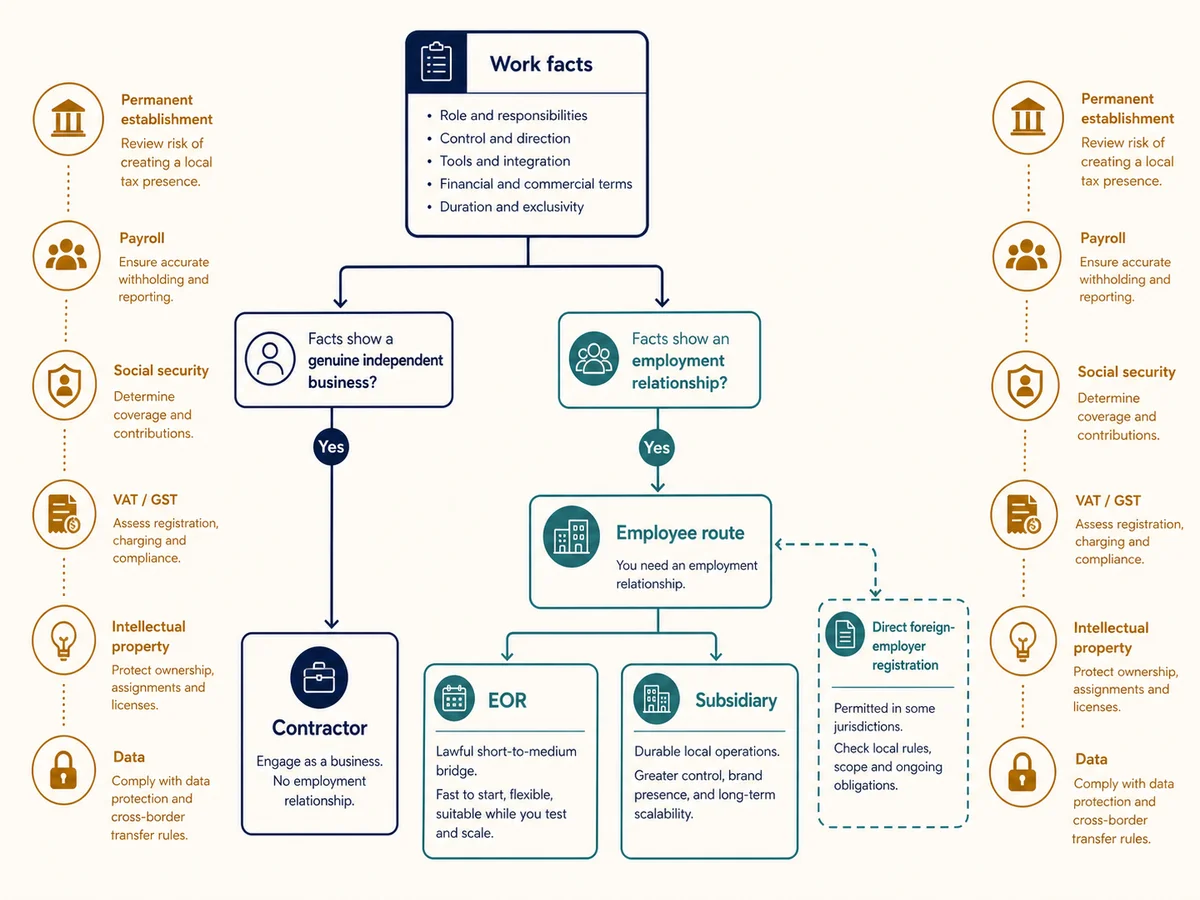
Use a staged decision and transition framework
Use the following sequence for each country and role.
- Write the operating facts. Record duties, location, duration, schedule, manager, substitution rights, tools, expenses, exclusivity, customer contact, signing authority, regulated work, immigration status, IP creation and data access.
- Run local status tests. Have local counsel or a qualified adviser apply employment, tax and social-security tests. If the facts require an employee, remove the contractor option instead of pricing misclassification as a routine fee.
- Map employee routes. Compare EOR, direct foreign-employer registration where available, and a subsidiary. Confirm payroll, benefits, immigration, agency-work and collective-agreement requirements for each.
- Test corporate and indirect-tax exposure separately. Review PE, dependent-agent authority, corporate registration, VAT/GST, withholding and customer-contract consequences. The payroll label does not decide them.
- Choose a review date and trigger. Reassess when duties, authority, work location, exclusivity, team size, local revenue or expected duration changes.
| Observed change | Required review | Likely direction |
|---|---|---|
| Contractor becomes exclusive, managed and open-ended | Immediate classification review | Employee route if local test is met |
| EOR team gains local management or customer authority | PE, agency-work and entity business case | Often toward subsidiary or direct employment |
| Country remains a single short-lived employee location | EOR quality and direct-registration comparison | Often remain EOR if lawful and economical |
| Local revenue, premises or regulated activity begins | Corporate, tax and licensing review before launch | Entity or other registered presence may be needed |
Because the best fit can change, give every temporary arrangement an explicit review date. Keep a country file with the status analysis, provider diligence, tax memo, approvals and transition triggers. That record is useful when finance, a regulator or an acquirer asks why the model was chosen.
Frequently Asked Questions
Is an EOR always safer than hiring a contractor?
No. An EOR can remove contractor-classification risk by employing the person, but only if the arrangement is lawful and properly operated in that country. Agency-work rules, licensing, immigration, data, PE and client-employer duties can remain.
Can a strong contractor agreement prevent reclassification?
No agreement guarantees that result. It should accurately document a genuine independent business relationship. Authorities may consider contractual rights, actual conduct, economic dependence or a jurisdiction-specific combination. A false label has little value.
Does an EOR prevent permanent establishment?
No. PE depends on treaty wording, local law and facts such as the worker's location, authority, home-office use and commercial role. The EOR may reduce some employment administration without changing those facts.
How many employees justify a local subsidiary?
There is no universal number. Compare expected duration, compensation and EOR fees with setup and annual entity costs, then consider authority, revenue, regulation and operational commitment. One high-authority role may justify earlier action than several low-risk roles.
Who owns work created by a contractor hired abroad?
The answer depends on the applicable IP law and contract. Do not assume payment transfers ownership. Address assignment or licensing, prior materials, moral rights, confidentiality, further assurances and post-termination access in locally reviewed terms.
Sources Used in This Guide
- IRS: Independent contractor or employee?
- U.S. Department of Labor: Fact Sheet 13
- GOV.UK: Employment status
- HMRC: Check employment status for tax
- Canada Revenue Agency: Employee or self-employed
- Australian Taxation Office: Employees and independent contractors
- Australian Taxation Office: Super for independent contractors
- Employment New Zealand: Employee or contractor?
- ILO: Employment Relationship Recommendation No. 198
- ILO: Disguised employment and dependent self-employment
- EUR-Lex: Equal treatment of temporary agency workers
- European Commission: Which social-security rules apply?
- Your Europe: Registering as an employer
- Your Europe: Posted workers
- European Commission: VAT place of taxation
- European Commission: VAT invoicing
- OECD: 2025 Model Tax Convention update
- OECD: Cross-border remote work and taxable presence
- IRS: PEO third-party payer arrangements
- IRS: What CPEO customers need to know
- UK Intellectual Property Office: Ownership of copyright works
- Your Europe: Business registration, permits and licences
- ICO: International transfers
- ICO: Controller-processor contract requirements