
In This Guide
- Dubai free zone and Estonia e-Residency are not the same product
- Estonia wins when you want the lightest possible remote-first company
- Dubai costs more, but it gives you a real base
- Tax is not a tie, and the brochure version is wrong
- Banking, compliance, and substance usually decide it faster than tax does
- Which one fits which online business?
- Bottom line
- Frequently Asked Questions
- Sources Used in This Guide
Dubai free zone and Estonia e-Residency are not the same product
This comparison goes wrong when people treat both options as if they were just low-friction company registries. Estonia e-Residency is a government-issued digital identity for non-residents. It helps you authenticate, sign documents, and run an Estonian company online. A Dubai free zone setup is different. You are forming an actual UAE entity inside a specific zone, such as DMCC or DAFZ, usually with a licence, a registered address, office or flexi-desk rights, and often a visa pathway.
The cleanest way to read the official sources is this: Estonia sells a remote operating layer for an EU company. Dubai sells a business base. That distinction matters more than the tax headline, because it shapes what you are really buying on day one.
Estonia itself is explicit about the limits. The programme says e-Residency does not confer tax residency, citizenship, physical residency, or a right of entry. Dubai, by contrast, can connect company formation to residence options. The UAE government's residence-visa guidance and ICP's Green Residency page both frame the UAE as a place you can actually live and work from, not only a place where your entity exists on paper.
| Question | Estonia e-Residency | Dubai free zone company |
|---|---|---|
| What you get | Digital ID plus access to create and run an Estonian company online | A licensed UAE entity inside a specific free zone |
| Personal residency rights | No | Often yes, depending on visa route and package |
| Physical operating infrastructure | Usually outsourced through service providers | Built into the free-zone model through flexi desks, offices, warehouses, or related services |
| Tax-residency effect | None by itself | Separate process, but the ecosystem is built around residence and tax-certificate workflows |
| Best fit | Remote-first digital services and founders who already live elsewhere | Founders who want a UAE base, visas, regional hiring, or logistics |
Estonia is a digital company tool. Dubai free zones are a business-and-residency package. If you start there, the rest of the comparison gets much easier.
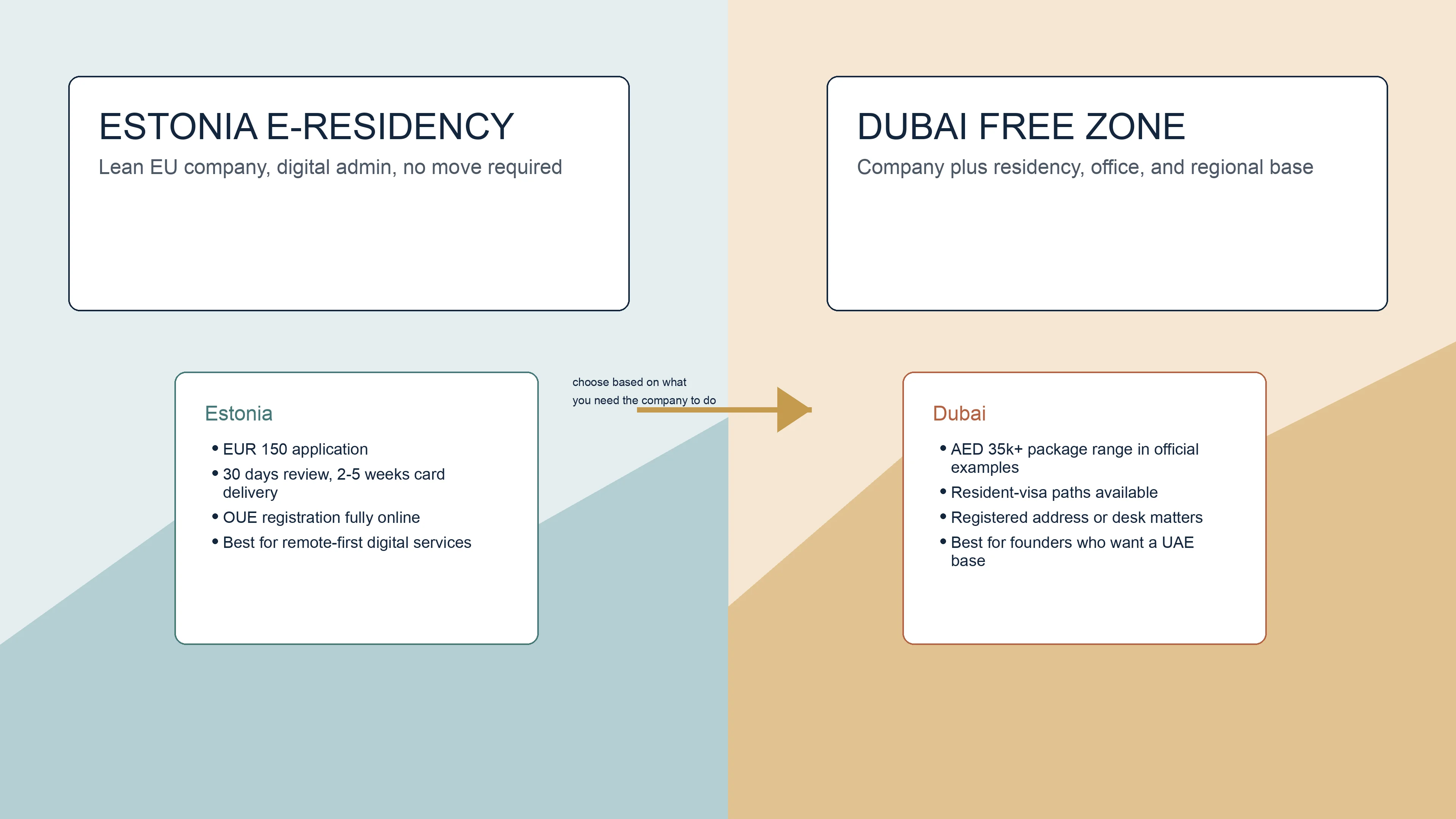
Estonia e-Residency Dubai free zone
Best for: remote-first EU company Cheap admin, no relocation Best for: UAE base plus company Visa, office, regional ops
Watch-outs: no visa, no tax residency banking not guaranteed Watch-outs: higher cost, CT/VAT rules substance and audit can matter
Source: Estonia e-Residency, EMTA, UAE FTA, MOF, DMCC, DAFZ, ICP Official sources reviewed on March 15, 2026
Estonia wins when you want the lightest possible remote-first company
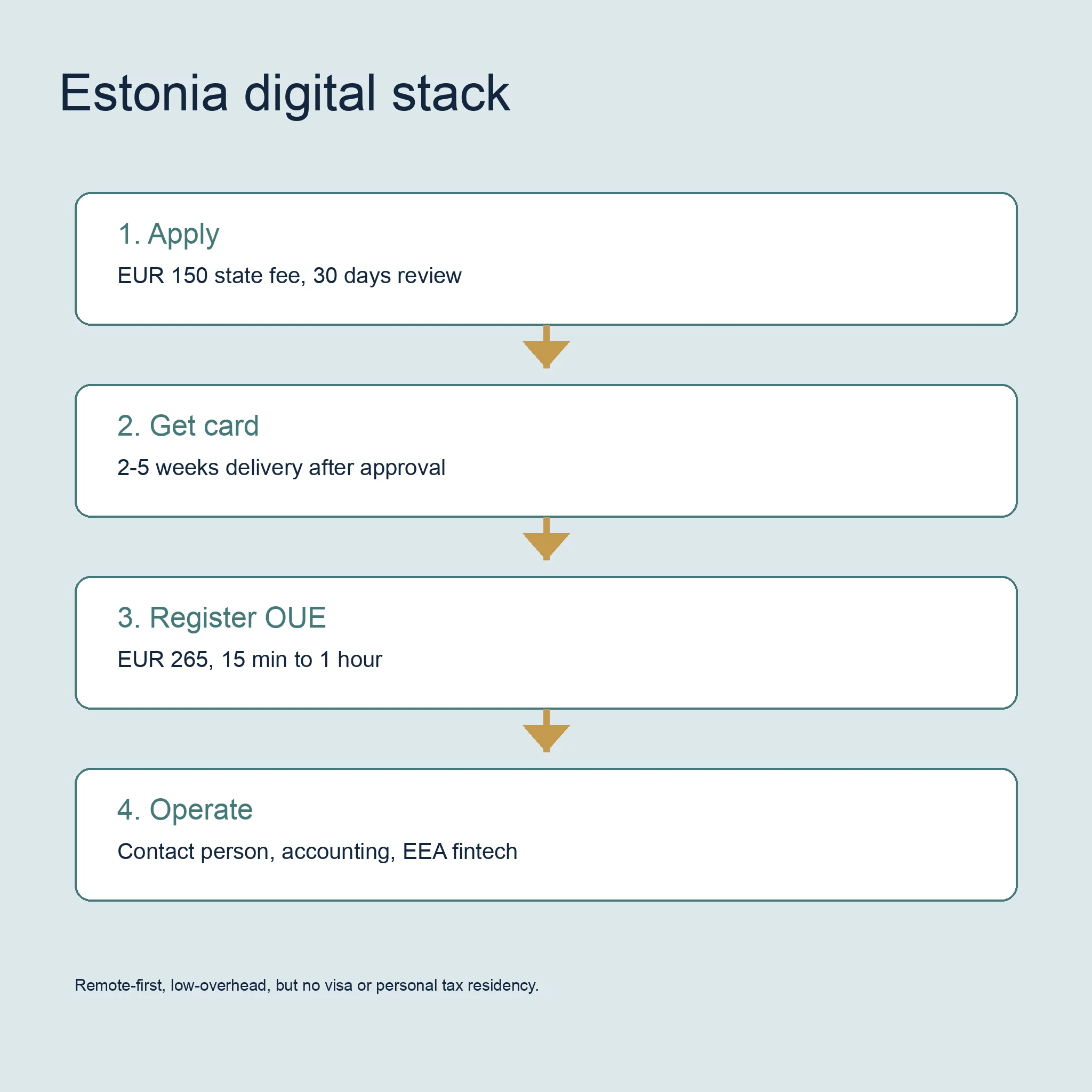
If your business is a SaaS product, an agency, a consulting practice, a design studio, or a one-person services company selling across borders, Estonia usually wins the simplicity argument. The official application page puts the entry fee at EUR 150, with a typical review time of 30 days and card delivery in another 2 to 5 weeks. Once the card is active, the start-a-company page says you can register a private limited company online in about 15 minutes to 1 hour.
The cost stack is unusually transparent. The programme's own costs and fees guide lists EUR 265 to register a private limited company, EUR 200 to 400 a year for a contact person, and accounting from EUR 50 a month. It also gives a rough first-year estimate of about EUR 600 if you do most of the admin yourself, or about EUR 1,300 if you buy accounting support. Those are not marketing numbers from a reseller. They are the programme's own planning figures.
| Estonia first-year line item | Official reference point | Why it matters |
|---|---|---|
| E-Residency application | EUR 150 | Cheap enough to test the model before you build anything elaborate |
| Contact person or legal address | EUR 200-400 per year | Usually unavoidable for foreign founders |
| Company registration | EUR 265 | One-time state fee for the standard private limited company path |
| Accounting | From EUR 50 per month | Real recurring cost, even for a small online company |
| Rough first year | About EUR 600 DIY or EUR 1,300 with accounting | Low enough to stay lean while validating a business |
That low overhead is only half the story. Estonia is also operationally clean for founders who never planned to move. The programme says 100% of government services are online, and the core workflow is built around digital signatures, remote filings, and service-provider support. The same official company-setup page openly recommends EEA fintech accounts as the best fully online banking option for e-residents.
But Estonia only stays clean if you accept what it does not solve. The responsibilities page and EMTA's tax-residency guidance both make the same point from different angles: e-Residency does not change your personal tax residency. If you live in Spain, Germany, the UK, or anywhere else, that country may still tax you personally. If your Estonian company is effectively managed elsewhere, foreign tax rules may also attach to the company. Estonia is efficient. It is not magic.
This is why Estonia is strongest for founders who already know where they live, where they are tax resident, and how they want to invoice the world. In that context, an Estonian company can be a very sharp tool. Without that clarity, it can become an elegant wrapper around a messy tax problem.
Dubai costs more, but it gives you a real base
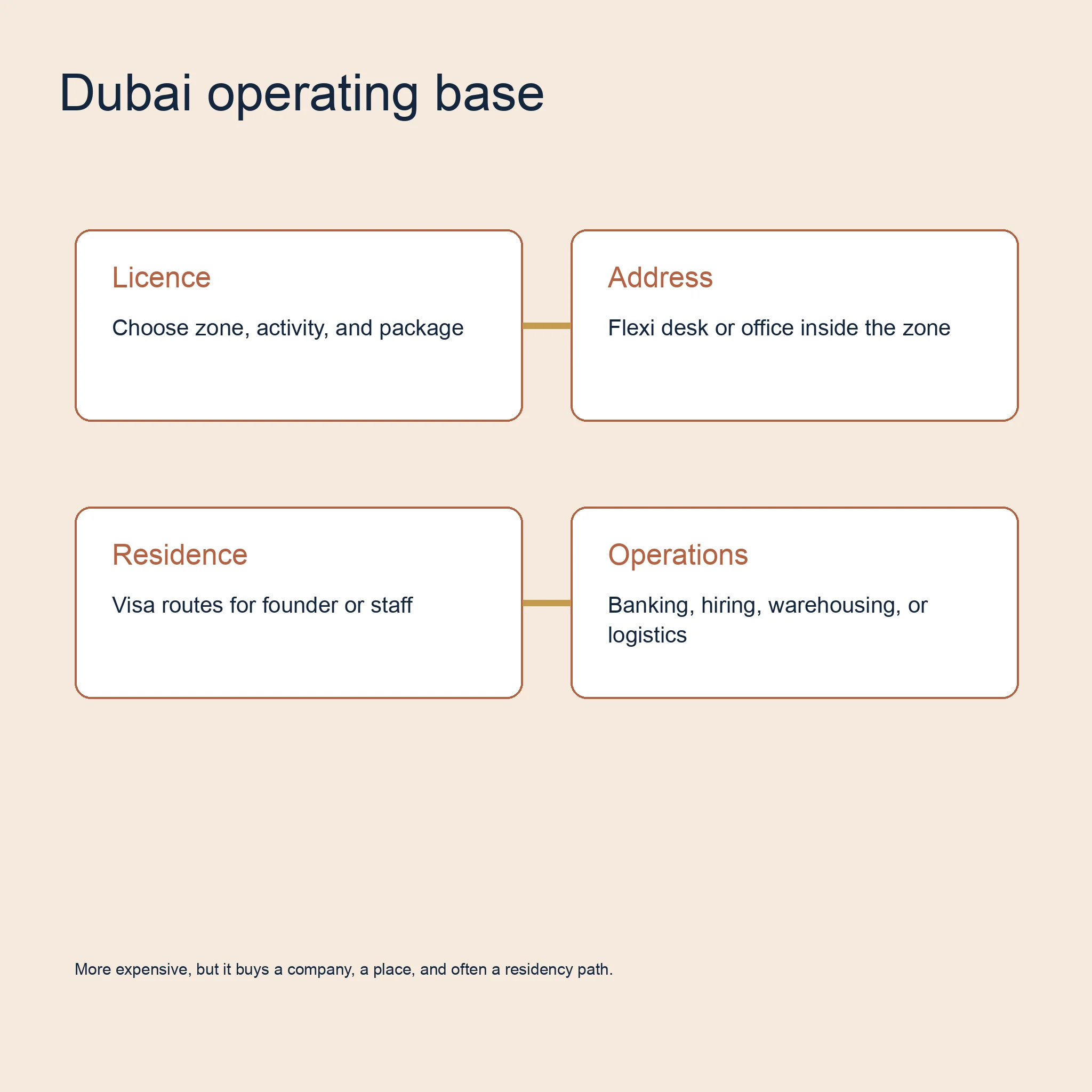
Dubai free zones are heavier, more expensive, and far more complete. The official package pages show that clearly. DMCC's Basic Biz Package is priced at AED 35,484 and gives an entrepreneur a DMCC company licence plus special flexi-desk options that are eligible for one resident visa. Its Jump Start Package is AED 43,780 and includes one UAE residency visa in the package price, plus a standard flexi desk or co-working option that can support up to three visas.
That is already enough to show why the Estonia comparison can mislead. Dubai is not just selling incorporation. It is selling incorporation plus operating rights plus a path into the UAE system. On the DMCC setup page, the zone says every company needs a registered business address inside DMCC. On the DAFZ setup page, you can see the other side of the model: office space, warehousing, industrial space, and even cold storage. Estonia has service providers. Dubai has business infrastructure.
DAFZ also shows how this works at the legal-entity level. Its official setup page says a free-zone company can be formed with 1 to 50 shareholders and a minimum share capital of AED 1. That low capital requirement sounds light, but the surrounding structure is still not light in the Estonian sense. You are choosing a zone, a licence class, a desk or office format, and often a visa strategy.
The residence side is where Dubai starts making sense for a different type of founder. The UAE residence-visa page says the Green visa is self-sponsored for five years. For freelancers and self-employed people, it requires a self-employment permit, a bachelor's degree or specialised diploma, and annual self-employment income of at least AED 360,000 over the previous two years, or proof of financial solvency. That is a real residency route, not a digital card with a nice brand.
Dubai is also stronger for businesses that need inventory, local hires, fulfilment, or regional customer operations. The official UAE ecommerce page highlights Dubai CommerCity and EZDubai as purpose-built ecommerce ecosystems. That is the kind of source that makes the answer obvious for a GCC-focused online retailer. If your business has stock, warehousing, returns, or import logic, Estonia usually stops being the natural choice very quickly.
| Dubai example | What the official page offers | Why that matters |
|---|---|---|
| DMCC Basic Biz | AED 35,484, special flexi desk, one resident-visa eligibility | Entry-level option for a founder who wants a company plus a UAE footprint |
| DMCC Jump Start | AED 43,780, one UAE residency visa included, standard flexi desk or co-working | Closer to a full founder package than a pure incorporation service |
| DAFZ free-zone company | 1-50 shareholders, AED 1 minimum share capital, office and warehousing options | Useful when your online business touches logistics or regional operations |
| DAFZ Talent Pass | AED 7,500 licence fee, visa handled separately, no employee sponsorship | A lighter route for solo professionals, but still not the same thing as e-Residency |
So yes, Dubai is more expensive. That is true. It is also a different product. If you want a place to live, hire, warehouse, invoice, and build a Middle East presence, the extra cost is buying something real. If you only want the lightest remote company possible, it is probably buying complexity you do not need.
Tax is not a tie, and the brochure version is wrong
People reduce this choice to, "Estonia taxes companies, Dubai does not." That is too crude to be useful. Estonia's system is more nuanced, and Dubai's is less tax-free than old free-zone sales pages still suggest.
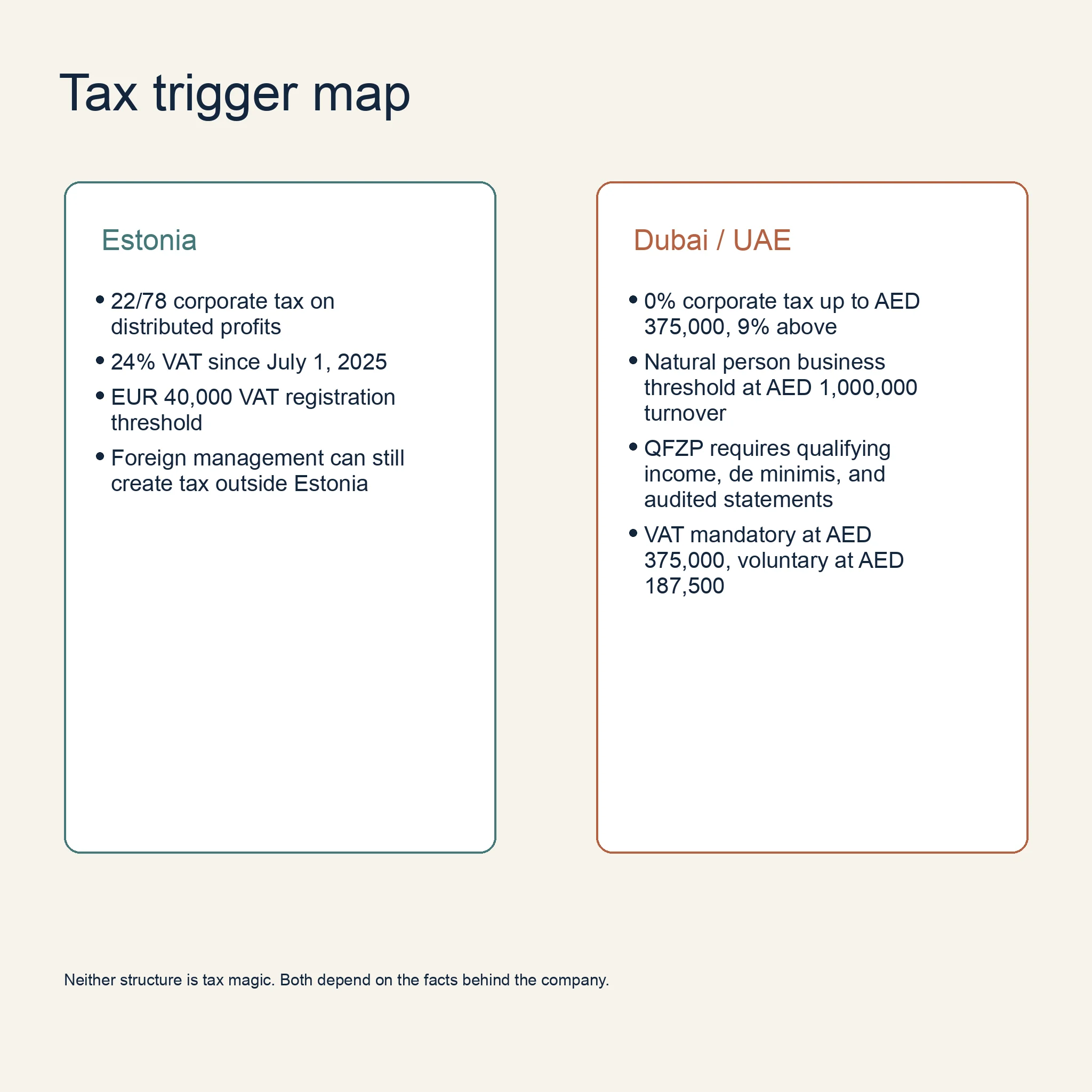
Start with Estonia. EMTA says an Estonian legal person is resident if it is established under Estonian law. Its guidance on companies established by e-residents says the company pays corporate income tax in Estonia on worldwide income, but the timing of taxation is deferred until profits are distributed. The current tax-rates page puts that distributed-profit tax at 22/78. For many remote founders, that is attractive because retained earnings can stay inside the company without an annual profit tax drag.
But Estonia also comes with hard edges. The same EMTA materials warn that if business is managed from outside Estonia or carried on elsewhere, foreign-country tax can still arise. The VAT page says the standard rate has been 24% since 1 July 2025, and mandatory VAT registration kicks in when taxable Estonian supplies exceed EUR 40,000. Estonia can be very efficient, but it still behaves like a real EU tax system.
Now Dubai. The official UAE government tax page says the UAE does not levy income tax on individuals. For a founder who wants to live in Dubai and draw salary or live off personal investment income, that headline matters. But the FTA's natural-person guidance says a natural person comes into Corporate Tax if they conduct business in the UAE and their turnover exceeds AED 1 million in the calendar year. Wages, personal investment income, and real-estate investment income are excluded from that business-income test.
On the company side, the Ministry of Finance's threshold announcement confirms 0% corporate tax up to AED 375,000 of taxable income and 9% above that. Free-zone entities can still do better, but only conditionally. The Ministry's corporate-tax page says a Qualifying Free Zone Person can get 0% on qualifying income. The FTA Free Zone Persons guide then supplies the catch: non-qualifying revenue must stay below the lower of 5% of total revenue or AED 5,000,000, and the free-zone company must maintain audited financial statements. That is a compliance regime, not a brochure slogan.
VAT adds another layer. The FTA VAT-registration page says mandatory UAE VAT registration starts at AED 375,000 of taxable supplies and imports, with voluntary registration available above AED 187,500. So the honest tax reading is not "Dubai is tax free." It is "Dubai can still be very tax efficient, but the answer depends on whether you are looking at personal income, natural-person business income, ordinary corporate income, qualifying free-zone income, or VATable activity."
| Tax issue | Estonia | Dubai / UAE |
|---|---|---|
| Personal tax residency | E-Residency does nothing by itself | Separate residence and TRC rules can matter a lot |
| Company profit tax baseline | 22/78 on distributed profits | 0% up to AED 375,000 and 9% above for ordinary taxable income |
| Natural-person business rule | Not the key comparison point | Corporate Tax applies only above AED 1,000,000 turnover if business is conducted in the UAE |
| Free-zone concession | None | 0% only for qualifying income if QFZP conditions are met |
| VAT trigger | EUR 40,000 threshold for mandatory registration | AED 375,000 mandatory, AED 187,500 voluntary |
Estonia is cleaner if you want an EU company that can retain profits. Dubai is cleaner if you want a personal base in the UAE and can actually satisfy the free-zone and residency rules that make the model work.
Banking, compliance, and substance usually decide it faster than tax does
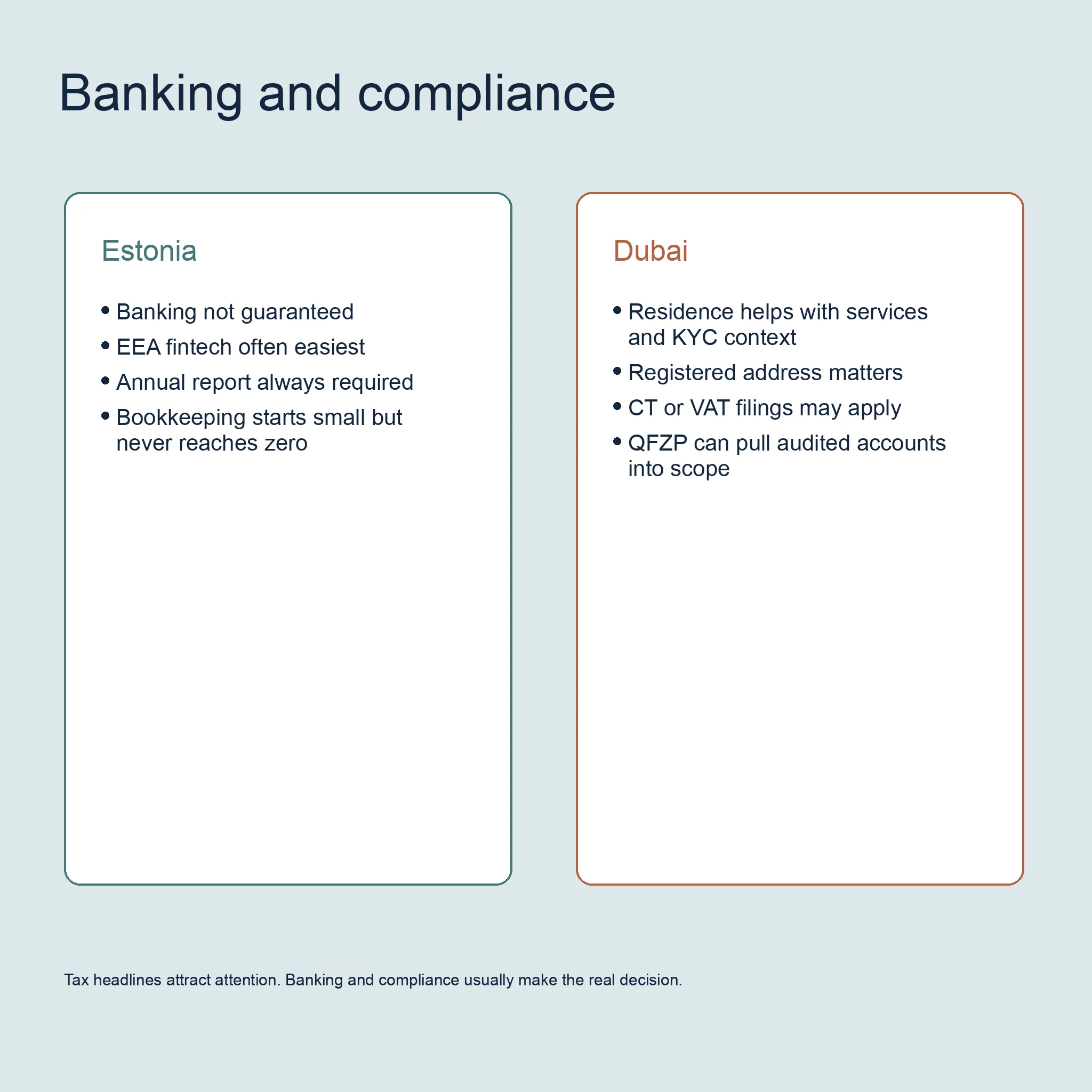
Founders often obsess over the top-line tax rate and miss the operational bottlenecks. Banking is the classic example. Estonia's programme is refreshingly honest here. The knowledge base says e-Residency alone does not guarantee banking services. The company-setup page points founders toward EEA fintech accounts because those are the smoothest remote option. That is workable for many digital businesses, but it is not the same as saying you will definitely get a traditional bank account on day two.
Admin is the next filter. The cost guide says all Estonian companies need an annual report, even if they have not been active. Accounting support starts at EUR 50 a month for a reason. Estonia is not hard, but it expects competent bookkeeping and proper filing. It is a great fit if you want to run the company from a laptop and outsource the local admin. It is a weak fit if you hate recurring paperwork.
Dubai changes the balance. The official work-and-residence guidance says a residence visa is essential for core services such as opening a bank account, obtaining a driving licence, and more. That is not a guarantee of business-bank approval, but it does show why founders who actually want to live in the UAE often find the operating environment more coherent than a pure remote structure. You are inside the system instead of interfacing with it from abroad.
On the other hand, Dubai asks for more substance up front. DMCC requires a registered address in the zone. Qualifying Free Zone Person status can require audited financial statements. Visa renewals, office or desk rights, and corporate registrations all become part of the annual maintenance burden. This is manageable, but it is not passive.
| Operational friction | Estonia | Dubai / UAE |
|---|---|---|
| Banking | Fintech-friendly, but access is not guaranteed | Usually better once resident and locally structured, but still KYC-driven |
| Local presence | Mostly handled through service providers | Built around a registered address, desk or office, and visa status |
| Recurring admin | Bookkeeping plus annual report | Zone fees, CT or VAT compliance as applicable, residence renewals, possible audits |
| Works best when | You are happy operating remotely from another country | You genuinely want a UAE base and can use the ecosystem |
That is why the decision is often less about tax rates than about where you want your life and company to touch the ground. If nowhere, Estonia has the edge. If the answer is Dubai, and you mean it, Dubai starts to justify itself very quickly.
Which one fits which online business?
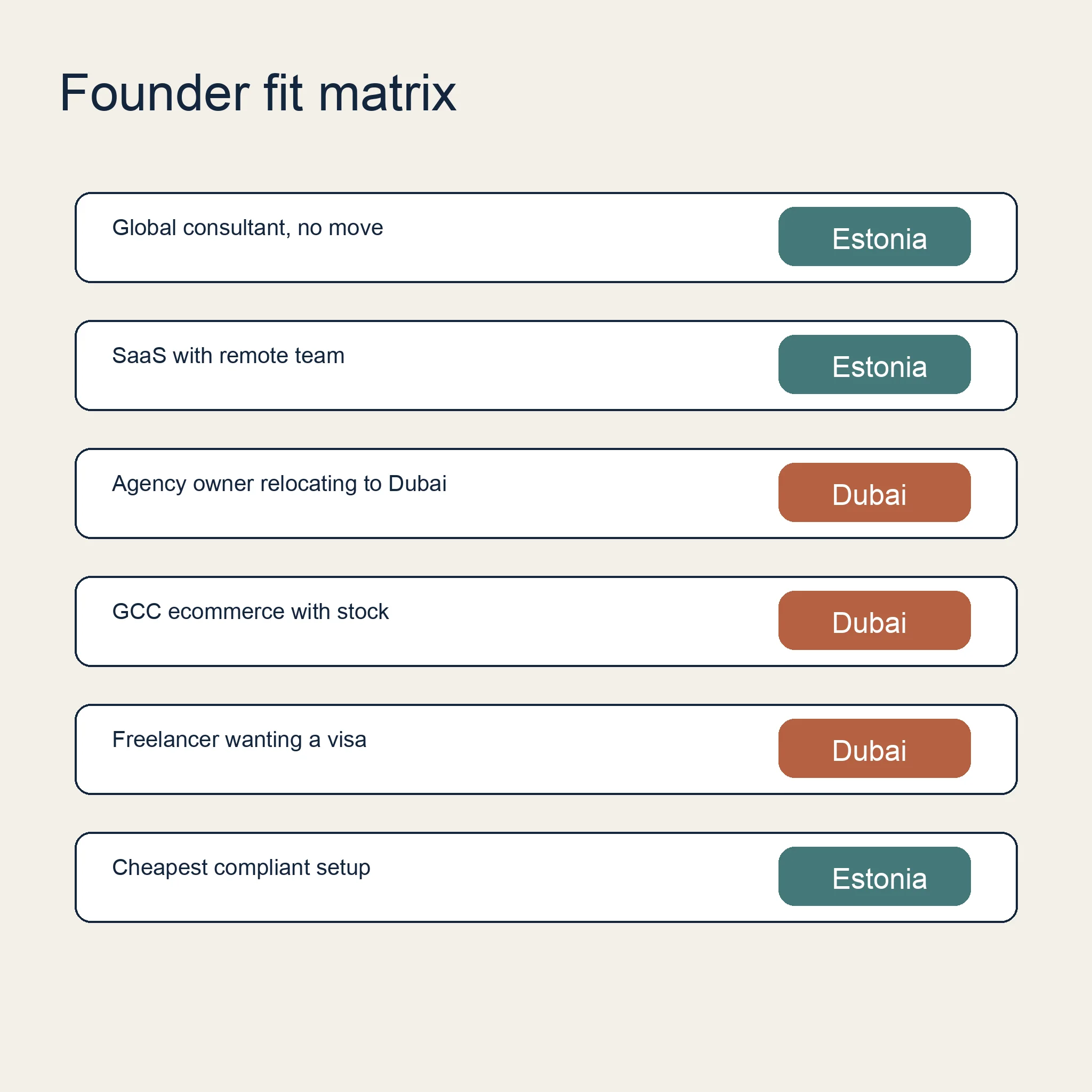
The official sources point toward a simple pattern. Estonia is better for companies that are mostly software, services, contracts, and remote admin. Dubai is better for companies that need a founder base, visas, regional execution, or a stronger physical link to where the business is run.
| Founder or business profile | Better fit | Why | Main warning |
|---|---|---|---|
| Solo consultant with global clients, no plan to relocate | Estonia | Lowest overhead and fully digital management | Your personal tax residency stays wherever you actually live |
| SaaS founder selling worldwide from a distributed team | Estonia | EU company, online admin, retained-profit logic can be efficient | Foreign management or PE issues still need review |
| Agency owner who wants to live in Dubai and hire regionally | Dubai free zone | Residence, local operating base, visa capacity | Budget and compliance are much higher |
| GCC-focused ecommerce operator with stock or fulfilment needs | Dubai free zone | Official ecommerce and logistics ecosystems are built for this | Do not confuse free-zone marketing with automatic 0% tax in every scenario |
| Freelancer who wants a visa first and a company second | Dubai free zone | The UAE has clear residence products for self-employed people | Green visa income or solvency rules still apply |
| Founder who wants the cheapest compliant setup and no move | Estonia | The first-year cost difference is huge | You still need service providers, bookkeeping, and a real personal tax plan |
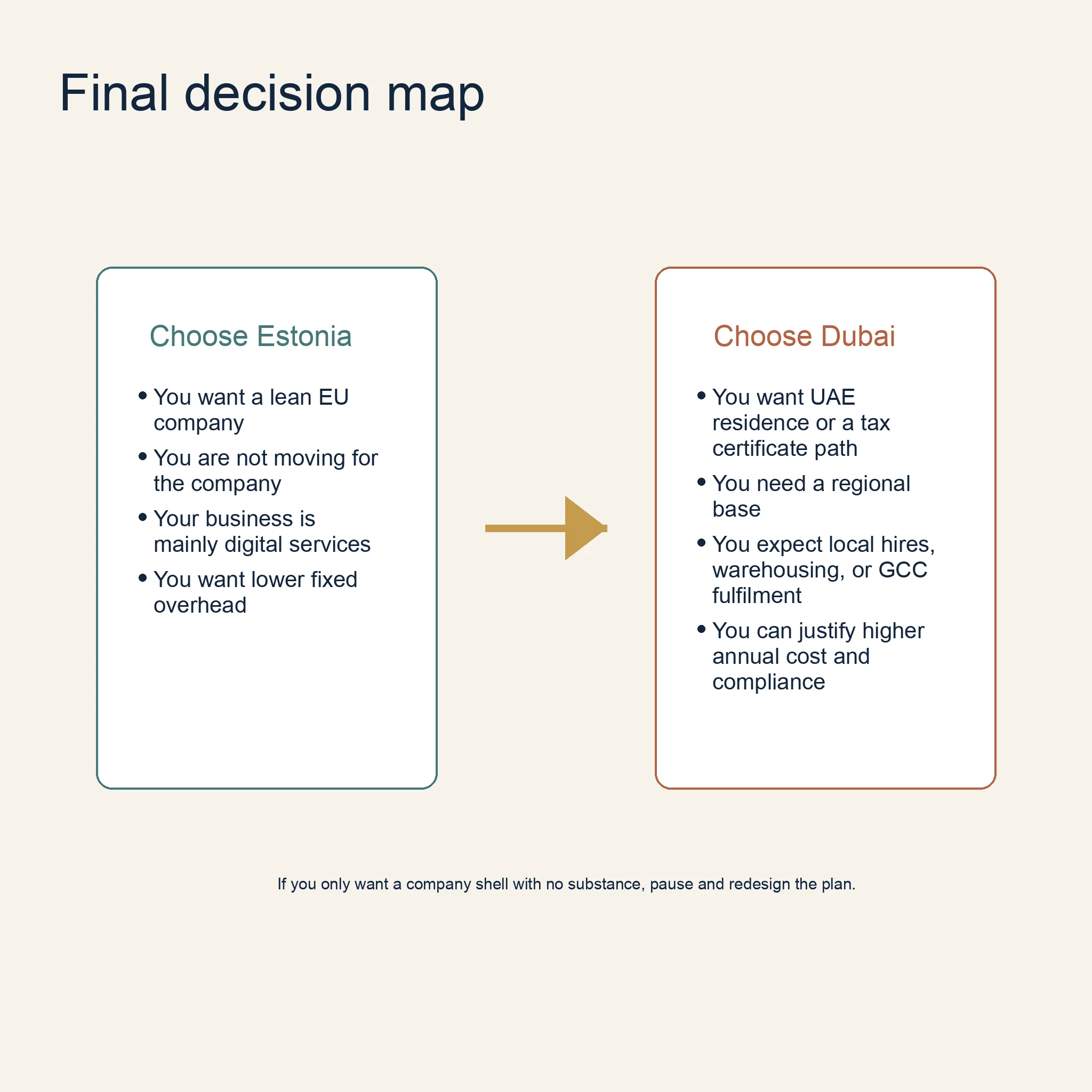
- If your business is mostly digital services and you do not want to relocate, start by testing Estonia.
- If you want a company plus residence plus a regional base, price Dubai honestly and decide whether you will actually use those benefits.
- If you mainly want a no-tax story without moving, substance, or paperwork, neither option really solves the problem you think you have.
That last point deserves emphasis. Estonia is a practical, compliant remote-company system. Dubai is a practical, compliant operating base. Both work best when the founder's facts line up with the structure. Both become fragile when they are used as shortcuts around personal tax residency, substance, or commercial reality.
Bottom line
Pick Estonia if you want the lightest possible remote-first EU company, you can live without a residency product, and you already understand where you are personally tax resident. The official Estonia materials support that use case very well: low setup cost, online company registration, digital signatures, and service-provider support for the admin you cannot or do not want to handle yourself.
Pick Dubai free zone if you want more than a company. The UAE sources make sense for founders who want a residence path, access to local infrastructure, a stronger banking and operating context, or a Middle East base for clients, staff, and fulfilment. You will spend more, and you will comply more, but you are buying a much wider platform.
If I had to reduce the answer to one sentence, it would be this: Estonia is better for an online business you run from somewhere else, while Dubai is better for an online business you want to anchor in the UAE.
Disclaimer: This guide is for general information only. Company residence, permanent establishment, VAT, free-zone qualification, and personal tax residence depend on exact facts. Get jurisdiction-specific legal and tax advice before acting.
Frequently Asked Questions
Does Estonia e-Residency make me an Estonian tax resident?
No. Estonia's own official guidance says e-Residency does not confer tax residency. It is a digital identity and access tool, not a personal residence status.
Can a Dubai free zone company still owe UAE tax?
Yes. The Ministry of Finance and the FTA Free Zone Persons guide both make clear that free-zone companies are within the Corporate Tax system. The 0% result applies only to qualifying income when the conditions are met.
Which option is cheaper in the first year?
Estonia, by a wide margin. The programme's own cost guide puts a typical first year at roughly EUR 600 DIY or EUR 1,300 with accounting support. Official Dubai free-zone packages in DMCC start far higher, with examples such as AED 35,484 and AED 43,780 before you start adding all optional extras.
Which one is better for a SaaS company or online agency?
Usually Estonia if the founder will stay tax resident elsewhere and wants the leanest remote setup. Usually Dubai if the founder wants to live in the UAE, hire there, or make the UAE the actual operating base.
Which one is better for ecommerce with inventory or regional fulfilment?
Usually Dubai. The official UAE ecommerce guidance and the DAFZ materials both point toward logistics-oriented infrastructure that Estonia e-Residency does not try to provide.
Sources Used in This Guide
- Estonia e-Residency: Become an e-resident
- Estonia e-Residency: Start a company
- e-Residency knowledge base: Costs & fees
- e-Residency knowledge base: Responsibilities of e-residents
- e-Residency knowledge base: Application status & timeline
- e-Residency knowledge base: What is e-Residency?
- Estonian Tax and Customs Board: Tax residency
- Estonian Tax and Customs Board: Tax rates
- Estonian Tax and Customs Board: Value added tax
- Estonian Tax and Customs Board: Tax liabilities of companies established by e-residents
- Estonia e-Residency: 2025 state revenue and programme statistics
- UAE Government: Other taxes in the UAE
- UAE Ministry of Finance: Corporate Tax in the UAE
- UAE Ministry of Finance: AED 375,000 corporate-tax threshold announcement
- Federal Tax Authority: Basis of Taxation - Natural Person
- Federal Tax Authority: Registration for VAT
- Federal Tax Authority: Issuance of Tax Certificates for Tax Residency
- Federal Tax Authority: Free Zone Persons guide
- UAE Government: Residence visa for working in the UAE
- ICP: Green Residency
- ICP: Golden Residency
- ICP: Permit to stay outside the UAE for more than 6 months
- UAE Government: eCommerce
- DMCC: Business setup packages
- DMCC: Set up a new business
- DAFZ: Start your business in Dubai
- DAFZ: Talent Pass